Kristian Gorenc Z
Mar 20, 2026



Music trends often arrive with a sense of urgency. A song goes viral, a dance spreads across social platforms, and a genre is suddenly labeled as “next up.” But viral moments do not always translate into lasting growth. To understand whether a genre is truly expanding, it helps to look past individual hits and examine how audiences are growing across artists over time.
📌 Viberate Analytics: Professional music analytics suite at an unbeatable price: $19.90/mo. Charts, talent discovery tools, plus Spotify, TikTok, and other channel-specific analytics of every artist out there.
This article uses music analytics to take that broader view. By analyzing artist-level performance data across multiple genres, it asks which genre shows signs of sustained, structural growth rather than short-lived attention. The findings point consistently in one direction: Amapiano.
Many of the world’s most recognizable genres already command enormous audiences. Pop, hip-hop, and electronic music regularly dominate global charts, but short-term changes in those genres are often driven by superstar releases, promotional cycles, or seasonal listening patterns. That makes it difficult to tell whether a genre itself is growing or whether attention is simply shifting among familiar names.
To address that challenge, this analysis focused on growth behavior instead of scale. Rather than asking which genre is biggest, it examined how growth is distributed across artists and whether that growth holds up over time.
The data came from global Top 500 artist charts filtered by genre and observed over two timeframes: a 30-day snapshot and a three-month snapshot. Each genre was analyzed using the same approach, allowing patterns to be compared on equal footing.

Four indicators were used to evaluate whether a genre could reasonably be described as rising.
First, growth distribution measured whether listener gains were shared across many artists or concentrated at the very top. If most growth comes from a small handful of stars, the genre may be popular without expanding.
Second, pipeline strength looked at whether mid-tier and smaller artists were growing faster, in percentage terms, than established leaders. This pattern often signals that new listeners are entering the genre through multiple artists rather than circulating among the same few names.
Third, persistence examined how many artists appeared in both the 30-day and three-month charts. A stable but not overwhelming overlap suggests continuity without stagnation.
Finally, temporal consistency compared short-term growth with three-month trends to reduce the risk of mistaking short-lived spikes for meaningful momentum.
Several genres were evaluated using this framework, including Amapiano, Afrobeat, Afropop, K-pop, and Techno. Each of these genres is influential in different ways, and each showed strength in at least one dimension.
Afrobeat and Afropop posted strong short-term growth, but much of that growth was concentrated among a small group of top artists. K-pop showed high persistence across timeframes, with many of the same artists remaining visible month after month, though growth was heavily centered on its biggest acts. Techno, meanwhile, displayed remarkable stability but relatively modest growth, consistent with a mature genre in equilibrium.
Amapiano stood apart because it combined several favorable signals at once.
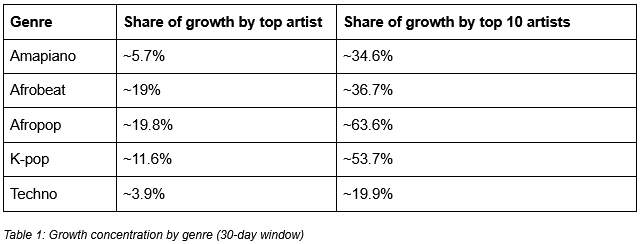
Lower concentration indicates that listener growth is spread across more artists, rather than being driven by a small number of top acts.
In the 30-day snapshot, Amapiano showed one of the lowest levels of growth concentration among the genres analyzed. The top artist accounted for less than 6% of observed listener gains, while the top 10 together represented just over one-third. In comparison, the top 10 artists in K-pop captured more than half of all observed growth.
This distribution matters because it suggests that Amapiano’s momentum does not hinge on a single breakout moment. Instead, growth is spread across dozens of artists at the same time.
Tier-level analysis reinforced this picture. When artists were grouped by current listener size, smaller Amapiano artists showed faster median percentage growth than the genre’s leaders. Artists ranked outside the top 200 recorded median percentage growth above 24% in the 30-day window, compared with under 16% for the top tier.
That pattern points to a functioning pipeline, where new and mid-level artists are attracting listeners at a faster relative pace. In genres with flatter pipelines, growth tends to recycle attention among established names rather than bringing in new audiences.
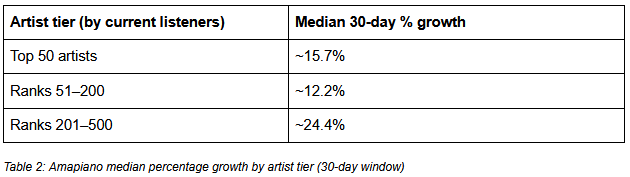
The upward trend toward smaller artists highlights the genre’s ability to generate new audience growth beyond its most established names.
Short-term growth can be misleading if it fades quickly. To address that risk, the analysis compared Amapiano’s 30-day and three-month charts.
Of the Top 500 artists in each period, 281 appeared in both. More than three-quarters of those overlapping artists recorded positive growth in both windows. At the same time, over 200 artists entered or exited the chart between snapshots, showing that the genre continues to renew itself.
This balance between persistence and turnover suggests that Amapiano’s rise is not a fleeting surge but an ongoing process.
Artist-level examples mirror the broader trend. Established figures such as Kabza De Small and DJ Maphorisa continued to add listeners across both timeframes, showing that leading artists are still expanding their reach. Mid-tier artists like Tyler ICU recorded steady gains, while artists such as Mellow & Sleazy and Scotts Maphuma posted strong relative growth over both the short and medium term.
Not every artist followed the same path, and some experienced periods of stabilization. Taken together, however, these trajectories align with the genre-level pattern of distributed and sustained growth.

Across all measures used in this analysis, Amapiano stands out as the clearest example of structural genre growth among those examined. Its rise is not defined by a single hit or star, but by broad, persistent audience gains across its artist ecosystem.
For readers trying to understand how genres evolve in a crowded global music landscape, Amapiano offers a case study in how sustained growth looks when viewed through music analytics rather than headlines alone.
Source of music data: Viberate.com
 Next article
 Previous article
11M+ artists, 100M+ songs, 19M+ playlists, 6K+ festivals and 100K+ labels on one platform, built for industry professionals.