Kristian Gorenc Z
Feb 11, 2026

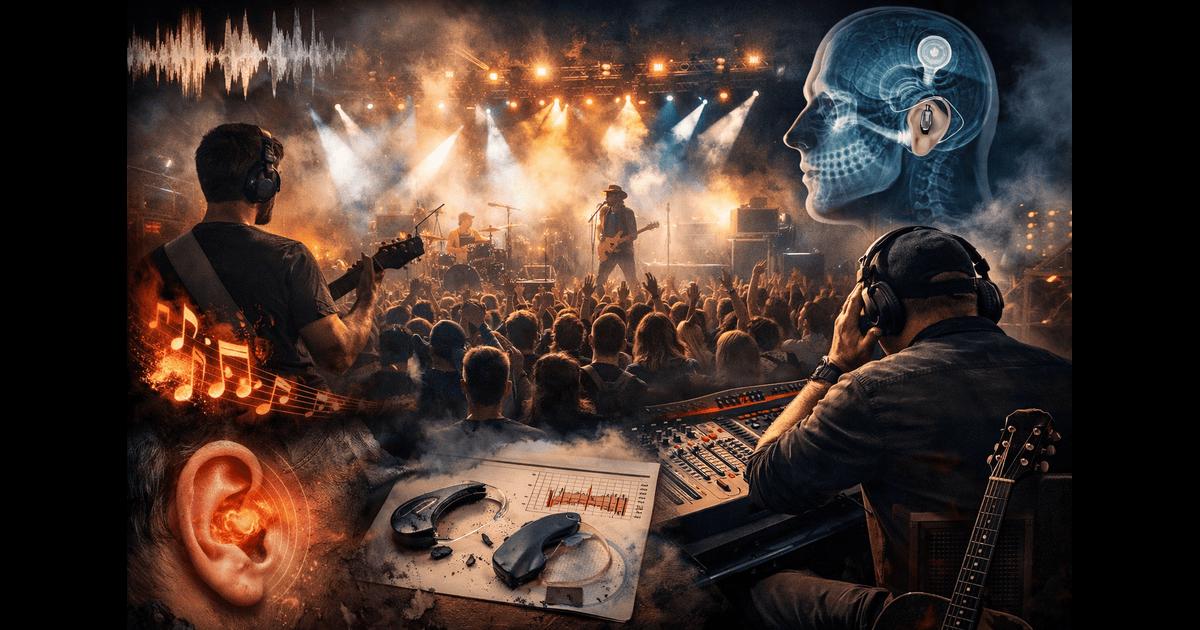

A loud show is a full-body experience. The kick hits your chest, the crowd moves as one, and the room hums long after the last chorus. For many artists and music pros, that intensity is routine: rehearsals, soundchecks, long sets, then travel with headphones or earbuds filling the gaps.
The issue is simple. Ears do not reset between gigs. Hearing damage can build quietly, and once it becomes obvious, it can be difficult to reverse.
Live music stacks risk factors in a way few other workplaces do. Decibel levels at concerts and clubs often reach ranges that become harmful with enough exposure, and the exposure is rarely limited to a single night. DJs play extended sets. Touring musicians run back-to-back dates. Engineers and crew spend hours in the same blast zone.
A few reasons live settings hit especially hard:
If it feels like you have “adapted” to volume, treat that as a prompt to check in, not to prove your ears are fine.
Most people in music have experienced post-show ringing. That can be an early warning sign, even if it fades by morning. Over time, symptoms can shift from occasional to constant, and from mild annoyance to something that changes how you work.
Common signs often show up in musician-specific ways:
There is also a mental load. When your ears feel unreliable, you second-guess mix decisions, performance choices, and even basic balance.
Hearing protection works, and it remains the best first line of defense. High-fidelity earplugs, properly tuned in-ear monitors, smarter stage volume, and routine hearing tests can extend careers.
Still, some people reach a point where hearing loss becomes severe enough to warrant medical intervention. Cochlear implants are one option for certain types of hearing loss. They do not restore typical hearing. They use external and internal components to convert sound into electrical signals that stimulate the auditory nerve. That can be life-changing for communication, but music can feel different through any device-based signal path, especially when nuance matters.
And like any implanted medical device, performance and safety matter. If an implant malfunctions or contributes to complications, some patients explore legal options, such as a cochlear implant device failure lawsuit, to understand accountability and next steps. For music professionals, the stakes can feel higher because work often depends on fine detail and long hours in complex sound environments.
Music relies on separation, timbre, transient detail, and spatial cues that help you lock into a groove. When hearing devices underperform, it can affect the parts of sound that musicians rely on most.
For artists, producers, and engineers, this can show up as:
That frustration often sits next to practical concerns: medical costs, time away from work, and anxiety about whether tomorrow will sound the same.
Hearing changes can lead to an identity shift. Many musicians can handle a bad venue or a rough mix. Hearing loss feels different because it touches the core tool you bring to every session.
It can also be isolating. People may assume you are “fine” if you can still talk, while you struggle to separate cymbals from consonants, or harmonies from room reflections. The gap between what music used to feel like and what it feels like now can be hard to explain.
Prevention does not require perfection. It requires consistency.
A few habits that pay off fast:
Plan your run of shows: stacking loud nights with no breaks increases risk. If you are mapping festival season, Viberate’s Festival Finder can help you compare events and pace your schedule with recovery time in mind.
Live music is built on impact, but careers are built on longevity. Hearing damage can be slow, cumulative, and easy to ignore until it starts changing your work. Treat ringing and distortion as feedback, not background noise.
Protect what you can, get checked when something feels off, and stay informed about the tools and technologies people turn to when prevention is no longer enough. Because the goal is a music scene where the people who make it can keep hearing it for decades.
 Next article
 Previous article
11M+ artists, 100M+ songs, 19M+ playlists, 6K+ festivals and 100K+ labels on one platform, built for industry professionals.