Miha Prebil
Apr 22, 2026

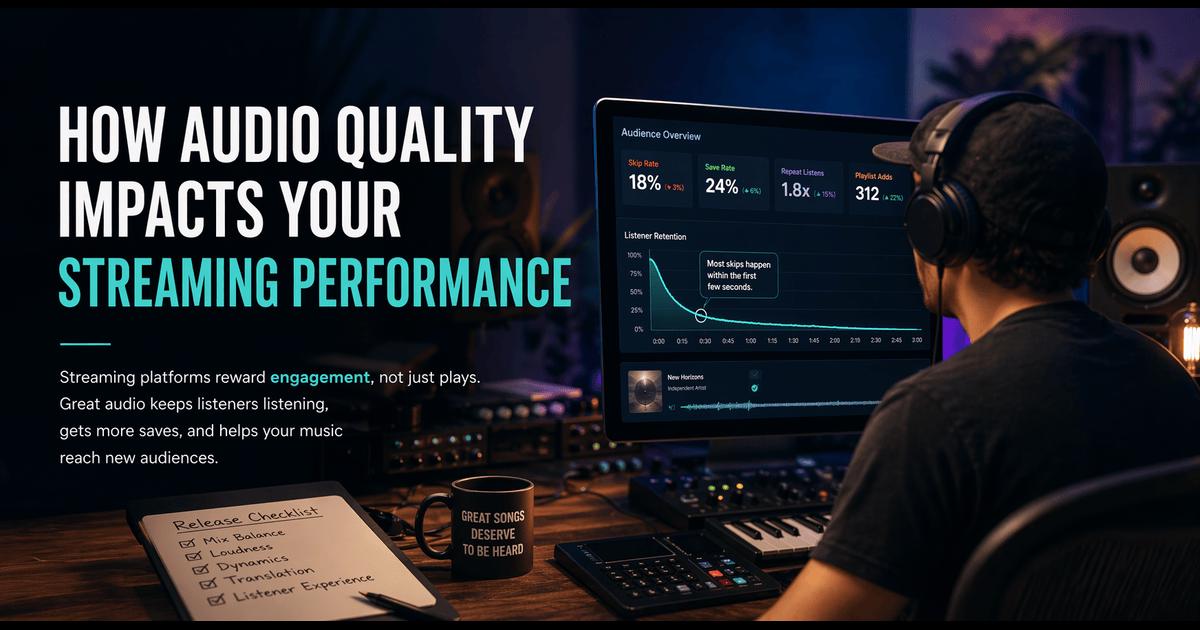

For independent artists, getting music onto streaming platforms used to be the primary hurdle. Distribution is now straightforward, but success on these platforms has become harder to achieve. The difference lies in what determines visibility. Streaming platforms no longer reward artists based on raw play counts. They reward listener behavior, and listener behavior is more sensitive to audio quality than most artists realize.
Over the past two years, recommendation algorithms on major streaming platforms have moved decisively toward engagement-based signals. Skip rate, save rate, repeat listens, and playlist adds now carry more weight in determining which tracks get surfaced to new audiences. Spotify leadership has spoken openly about this shift, framing retention and engagement as the metrics that matter most for a subscription business.
The practical consequence for artists is significant. A track that attracts a burst of plays but fails to hold attention will be deprioritized by the algorithm, while a track with lower initial reach but strong engagement signals can gain momentum over time. Volume alone is no longer enough. How listeners respond to the music is what drives ongoing distribution.
Engagement metrics are not only a reflection of creative quality. They also respond to the production and mastering standard of the track. A poorly mastered release creates friction in the listening experience that influences behavior before a listener can articulate what is wrong.
Loudness normalization is a clear example. Every major streaming platform normalizes audio to a target level, and tracks mastered too loud are turned down on playback. The aggressive compression and limiting used to achieve that loudness stays baked in, leaving the track sounding flat and fatiguing compared to properly mastered alternatives. Research on streaming performance has consistently shown that tracks mastered within recommended loudness ranges experience lower skip rates in the opening seconds than tracks mastered outside those ranges. Tools such as Cryo Mix have emerged in response to this, using AI to mix and master tracks to the loudness and dynamic range standards that streaming platforms reward.
The opening seconds are especially important. Studies of skip behavior on streaming platforms indicate that most skip decisions occur within the first few seconds of a track. Listeners make a rapid aesthetic judgment, and audio quality is part of what they are responding to, even if they do not consciously register it as a production issue. A harsh high end, a muddy low end, or a narrow stereo image can all accelerate a skip response.
Save rate follows a similar pattern. Listeners save tracks they want to return to, and tracks that feel tiring or unfinished tend to underperform on this metric regardless of how compelling the underlying song may be.
The engagement metrics that influence algorithmic distribution are also the metrics that help artists evaluate whether production quality is holding them back. Reviewing skip rates, save rates, and listener-to-stream ratios across releases makes it possible to identify patterns. A release that consistently underperforms on save rate compared to others in the same catalog, or a track with disproportionately high skip rates in the opening seconds, often points to a production or mastering issue rather than a creative one.
Platforms like Viberate give artists visibility into these metrics across streaming services, making it easier to compare releases and spot the signals that matter. When engagement data is reviewed alongside the production standard of each release, the connection between audio quality and performance becomes measurable rather than theoretical.
For artists who want to check their masters against streaming platform standards before release, this free Streaming Level Checker flags loudness and dynamic range issues likely to affect engagement.
The shift to engagement-based algorithms has raised the baseline for what is required to compete on streaming platforms. Audio quality is no longer a purely aesthetic concern. It is one of the direct factors that influences whether a track is retained, saved, and pushed to new listeners, or whether it is skipped and quietly dropped from algorithmic rotation.
Artists who treat mastering and production quality as an algorithmic variable, rather than a creative afterthought, build a more reliable foundation for long-term performance. In a landscape where engagement drives distribution, the technical standard of a release is part of how that release is evaluated, both by listeners and by the platforms that decide who hears it.
Source of music data: Viberate.com
-
📌 Viberate - Music Intelligence is the data & AI layer behind music analytics, connecting artist discovery, audiences, playlists, tracks, Spotify, TikTok, YouTube, streaming, and radio airplay.
 Next article
 Previous article
11M+ artists, 100M+ songs, 12M+ playlists, 6K+ festivals and 100K+ labels on one platform, built for industry professionals.