Kristian Gorenc Z
Jun 17, 2026

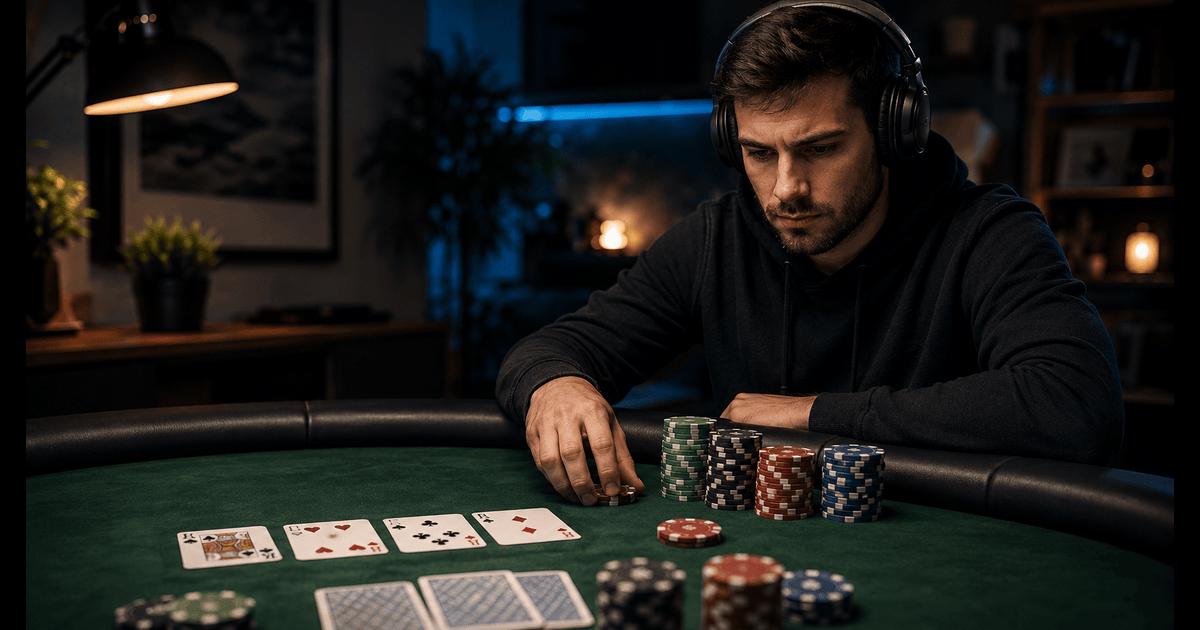

Athletes use music to get up. Card players need it for the opposite reason. Before a game, a sprinter puts something aggressive on and lets it push their heart rate up. That is the goal. For poker, elevated arousal is roughly the worst state you can be in. Decisions get faster when they should get slower. Folds feel like weakness. Calls feel justified by momentum rather than math. The music that helps you lift heavier is actively working against you at a table. Most players have never thought about this. They just put something on.
The Lyrics Problem Is Real
Here is the thing about language. Your brain does not really multitask with it. When a vocalist is doing something interesting, the part of your brain that handles words is handling the song. It is not fully available for the hand in front of you.
This is not a focus discipline problem. It is just how cognitive load works. You have a finite amount of verbal processing available per second, and a singer sharing a compelling line is drawing from the same pool as your pot odds calculation. One of them loses. Usually the one that requires more effort. Which is poker. Every time. The practical fix sounds almost too simple: no lyrics. But most people find silence either uncomfortable or distracting in its own way, which is where the choice of what to actually play becomes the real question.
Why 60 to 80 BPM Specifically
Research on focus and tempo keeps landing in the same place. Somewhere between 60 and 80 beats per minute, the brain settles into something resembling an alpha wave state: alert, processing, not hunting for the next stimulus. Below that range it gets sleepy. Above it, arousal starts climbing.
Lo-fi sits here naturally. So does slower deep house. Ambient techno, done right, barely registers as music at all in the traditional sense. Four Tet's quieter material. Jon Hopkins before the drops. Boards of Canada if you want something that feels like thinking rather than working out. The vinyl crackle in a lo-fi track is not aesthetic decoration. It gives the brain's background process something minor to handle, which reduces the impulse to go looking for something more interesting. That small detail is doing real work across a four-hour session even if you never consciously notice it.
What Tilt Actually Feels Like in Your Body
A bad beat is not just a mental event. Your heart rate goes up. Your jaw tightens. There is a physical pull toward the next hand, toward doing something, toward correcting the injustice that just happened. None of that is strategic thinking. It is just the body's stress response running its program.
The right audio environment does not erase that. Nothing does immediately. But a consistent, non-aggressive sonic background settles the physiological response faster than silence does, and dramatically faster than whatever aggressive track happened to be playing when the bad beat landed. Smooth transitions in a playlist matter here too. A genre jump or a dramatic drop is a micro-interruption. Fine once. Across a long session, it compounds.
How music affects concentration during mentally demanding tasks makes a point worth sitting with: the music that works best is almost always music you stop hearing. If a track is pulling your attention, it has already done damage.
Actually Building the Playlist
A few things that matter more than people expect: Length. A 90-minute playlist that loops creates its own problem: the moment a familiar track starts repeating, you clock it, and that moment of recognition is a break in the state. Build longer than the session or use a radio extension that keeps the texture without the repetition.
Transitions. Jarring gaps or dramatic shifts between tracks are the enemy. The goal is an unbroken sonic environment. If you notice the music changing, something went wrong. Vocals. Even a song you know well will pull focus when a familiar line hits. The emotional memory attached to it fires. That is a feature of music you love. At a poker table it is a bug.
Running the Actual Test
The only way to know if this makes a difference for you is to test it over real sessions rather than trusting the theory. Same stakes, same format, different audio conditions across three or four sessions. Pay attention to the final hour specifically, when decisions get worse for most people anyway and the gap between disciplined and undisciplined play is widest.
The WPT Global poker platform gives you enough session volume to run that comparison meaningfully: the tournament and cash game traffic is consistent enough that you can isolate the audio variable rather than attributing everything to table dynamics. Three sessions with the right playlist, three without. See what your last-hour decisions look like.
The playlist does not make you a better player. But it might stop you from becoming a worse one exactly when it matters most. It is a low-effort edge in a game where most edges require months of study. Four Tet costs nothing. The experiment costs an afternoon. The fold you do not talk yourself out of at hour three might be worth considerably more.
Source of music data: Viberate.com
-
📌 Viberate - Music Intelligence is the data & AI layer behind music analytics, connecting artist discovery, audiences, playlists, tracks, Spotify, TikTok, YouTube, streaming, and radio airplay.
 Next article
 Previous article
11M+ artists, 100M+ songs, 12M+ playlists, 6K+ festivals and 100K+ labels on one platform, built for industry professionals.