Kristian Gorenc Z
May 12, 2026

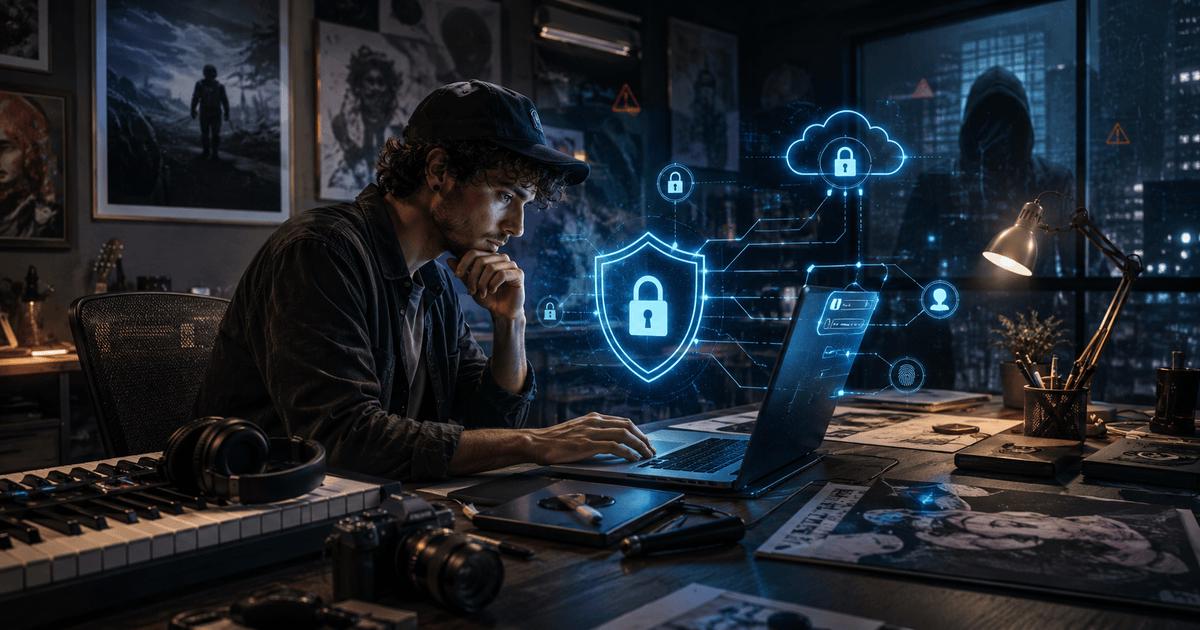

The internet gave artists freedom. It also opened the door to theft, impersonation, and data breaches. In 2024, cybercrime will cost the global economy over $9 trillion — and creative professionals, often working alone without IT support, are easy targets. Your music, designs, photos, and brand identity are worth protecting.
You might think hackers only go after banks or corporations. Wrong. Independent artists are targeted precisely because they tend to underestimate the risk. A stolen social media account, a leaked unreleased track, or a fake "official" website can destroy years of work overnight.
According to a report, 1 in 3 adults globally experienced cybercrime. Artists who rely on platforms like Bandcamp, Patreon, Etsy, or Instagram are constantly exposed — logging in from cafés, airports, studios, shared computers.
Here's something most artists overlook: the network you use matters just as much as the password you set. Public Wi-Fi at a coffee shop or venue is essentially an open door for attackers who intercept your traffic.
A VPN—Virtual Private Network—encrypts your connection and hides your real IP address. For artists working internationally, it also solves a separate problem: geo-blocked platforms. Trying to access a licensing service, streaming portal, or social network that's restricted in your country? If you had VeePN VPN solutions, this wouldn't be a problem. VeePN also offers free VPN extensions and add-ons to redirect traffic and unblock foreign content. Treat it as the baseline—the thing you turn on before anything else.
Most people reuse passwords. Most artists are most people. This is how accounts get compromised — not through sophisticated hacking, but through credential stuffing: someone takes a leaked password from one breach and tries it everywhere else.
A password manager like Bitwarden (free and open-source) or 1Password generates and stores unique, complex passwords for every platform. You remember one master password. The manager remembers the rest.
Passwords alone aren't enough anymore. Two-factor authentication adds a second layer — typically a six-digit code that expires every 30 seconds — so even if someone steals your password, they still can't get in.
Google Authenticator and Authy are the most widely used apps for this. Authy has the added advantage of encrypted cloud backups, which matters if you ever lose your phone. Enable 2FA on every platform that supports it: email, social media, your distributor, your website host — everywhere.
Theft doesn't always look like hacking. Sometimes it looks like someone else selling prints of your artwork, or a fake profile using your photos to scam fans. This happens constantly, and most artists find out about it months too late — or never.
Google Reverse Image Search is free and takes ten seconds. Do it regularly with your key portfolio images. For more systematic monitoring, tools like TinEye or Copytrack crawl the web and flag unauthorized uses of your visual work.
Copytrack even helps you pursue compensation in some cases. That's digital identity protection with actual teeth.
Your name is your brand. If someone registers a domain using your artist name — say, yourname-official.com or yourname-music.net — they can impersonate you, sell fake merch, or phish your fans. It's more common than you'd think.
Google Alerts is the simplest starting point: set up alerts for your artist name, your song titles, your brand. Free, takes two minutes. For more thorough coverage, platforms like Mention or Brand24 track social media, forums, and news in real time.
Own your domain before someone else does. Even if you don't use it yet, register it.
Tools only work if you actually use them. The artists who stay protected aren't necessarily more tech-savvy — they're more consistent. They check. They update. They notice when something feels off.
Cybersecurity education is part of this. Initially, you'll need to make an effort to find a VPN and activate it when needed. A little later, activating VeePN became a simple ritual, but no less necessary. Start small. Install a password manager this week. Turn on 2FA tomorrow. Add a VPN before your next public Wi-Fi session.
Independent artists spend enormous energy protecting their creative vision. Protecting the digital infrastructure around that vision deserves the same attention. One breach can mean lost income, a broken fanbase relationship, or a stolen identity that takes years to reclaim.
The tools exist. Most of them are free or nearly free. The only real cost is the time to set them up — and that's a trade worth making.
Source of music data: Viberate.com
-
📌 Viberate - Music Intelligence is the data & AI layer behind music analytics, connecting artist discovery, audiences, playlists, tracks, Spotify, TikTok, YouTube, streaming, and radio airplay.
 Next article
 Previous article
11M+ artists, 100M+ songs, 12M+ playlists, 6K+ festivals and 100K+ labels on one platform, built for industry professionals.