Kristian Gorenc Z
Apr 21, 2026



Every Eurovision season builds its own kind of momentum long before the final results are in. Songs begin to travel across streaming platforms, fan communities start to rally around early favorites, and some entries separate themselves through sheer scale, while others build more quietly through steady growth. By the time the contest reaches its final stretch, platform data can already reveal which tracks are breaking through and which ones are still trying to catch up.
That does not mean data can fully explain Eurovision. Live performances, staging, jury preferences, national voting patterns, and the unpredictable chemistry of the night still matter. But platform performance can offer a useful early read on where attention is concentrating, which entries are accelerating at the right time, and which songs look strongest if the field is judged only on measurable traction.
With that in mind, this analysis examines 35 nominated Eurovision 2026 tracks through a data-only lens. The goal is to identify which songs are gaining momentum, which ones already command the strongest audience demand, and which entries have built the broadest platform support. In other words, it asks a simple question: if measurable streaming and platform signals were the main basis for judging the field, which songs would look strongest heading into Eurovision 2026?

In a contest built on live performance, staging, and national voting patterns, raw platform data can never tell the whole story. Still, it can say a lot about which songs are breaking through before viewers cast a single vote.
To see which Eurovision 2026 entries look strongest on measurable traction alone, 35 nominated tracks were ranked using a data-only model built from recent demand, momentum, and platform support signals. The analysis focused on three questions: Which songs are attracting the most audience demand right now? Which ones are gaining momentum at the right moment? And which entries are receiving the strongest platform support through playlist reach and related indicators?
That approach does not attempt to predict the actual winner. Eurovision has always been more complicated than a streaming race. Jury preferences, diaspora patterns, live vocals, staging, and the chemistry of the night can all change the outcome. But if the field is judged only on current data signals, a clearer hierarchy emerges.
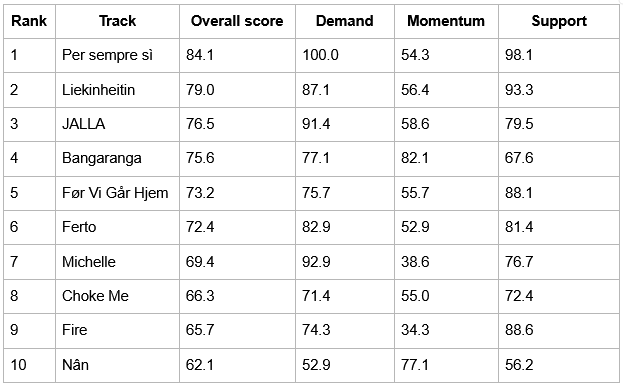
At the top of that hierarchy is “Per sempre sì.” The track leads the full field in overall score, driven by the strongest demand profile and the highest support score in the 35-song set. In practical terms, that means it is not simply posting one strong metric. It is performing at a high level across the areas the model values most: sustained audience pull and broad platform backing. Its recent momentum is solid rather than spectacular, but the base is strong enough that it still finishes clearly ahead of the rest of the field.
The main reason that matters is that big tracks can lead in different ways. Some are rising quickly from a smaller base. Others are already operating from a position of scale. “Per sempre sì” belongs to the second group. Its case is not that it is the fastest riser in the race. Its case is that it has already built the largest measurable footprint while maintaining enough current movement to stay in front.
Behind it, the chasing group is tighter and more interesting. “Liekinheitin,” “JALLA,” “Bangaranga,” “Før Vi Går Hjem,” and “Ferto” form the clearest second tier in the model. Those songs do not all get there the same way, which is one reason the analysis is more useful than a simple streams chart.
“Liekinheitin” looks like one of the most secure all-round contenders. It combines high demand, strong support, and enough momentum to avoid looking static. It does not dominate one category as decisively as the leader, but it does very little wrong. That makes it one of the least fragile profiles in the top tier.
“JALLA” also scores strongly, especially on scale. It has one of the strongest demand profiles in the set, and its support metrics remain good enough to keep it firmly among the leaders.
If one song makes the strongest case as the most balanced challenger, though, it is “Bangaranga.” That track stands out because it does not lean too heavily on one pillar. Its demand is strong, its momentum is among the best in the upper tier, and its support metrics are solid enough to keep it competitive. In a data-only ranking, balance matters. A track that is merely large can stall. A track that is merely rising can still be too small. “Bangaranga” looks more complete than that. It is one of the few entries near the top that looks strong in all three directions at once.
“Før Vi Går Hjem” and “Ferto” round out the strongest cluster. Both are credible high-end contenders in the model, but with slightly different profiles. “Før Vi Går Hjem” leans more on support and steady demand than on explosive recent acceleration. “Ferto” looks broad and stable, with fewer extreme strengths but no major weakness. Neither track feels inflated by one odd metric or one short-lived spike, which helps explain why both remain close to the top in multiple scoring scenarios.
That stability matters because the model was rerun under alternative weighting systems, including versions that gave more weight to demand and momentum. The ordering shifted slightly, but the same core group stayed near the front. That is one of the strongest signs that the ranking is capturing something real rather than producing an arbitrary result.
Just below the top cluster, a second analytical divide appears. Some songs look strong because they are already large. Others look dangerous because they are moving fast.
The clearest momentum names in the wider field include “Nova Zora - Eurovision 2026,” “Paloma Rumba,” “Ridnym - Eurovision Version,” “Just Go,” and “Nân.” These tracks show stronger acceleration patterns than many of the bigger entries above them. That makes them worth watching, but not all momentum profiles should be treated the same way. A track can climb quickly while still lacking enough total demand or support to challenge the leaders outright.
That is why “Nân” is the most interesting of the momentum-heavy group. It does not merely post a strong growth signal. It also carries enough total strength to break into the top 10 overall. In other words, it looks less like a curiosity and more like a plausible late mover.
By contrast, tracks like “Paloma Rumba” and “Ridnym - Eurovision Version” read more like surge stories than frontrunner stories. Their momentum helps them stand out, but their overall scale remains thinner than the songs at the top of the ranking. In a data-only model, that makes them more compelling as rising threats than as outright leaders.
The reverse is also true. A few entries show the opposite pattern: large footprint, softer recent pace. “Michelle,” “Fire,” “My System,” and “REGARDE !” all fall somewhere in that category. None of them can be dismissed. In fact, “Michelle” is especially strong on pure demand. But their current movement does not look as convincing as their overall size. That distinction matters because it separates songs riding a strong present wave from songs holding on to a larger existing base.
One of the most useful parts of this analysis is identifying where the model itself is most likely to overrate or underrate songs. Tracks with especially strong support scores but weaker direct audience pull can look better in a composite than they would in a pure demand race. That appears to be more relevant for entries like “Fire,” “TANZSCHEIN,” and “Ya Ya Ya.” These are not weak songs in the data, but they lean more on platform support than on direct audience-demand leadership.
Another warning sign appears in one-platform skew. A track that looks strong on Spotify but much weaker on YouTube, or vice versa, may have a narrower base than its headline position suggests. That is one reason broad, cross-platform strength is more persuasive than one large isolated number.
The final result is not a prediction of who will win Eurovision 2026 on stage. It is a ranking of which entries currently look strongest if platform demand, recent momentum, and support signals are treated as the contest’s only inputs.
On that basis, “Per sempre sì” is the clearest leader. “Liekinheitin,” “JALLA,” “Bangaranga,” “Før Vi Går Hjem,” and “Ferto” make up the strongest immediate chasing pack. And within that group, “Bangaranga” may be the most interesting analytical challenger, because its profile is the most balanced rather than the most lopsided.
This analysis compared 35 nominated Eurovision 2026 tracks using recent platform data from Viberate exports. Each song was assessed in three areas: audience demand, recent momentum, and platform support. Demand was based on recent Spotify and YouTube activity, momentum was based on whether a track was picking up speed over the recent tracking window, and support was based on playlist reach and related Spotify indicators.
To keep the comparison fair, the ranking focused on recent 30-day performance rather than raw longer-term totals, since the nominated songs were not all released at the same time. That reduced the advantage older releases would otherwise have had. The final result is a data-based ranking of which entries currently look strongest on measurable traction.
Source of music data: Viberate.com
-
📌 Viberate - Music Intelligence is the data & AI layer behind music analytics, connecting artist discovery, audiences, playlists, tracks, Spotify, TikTok, YouTube, streaming, and radio airplay.
 Next article
 Previous article
11M+ artists, 100M+ songs, 12M+ playlists, 6K+ festivals and 100K+ labels on one platform, built for industry professionals.