Kristian Gorenc Z
Jun 10, 2026


Summer music festival season gives fans, artists, and industry teams more choices than a poster can explain. Major events compete for attention with long lineups, high-profile headliners, genre-focused gatherings, and smaller festivals built around specific scenes. The common starting point is simple: Look for the biggest name or the most familiar artist. That approach can help, but it leaves out much of what makes a festival a good fit.
To show how data can sharpen the comparison, Viberate analyzed selected 2026 summer festival lineups using artist-level data from each festival’s lineup table. The analysis reviewed genre tags, subgenre tags, artist countries, artist ranks, and the number of festival performances each artist had in the 12 months leading up to May 20, 2026. The examples are illustrative and are not presented as a ranked list of summer music festivals.
The data points to a practical conclusion: The right festival depends on fit. A megafestival can offer broad exposure across scenes, a genre-focused event can provide a clearer match for specific tastes, and a medium-sized festival can be more relevant to a niche audience than a larger general event.
Festival discovery often starts with headliners. That makes sense. Headliners carry much of the marketing weight, and they help explain why a festival gets public attention.
But headliners can distort how a festival is perceived. A festival with several pop headliners may still have a large electronic bill. A jazz festival may include R&B-, rock-, hip-hop-, and country-adjacent artists. A punk festival may include enough metal acts to appeal to a different audience than the headline genre suggests.
That is why lineup-level analysis matters. Instead of asking only which names appear at the top of the announcement, a data-based approach asks more specific questions:
These questions do not produce one universal answer. They make the comparison more precise.
For this analysis, Viberate reviewed updated 2026 lineup data for four festivals: Coachella, Tomorrowland, Newport Jazz Festival, and Jera On Air. The group was selected to illustrate different festival-selection scenarios rather than to rank the events against one another.
Coachella and Tomorrowland are both megafestivals, but the data shows different lineup patterns. Newport Jazz Festival and Jera On Air are medium-sized festivals, but each has a clearer genre and scene identity.
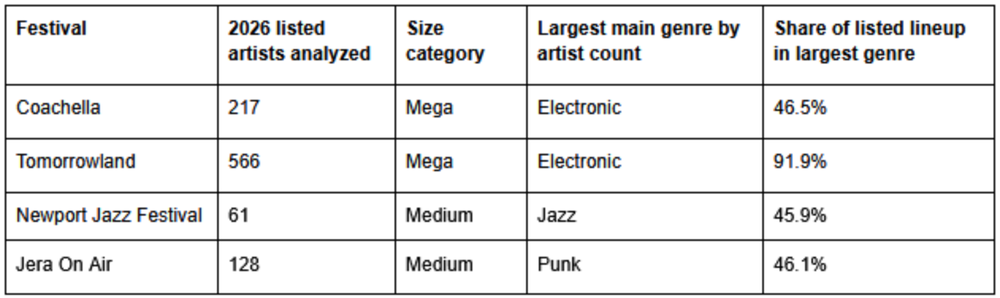
The table shows why size alone is a limited filter. Coachella and Tomorrowland are both megafestivals, but their genre structures differ sharply. Newport Jazz Festival and Jera On Air are both medium-sized, but they serve different listening contexts.
Coachella is often discussed through celebrity appearances, pop culture visibility, and major headliners. That framing is understandable, but it does not fully describe the 2026 lineup.
In the lineup analyzed by Viberate, electronic was the largest main genre by artist count, with 101 of 217 artists listed. That does not mean Coachella is only an electronic festival. It means the listed lineup contains a large electronic layer alongside other genres.
The same dataset shows why broad festivals are hard to reduce to a single label. Coachella’s 2026 lineup included artists tagged across pop, Latin, hip-hop, rock, R&B, reggae, jazz, country, African, and Asian categories. House was the top subgenre by artist count.

For fans, this can change how the festival is evaluated. A listener using only the biggest names may miss the sections of the lineup that are closest to their taste. For artists and teams, the same logic applies: Festival reputation alone does not show whether the middle and lower sections of the bill match a specific sound or career lane.
Coachella’s example points to a broader lesson. Large festivals can offer wide discovery value, but they require a more detailed read. Scale does not automatically make a festival a clean fit.
Tomorrowland provides the clearest genre-fit example in this analysis. In the 2026 lineup analyzed by Viberate, 520 of 566 artists were tagged as electronic. That equals 91.9% of the listed lineup.
This does not mean every artist at Tomorrowland fits the same subgenre. The lineup still includes different branches of electronic music and some crossover appeal. But compared with a broad multigenre festival, the data shows a much more concentrated identity.
Dance was the top subgenre by artist count in the 2026 lineup. That first layer of analysis already answers a practical question: If someone is looking for a festival built around electronic music, Tomorrowland is easier to assess by genre fit than a festival with a wider genre spread.
The updated lineup also shows why complete data matters. With 566 listed artists analyzed, Tomorrowland’s lineup includes a much larger long tail than a first-page review would suggest. That makes the genre-fit finding more specific: The festival is highly concentrated around electronic, while still covering a broad depth of artists within and around that space.
A focused genre profile does not make a festival better, but it does make the festival easier to evaluate for a specific purpose.
Newport Jazz Festival provides a different type of example. It is not competing with megafestivals on scale in this analysis but, it shows how a medium-sized festival can be relevant because of genre and scene context.
The 2026 Newport lineup analyzed by Viberate included 61 listed artists. Jazz was the largest main genre, representing 45.9% of the lineup. Jazz fusion was the top subgenre by artist count.
The lineup went beyond jazz. It also included R&B, rock, pop, hip-hop, country, Asian, and other tags. That mix matters because it shows how a genre-rooted festival can still include adjacent styles that widen its audience and programming range.
For a listener, this may mean the festival offers a specific starting point rather than a general-purpose lineup. For an artist or team, it may indicate a different kind of fit: not the largest audience in the sample but a more relevant cultural and musical context.
This is one of the central points of data-based festival comparison. A smaller scale does not automatically mean a weaker fit. In some cases, the narrower context is the main value.
Jera On Air is another medium-sized example, but in a different scene. The festival’s 2026 profile places it in Ysselsteyn, Netherlands, with punk and metal as its main genre positioning.
In the updated 2026 lineup analyzed by Viberate, punk was the largest main genre, representing 46.1% of the listed artists. Punk rock was the top subgenre by artist count. Metal was the second-largest main genre, giving the lineup a clear punk/metal crossover profile.
This type of festival shows why genre-specific analysis should not stop at the headline category. Punk and metal can overlap in live settings, but the distinction matters for festival fit. A punk-leaning lineup with a major metal presence may attract a different audience than a general rock festival or a broader alternative event.
Jera On Air also shows why medium festivals can matter in a data-based search. Its value is measured by more than global rank or total size. It comes from the fit between the lineup, the scene, and the audience most likely to care about that mix.
For festival discovery, that is a useful correction. A medium punk/metal event may be more relevant to the right listener or artist than a larger festival with only a small number of similar acts.
Genre is only one part of the decision. Lineup depth also matters.
To compare depth, Viberate reviewed artist ranks and festival-performance activity across the four updated 2026 lineups. Artist rank gives one view of scale. Festival-performance activity shows how often the booked artists had appeared at festivals in the previous 12 months.
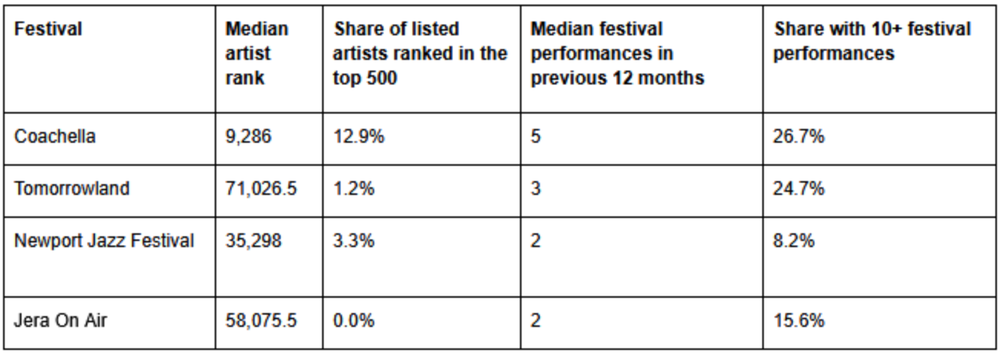
Coachella had the strongest rank-depth profile among the four selected examples, with the lowest median artist-rank number and the highest share of listed artists ranked in the top 500. That fits its role as a broad megafestival with a large upper tier.
Tomorrowland had a much larger listed lineup and remained highly concentrated around electronic. Its median rank was higher than Coachella’s because the updated export included a broader long tail of artists. Still, nearly a quarter of Tomorrowland’s listed artists had 10 or more festival performances in the previous 12 months, close to Coachella’s 26.7%.
Newport Jazz Festival and Jera On Air had fewer top-500-ranked artists, which reinforces that these festivals serve different kinds of fit. A festival with more globally ranked artists may offer broader visibility. A festival with lower-ranked but highly relevant artists may still be useful for a genre-specific audience.
The country distribution of a lineup can also shape how a festival is understood.
In the updated 2026 lineups analyzed, the largest artist-origin country varied by festival. U.S. artists made up 47.5% of Coachella’s listed lineup. Belgian artists were the largest country group at Tomorrowland, with 24.4%. U.S. artists accounted for 78.7% of Newport Jazz Festival’s listed lineup and 42.2% of Jera On Air’s lineup.
These numbers describe where the booked artists are tagged as coming from. That distinction matters. Artist-country data can help show whether a lineup is locally concentrated, regionally mixed, or globally spread. It cannot prove who will attend the festival.
For festival comparison, this can still be useful. A festival with a high domestic artist share may have a different scene function than one built mostly around international touring acts. Again, the value depends on the goal.
Lineup data can make festival comparison more objective, but it cannot answer every practical question.
A dataset cannot fully capture ticket price, travel cost, weather, local infrastructure, set times, venue layout, artist fees, booking relationships, production needs, visa issues, or the real on-site atmosphere. It also cannot define what a listener personally wants from a festival weekend.
That is why data works best as a filter. It can show whether a festival is broad or focused, whether its lineup matches a genre, whether booked artists are active on the festival circuit, and whether the lineup is local, domestic, or international in composition.
The final decision still depends on context. For a fan, that context may be taste, budget, and travel. For an artist or manager, it may be a realistic booking fit, market strategy, and routing. For a label or promoter, it may be audience overlap and scene relevance.
For fans traveling internationally, the festival itself may be only one part of the trip. Looking at local transport, accommodation, seasonal conditions, and responsible ways to explore the destination can make the overall experience easier to plan. Resources focused on responsible travel, such as EcoExplorer Thailand, can add that destination-level context when a festival trip includes time in Thailand or the wider region.
The main takeaway is not that data can make the search less dependent on reputation, assumptions, and headline names.
Viberate analyzed four selected 2026 summer festival lineups: Coachella, Tomorrowland, Newport Jazz Festival, and Jera On Air. The festivals were selected to illustrate different types of festival fit: a broad megafestival, a genre-focused megafestival, a medium jazz/R&B-oriented festival, and a medium punk/metal festival.
The analysis used updated artist-level data from each festival’s 2026 lineup table, including artist name, country, main genre, subgenre, Viberate rank, and festival performances in the previous 12 months. Genre and subgenre shares were calculated from the current-year listed artists. Historical genre-distribution charts were excluded where they did not match the 2026 lineup year.
Artist-country shares were calculated from the listed artist country field. Median artist rank was calculated from available Viberate rank values. Rank-band shares, including the share of artists ranked in the top 500, were calculated from the same artist-rank field. Festival-performance activity was calculated from the number of festival performances listed for each artist in the previous 12 months.
For consistency, percentage shares in the article use the full listed lineup as the denominator. Newport Jazz Festival had one artist row without available genre or country data, and Tomorrowland had four artist rows without available country data; those rows remained in the full lineup denominator. The examples are illustrative and are not presented as a ranking of summer music festivals. The analysis does not account for ticket prices, travel costs, booking fees, artist availability, set times, venue conditions, or on-site attendance data.
Source of music data: Viberate.com
-
📌 Viberate - Music Intelligence is the data & AI layer behind music analytics, connecting artist discovery, audiences, playlists, tracks, Spotify, TikTok, YouTube, streaming, and radio airplay.
 Next article
 Previous article
11M+ artists, 100M+ songs, 12M+ playlists, 6K+ festivals and 100K+ labels on one platform, built for industry professionals.