Kristian Gorenc Z
Apr 29, 2026

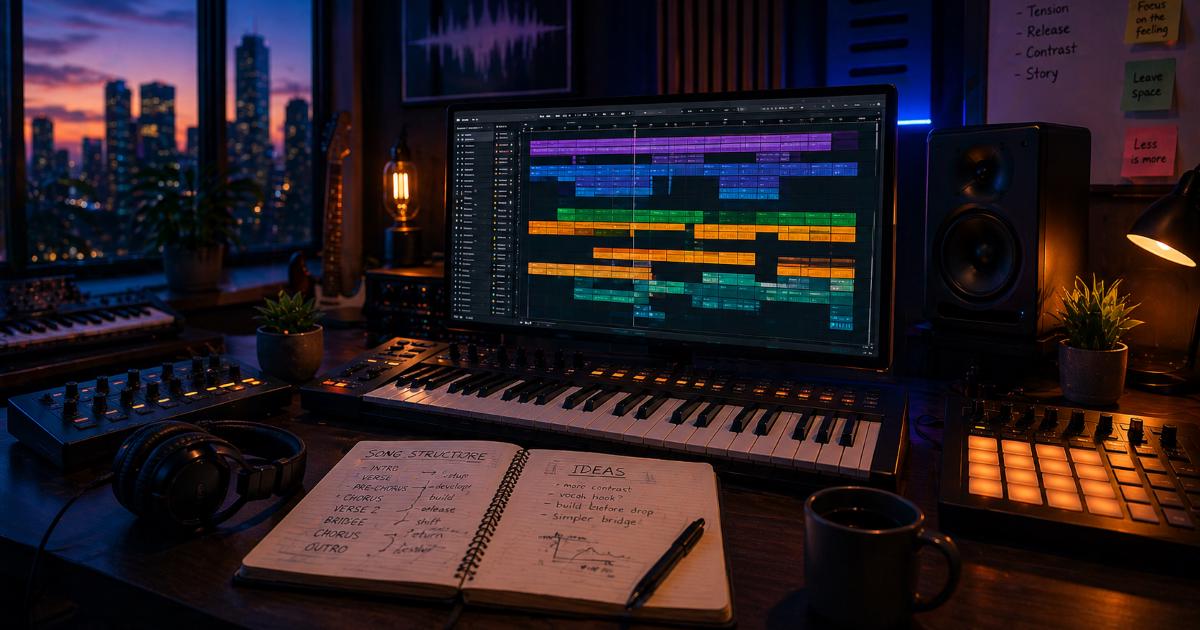

Most modern producers can build an appealing 8 or 16 bars. They can find a solid drum groove, write a catchy chord progression, shape a bassline, and land on a sound palette that feels current. That part of the process is often fast. The bigger problem comes later, when the producer has to turn that loop into a track that feels complete.
A lot of unfinished projects do not fail because the core idea is weak. They fail because the arrangement never develops beyond the initial section. The producer keeps refining the same loop, adding details, changing sounds, and trying to force progress out of a section that was never designed to carry the whole track on its own.
That is why song structure matters so much for modern production. It is the system that helps a track move from a promising fragment to a finished piece of music. Without it, even a good idea can stall.
There is a reason so many producers collect unfinished sessions.
Loop-based workflow is efficient at the start. It lets you test sounds quickly, build momentum, and get to the fun part of production without too much planning. That is useful. The issue is that the same workflow can also trap you in a very small part of the song.
Once the loop works, the next questions become harder. How long should the intro be? What should change before the chorus or drop? When should the bass disappear? Does the arrangement need a bridge, a breakdown, or a reduced section before the final return? How much contrast is enough?
These are song structure questions, and they usually decide whether the track will be finished or abandoned.
Many producers try to solve them too late. They spend hours perfecting one section and only then start thinking about the full shape of the track. By that point, the loop feels familiar, but the broader arrangement still has no real logic.
Some producers resist structure because they associate it with formula.
That view misses the point. Good song structure does not make music less creative. It gives creative ideas a form that listeners can actually follow. In practice, structure is what allows tension, release, surprise, and payoff to work.
A track with no structural logic may still have strong sounds, but it often feels aimless. The listener hears material, not direction. On the other hand, when the structure is clear, even simple ideas can feel convincing because each section has a role.
The intro can create expectations. The verse or reduced section can hold things back. The chorus, hook, or main section can deliver the payoff. A bridge, breakdown, or switch-up can reset attention. The outro can close the idea cleanly.
The exact labels vary by genre, but the purpose remains the same. Song structure organizes how the track unfolds over time.
One of the most common mistakes is treating the full arrangement like an extended copy of the best loop.
That usually leads to repetition without real development. Elements may come in and out, but the listener understands the track too early because the core experience does not change enough.
Another mistake is starting too full. Producers often load the opening section with too many strong elements because they want immediate impact. The problem is that this leaves little room to build. If the main drums, bass, lead, pads, and effects are already present near the start, later sections lose their ability to feel bigger.
A third problem is weak contrast. Modern production often emphasizes polish, density, and constant stimulation. But if every section aims for maximum impact, the arrangement loses shape. A track needs lighter moments as well as heavier ones. It needs expansion and reduction.
This is where song structure becomes practical rather than theoretical. It helps the producer decide when to introduce, remove, or vary material so the listener feels progression.
The most useful way to understand arrangement is to stop thinking only in labels and start thinking in functions.
An intro prepares the ear. A verse often develops the core idea without fully releasing its energy. A chorus or drop usually provides the largest payoff. A bridge can shift mood, harmony, or texture. A breakdown can create space before the next lift. An outro resolves the track.
This matters because song structure is about what sections do, not only what they are called.
If a section has no distinct function, it often feels unnecessary. If every section performs the same job, the arrangement feels flat. But when each part contributes something different, the song begins to move with purpose.
That is the difference between a timeline full of copied clips and a track that actually feels arranged.
A lot of producers try to build energy by adding more and more layers.
Sometimes that works. Often it does not.
Energy depends on contrast. A chorus feels bigger when the section before it gives it room to arrive. A drop feels stronger when tension has been built properly. A final section feels satisfying when something earlier made the listener want that return.
Without contrast, the arrangement has nowhere to go.
This is one of the core lessons of song structure. Bigger is only effective if something smaller came before it. Dense is only exciting if there is enough space around it. Repetition is only satisfying if variation prevents fatigue.
For modern producers, this is especially important because production tools make it easy to stack sounds quickly. The challenge is no longer access to layers. The challenge is knowing when not to use them.
DAWs are excellent for building details, but they can also encourage tunnel vision.
A producer may spend an hour refining the drums in one loop and still learn nothing about whether the full track works. This is why broader arrangement thinking matters early, not only at the finishing stage.
Some producers solve this with templates. Others sketch the entire arrangement before deep sound design. Others use tools that generate a structural starting point they can then edit and develop.
That is part of why platforms like Jukeblocks have found an audience among producers who struggle with arrangement. Jukeblocks generates full arrangement ideas by genre, with sections laid out across a grid and elements placed in a way that gives the track immediate direction. Instead of beginning from a blank timeline, the producer starts with a shape they can change, edit, and download into MIDI or compatible DAW project files.
That does not replace musical judgment. It just reduces the friction between idea and execution, which is often where projects stall.
For producers stuck in loop mode, one practical approach is to think in stages.
First, establish the identity of the track. That means introducing enough material to make the sound and mood clear without revealing everything at once.
Second, develop the idea. This is where the listener needs confirmation that the track is going somewhere, not staying in one place. That may involve new layers, a harmonic shift, a rhythmic change, or a reduction that creates anticipation.
Third, deliver the main payoff. This is the point where the arrangement should feel most direct, most open, or most physically effective.
Fourth, create a change in perspective. This can happen through a bridge, breakdown, switch-up, or stripped section that resets the ear.
Finally, return or resolve. The listener should feel that the track has completed a path, not simply stopped after repeating enough times.
This is not the only way to think about song structure, but it is a useful one because it keeps the producer focused on movement.
A strong arrangement makes decisions easier.
When the producer understands the role of each section, the project becomes less overwhelming. Instead of asking endless open questions, they can evaluate whether the current part is preparing, building, delivering, shifting, or resolving energy.
That reduces decision fatigue, which is one of the main reasons projects stay unfinished.
It also improves editing. Once the full shape of the track is visible, it becomes easier to remove unnecessary sections, tighten transitions, or hold back elements until they matter more. In other words, song structure is not only about adding parts. It is also about knowing what to cut.
For producers who want to finish more tracks, that is a serious advantage.
A good loop proves there is something worth developing.
A finished record proves that the idea can survive across time.
That difference is what structure solves. It turns isolated material into a sequence that guides the listener through tension, release, contrast, repetition, and change. It makes the music feel intentional instead of accidental.
This is why song structure remains one of the most important skills for modern producers, even in an era where generating sounds, melodies, and patterns is easier than ever.
Technology has sped up idea creation. It has not removed the need for arrangement.
If anything, it has made structure more important. When everyone can build a strong loop, the producers who finish compelling tracks are often the ones who know how to shape that loop into a full song.
Source of music data: Viberate.com
-
📌 Viberate - Music Intelligence is the data & AI layer behind music analytics, connecting artist discovery, audiences, playlists, tracks, Spotify, TikTok, YouTube, streaming, and radio airplay.
 Next article
 Previous article
11M+ artists, 100M+ songs, 12M+ playlists, 6K+ festivals and 100K+ labels on one platform, built for industry professionals.