Kristian Gorenc Z
Nov 8, 2026



Music applications depend on accurate information about artists, tracks, playlists, and listening activity. Developers building artist dashboards, discovery platforms, and analytics software need structured access to this information without collecting everything manually.
A music streaming API provides a way for applications to retrieve music-related information programmatically. Depending on the provider, this can include artist profiles, track metadata, playlist information, streaming indicators, and historical performance data.
However, different APIs provide different levels of access. Some focus on the catalog of a single streaming service, while others combine information from multiple platforms to support wider music industry analysis.
Understanding these differences helps developers select the right solution for their applications.
A music streaming API is an application programming interface that allows software to communicate with a music platform or data service.
Instead of manually searching for artists or tracks, developers can submit requests and receive structured information that their applications can process.
For example, an application might request information about an artist, retrieve the artist's recordings, and display relevant statistics in a dashboard.
The available information depends on the API provider, the endpoints supported, and the permissions granted.
Some APIs primarily offer music catalog information and playback-related functionality. Others specialize in analytics, allowing developers to retrieve performance indicators and examine trends over time.
These distinctions are important because access to a streaming platform's catalog does not automatically include detailed streaming statistics or audience analytics.
Music APIs can be grouped according to the information and functionality they provide.
Platform-specific APIs connect applications to a particular music service.
They may provide access to artist profiles, albums, tracks, playlists, identifiers, and other catalog information.
Some also support account-related or playback functionality, subject to authorization and platform restrictions.
These APIs are useful when an application is built around one streaming ecosystem.
However, their data typically reflects the information that the individual platform makes available.
Developers should not assume that every platform provides unrestricted access to streaming counts, listener demographics, or historical performance.
Metadata APIs focus on descriptive information about recordings and artists.
This can include track titles, artist names, release dates, album information, genre classifications, and identifiers.
Metadata helps developers organize music libraries, match recordings, and display consistent information across applications.
For example, a catalog management system might use artist and track identifiers to connect recordings with their corresponding profiles.
Reliable identification becomes particularly important when different artists share similar names or recordings appear in multiple versions.

Analytics APIs provide access to performance measurements rather than catalog information alone.
Depending on the provider, these may include streaming indicators, audience development, playlist activity, popularity rankings, and historical trends.
This information supports applications designed for record labels, managers, music marketers, and A&R teams.
An analytics dashboard could use these measurements to track an artist's performance over time or compare multiple releases.
The exact metrics available vary between services, making endpoint documentation essential.
Cross-platform APIs combine information from multiple music and social platforms into a common data environment.
This allows developers to examine different aspects of an artist's performance without building separate integrations for every source.
For example, a music analytics product might combine Spotify indicators with YouTube performance and social media metrics.
The resulting dataset offers a wider view of an artist's digital presence.
Viberate's music data API provides structured information about artists, tracks, playlists, and other music industry entities, incorporating data from relevant streaming and social platforms.
The available data depends on the selected API, but several categories are especially relevant to music applications.
Artist information can include names, profiles, images, genres, identifiers, and platform-specific audience indicators.
Analytics-oriented APIs may also provide historical performance measurements and popularity rankings.
For developers, consistent artist identification is particularly valuable when combining records originating from different sources.
Track data may include recording metadata, associated artists, release information, and performance indicators.
Playlist information can help applications examine where recordings appear and how their placement changes.
These datasets are useful for catalog monitoring, playlist research, and release analysis.
However, access to playlist histories and detailed performance measurements varies between API providers.
Analytics services may provide streaming-related indicators, changes over time, and audience metrics where available.
These measurements can help developers build systems that monitor artist development or evaluate individual releases.
Cross-platform data adds information from video and social channels, creating opportunities to analyze how performance differs between services.
Developers should distinguish reported measurements from estimated or derived indicators when presenting this information.
Most music data APIs operate through a request-and-response process.
An application sends a request to an endpoint, specifying the information it needs. The service processes the request and returns data in a structured format, commonly JSON.
An artist endpoint, for example, might return profile information or available performance metrics associated with an artist identifier.
Developers can then process the response and display the results in their applications.
Several technical considerations affect implementation.
Authentication determines how applications identify themselves and access permitted resources. Rate limits define how many requests can be submitted within a particular period. Pagination helps retrieve larger collections of results, while historical data availability determines how far back performance analysis can extend.
Developers should also consider error handling, data caching, and refresh schedules.
A successful integration needs to account for these limitations rather than assuming that all endpoints provide unlimited access.
An artist's performance can vary considerably between streaming, video, and social platforms.
A musician might generate substantial streaming activity while maintaining a relatively modest social media audience. Another artist may experience rapid video growth before similar developments appear in audio streaming.
Analyzing only one service provides a limited perspective.
Cross-platform analytics helps applications examine these different signals together.
For record labels and A&R teams, this can support artist discovery and comparative research. Managers may use the information to monitor audience development, while technology companies can incorporate it into automated reports.
The quality of the underlying data remains essential.
When artist profiles are duplicated or incorrectly matched, cross-platform comparisons can become unreliable.
A consistent artist identifier helps connect performance measurements to the correct musician.
Music streaming APIs support a variety of professional applications.
Artist analytics dashboards can display performance trends and audience indicators for selected musicians.
A&R discovery tools can use rankings and historical data to identify artists experiencing measurable growth.
Release monitoring systems can track individual songs and generate regular performance updates.
Catalog management platforms can enrich artist and track records with structured metadata.
Automated reporting tools can retrieve updated measurements without requiring teams to compile every report manually.
The appropriate API depends on the product being developed and the measurements required.
A catalog application may prioritize metadata and identification, while an A&R platform needs reliable performance indicators and historical data.
Viberate offers a cross-platform music data API designed for applications requiring structured music industry information.
Its database covers more than 11 million artists and 100 million tracks, alongside millions of playlists and additional music industry entities.
Viberate emphasizes curated artist profiles with unique artist IDs, helping developers connect data from different platforms to a consistent artist identity.
The platform also provides daily-refreshed information from relevant streaming and social channels, subject to data availability.
This makes the API suitable for applications such as artist research tools, analytics dashboards, music discovery systems, and automated reporting.
Developers can select packages according to their technical requirements. Viberate's API pricing includes different request limits, pagination allowances, historical data periods, and entity coverage.
The available features depend on the selected package, so developers should review the relevant limits before implementing an integration.
Selecting a music streaming API involves more than comparing the number of endpoints.
Developers should evaluate whether the service provides the specific information their application needs.
Data coverage is particularly important when working with artists across different countries, genres, and platforms.
Update frequency affects how current the information remains, while historical availability determines whether an application can analyze longer-term trends.
Data integrity also matters. Duplicate artist profiles and inconsistent identifiers can introduce problems when combining large datasets.
Finally, developers should review authentication, request limits, documentation, commercial terms, and scalability.
These factors influence both implementation complexity and long-term operating costs.
A music streaming API allows developers to integrate music-related information into applications, dashboards, and automated workflows.
Platform-specific APIs provide access to individual music ecosystems, while metadata and analytics APIs serve different technical requirements.
Cross-platform music data APIs extend these capabilities by combining information from multiple services.
For applications that depend on accurate artist identification and regularly updated performance measurements, a structured music data provider can simplify development.
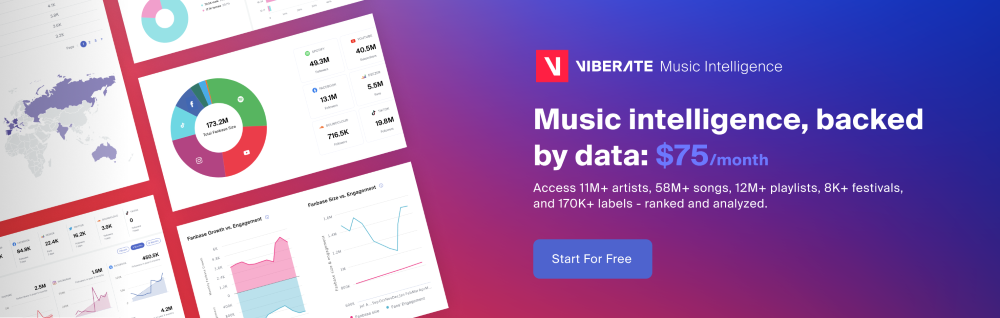
Viberate offers access to curated artist and track information, streaming and social metrics, and historical analytics through its API.
Choosing the right solution ultimately depends on the data required, the intended application, and the technical limits of the integration.
Source of music data: Viberate.com
-
📌 Viberate - Music Intelligence is the data & AI layer behind music analytics, connecting artist discovery, audiences, playlists, tracks, Spotify, TikTok, YouTube, streaming, and radio airplay.
 Next article
 Previous article

11M+ artists, 100M+ songs, 12M+ playlists, 6K+ festivals and 100K+ labels on one platform, built for industry professionals.