Kristian Gorenc Z
Jun 25, 2026

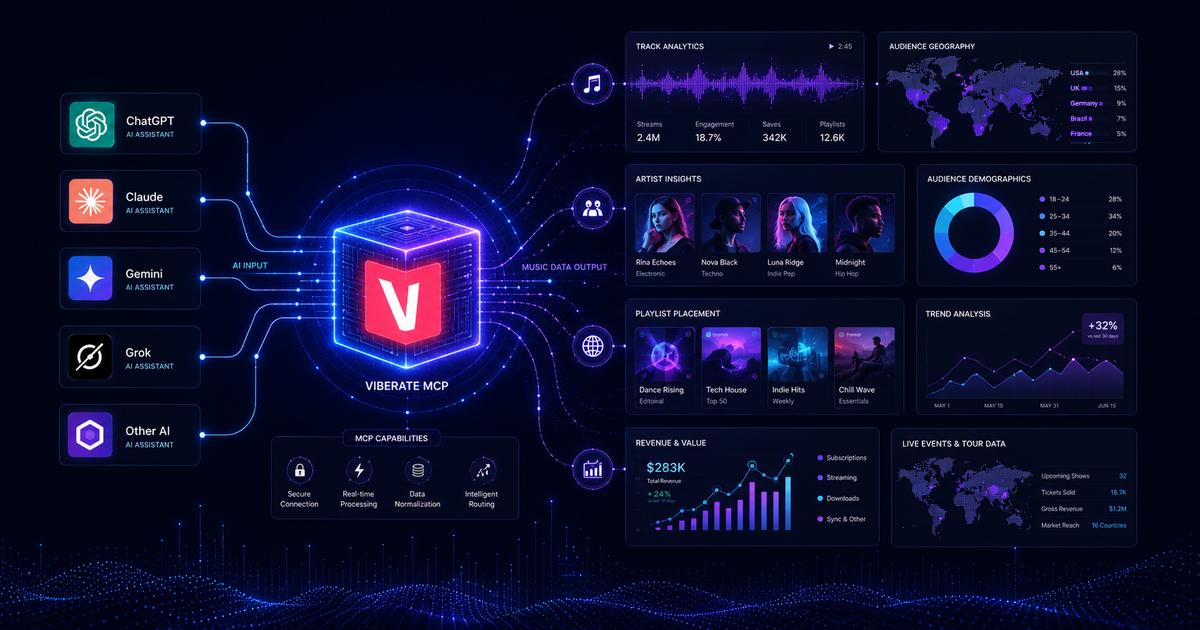

Music professionals work with more data than ever, but access is still often split between dashboards, exports, APIs, and internal reports. That creates a practical problem: the question you need to answer is rarely located in one place. You may need artist growth, playlist movement, audience geography, social signals, track performance, and market context before you can make a useful decision.
That is why matters for music data. It gives AI assistants a structured way to connect with external data sources, so the user can ask a question in natural language and receive an answer based on actual data instead of general AI knowledge alone.
For Viberate, this creates a new way to use its music analytics data. Until now, most users accessed Viberate through the platform interface or through the data API. The Viberate connector adds a third option: asking Claude, ChatGPT, Gemini, Grok, or another compatible AI service to work with Viberate data directly.
MCP stands for Model Context Protocol. It is often described as a bridge between AI assistants and external tools or databases. Instead of treating an AI assistant as a closed chat window, the protocol lets the assistant request context from connected services and use that context when answering.
In simple terms, the AI can stop guessing and start checking.
For a music industry team, that distinction matters. If you ask a general AI tool to evaluate an artist, it may rely on public knowledge, outdated information, or broad assumptions. When the assistant can connect to a structured music data source, the answer can include current artist stats, audience signals, playlist information, chart movement, and other data points.
This does not replace human judgment. It changes the starting point. A&R teams, managers, labels, marketers, and analysts can move from a vague question to a structured answer faster.

Music research is rarely a single-number task. A manager may want to compare an artist with three similar acts across streaming, playlisting, and top audience cities. A label may want to find rising artists in a specific genre and region. A brand team may want to understand whether an artist’s audience fits a campaign. A festival team may want ideas for lineup combinations based on genre, geography, and artist momentum.
These are not simple dashboard clicks. They are multi-step questions.
With Viberate’s connector, users can ask those questions inside their preferred AI assistant. The assistant can combine its reasoning with Viberate data and return a more useful response. For example, a user could ask for emerging Afro House artists in selected countries with strong Spotify growth and rising playlist reach. Another user could request an artist comparison focused on audience cities, YouTube views, and recent momentum.
The value is not only speed. It is flexibility. Users are no longer limited to a fixed dashboard path when the question is specific.
Viberate’s product is built around music data across artists, tracks, playlists, audiences, labels, charts, events, and markets. The connector lets users bring that data into AI workflows without building a custom integration for every task.
The free version gives users a way to test basic access, including artist search, essential artist information, headline metrics, and limited chart access. The paid version is designed for deeper research, including richer artist analytics, historical views, audience and geographic insights, track and playlist data, label information, live event data, comparisons, and other advanced workflows.
That separation is important. Not every user needs a full research setup on the first day. Some will only want to test basic artist queries. Others will need advanced access for scouting, reporting, planning, or internal data work.
For A&R teams, the main benefit is faster shortlisting. Instead of manually filtering charts, checking profiles, and comparing signals across several tabs, a user can describe the type of artist they want to find. The AI assistant can then help shape a shortlist based on the available data.
For managers, the workflow supports monitoring and benchmarking. A manager can compare an artist with similar acts, check audience markets, review playlist movement, or prepare a quick summary for a team call.
For brands and sync teams, the value is audience fit. Before a partnership, campaign, or sync opportunity, teams can check whether the artist’s audience matches the target market.
For developers and data teams, the connector provides an AI-native way to query music data. It does not replace a full API integration, but it can reduce the need to build custom internal workflows for every recurring question.
The important point is that this is not simply another dashboard feature. It is a different access layer for music data.
Dashboards are still useful when users want visual control, saved views, and repeatable workflows. APIs are still useful when teams need direct technical integration. AI-connected data sits between those two options. It gives non-technical users more flexibility while giving technical teams a faster way to test ideas before building.
That is where Viberate’s new connector fits. It lets users work with music analytics through conversation, while still grounding the answers in structured data.
For music professionals, that can reduce research time and improve the quality of early decisions. The user still needs to decide what matters, but the path from question to answer becomes much shorter.
Source of music data: Viberate.com
-
📌 Viberate - Music Intelligence is the data & AI layer behind music analytics, connecting artist discovery, audiences, playlists, tracks, Spotify, TikTok, YouTube, streaming, and radio airplay.
 Next article
 Previous article
11M+ artists, 100M+ songs, 12M+ playlists, 6K+ festivals and 100K+ labels on one platform, built for industry professionals.