Kristian Gorenc Z
Jul 3, 2026

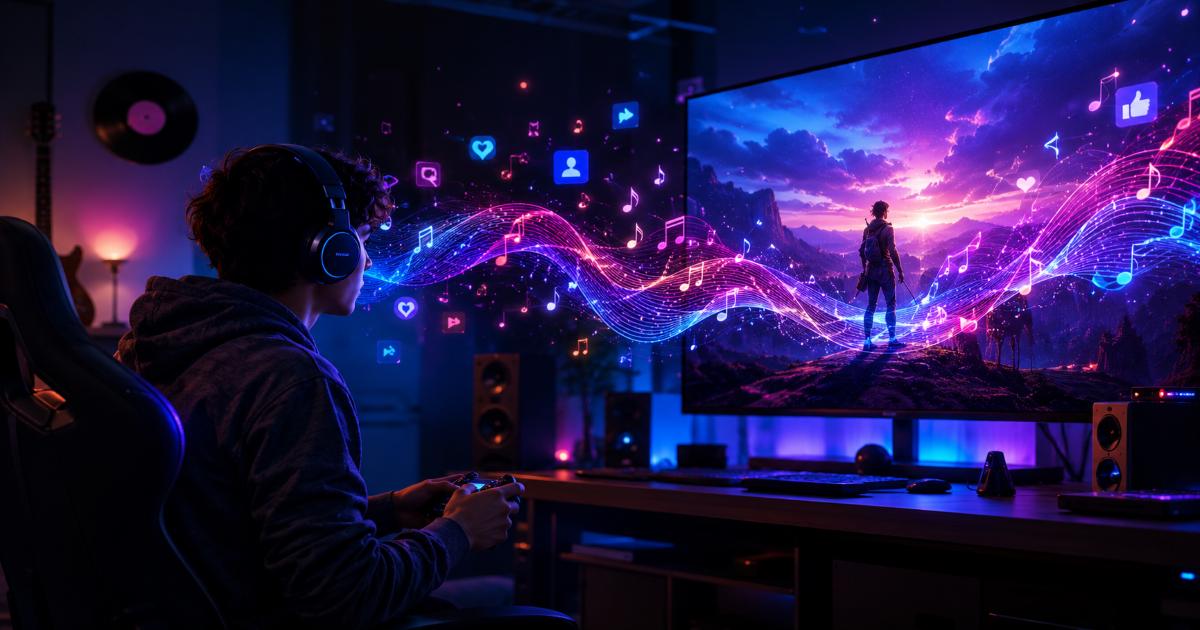

Gaming has become one of the most active spaces for music discovery. A song no longer needs to reach someone through radio, a playlist, or a social media trend first. It can enter their routine through a game menu, a racing sequence, a virtual concert, or a soundtrack that plays during hours of repeated sessions.
This gives music a different role. It does not simply accompany the action. It becomes tied to progress, competition, social interaction, and memorable moments. Players may hear the same track many times before they know its title or the artist behind it. Once the connection forms, that exposure can lead to searches, streams, follows, and deeper interest in an artist.
For musicians and music professionals, gaming is therefore becoming another channel to track alongside streaming, social media, playlists, radio, and traditional sync placements.
Music in games benefits from time and repetition.
A film viewer may hear a licensed song once during a scene. A player can return to the same menu, level, arena, or game mode dozens of times. Tracks become familiar without requiring the listener to make an active choice.
Research into music listening has shown that repeated exposure can initially increase a listener’s interest in unfamiliar music. Games create ideal conditions for this effect because repetition happens as part of an activity rather than through forced promotion.
The player also connects the track with an experience. A song may become associated with winning a difficult match, completing a mission, exploring a new location, or spending an evening online with friends. These memories can give the music meaning outside the game.
When players later hear the same track on Spotify, YouTube, TikTok, or radio, they already have a reference point. Recognition makes them more likely to pay attention.
Some games introduce music through carefully built soundtracks that function much like genre or mood playlists.
Sports, racing, and open-world games are especially effective at this. Their soundtracks often mix established acts with artists who are less familiar to mainstream audiences. Because players cannot always select every song, they encounter music outside their normal listening habits.
The Grand Theft Auto series is a clear example. Its in-game radio stations are organised by genre, era, and fictional station identity. Players can move between hip-hop, rock, electronic music, reggae, pop, funk, and other styles while driving through the game.
This setup adds context that an ordinary playlist may not provide. Presenters, station branding, fictional adverts, locations, and gameplay all shape how the music feels. A track becomes part of the game’s culture rather than an isolated audio file.
The same principle applies to smaller games. An independent title with a focused soundtrack can introduce players to niche electronic producers, composers, bands, or regional scenes. The audience may be smaller, but the relationship between the player and the soundtrack can be strong.
Modern games increasingly allow players to interact with music instead of only hearing it in the background.
Fortnite Festival, for example, is a rhythm-based experience where players perform licensed songs alone or with a group. Its Main Stage lets users choose instruments and difficulty levels, while its Jam Stage supports custom mixes made from musical loops.
This changes the listener’s role. Players repeat sections, learn rhythms, recognise arrangements, and spend time concentrating on individual parts of a song. A bass line or drum pattern that might go unnoticed during casual listening becomes part of the gameplay.
Music can also appear through character items, dances, virtual instruments, branded environments, and limited events. The result is a combination of listening, performance, identity, and social activity.
A player may first encounter an artist through a song, then use an item connected to that artist, share clips from the game, and later continue listening outside it. The discovery path moves across several formats rather than ending with the initial placement.
Casino-style games use music differently, but sound remains central to the experience.
Many digital casino games rely on short musical loops, changes in tempo, sound effects, and themed audio to signal different stages of play. Platforms offering online slots include games built around a wide range of themes, each using music to support its visual identity and pace.
In this setting, the soundtrack needs to work over repeated rounds without distracting the player. A track may become more energetic during a bonus feature, slow down between rounds, or use recognisable musical references to establish a setting quickly.
This form of audio design may not resemble a traditional album placement, but it demonstrates the same principle found across gaming: sound helps shape how users understand and remember an interactive experience.
For composers and producers, these formats also create work outside conventional artist releases. Short loops, adaptive arrangements, transition cues, branded themes, and sound effects all require music that can respond to player actions.
Games can now host performances and artist campaigns that resemble a mix of a concert, music video, and interactive promotion.
These events allow fans to enter the same digital space, experience a performance together, and participate through movement or game mechanics. Unlike a livestream, the audience does not simply watch from a fixed viewpoint. Players can move through the environment and become part of the event.
Virtual performances can also reach people who would never attend the artist’s physical tour. Geography, venue capacity, and travel costs become less restrictive. Fans from different countries can join the same event using hardware they already own.
However, a large in-game event does not guarantee long-term audience growth. The artist still needs a clear path from the experience to streaming profiles, social channels, videos, merchandise, or future releases.
Without that connection, players may remember the event but fail to build a lasting relationship with the music.
Music discovery rarely stays inside the game where it begins.
Players upload highlights, walkthroughs, reaction videos, live streams, edits, memes, and short clips. The soundtrack often travels with this content, giving the track another layer of exposure on YouTube, TikTok, Instagram, Twitch, and other platforms.
This can multiply the effect of a placement. A song heard by players during a game may later reach people who have never played it. Clips can also isolate a specific moment, making one section of a track more recognisable than the full recording.
Gaming creators play a major role here. A streamer who repeatedly uses or reacts to a song can introduce it to a close community. Research into social music sharing suggests that people are more likely to engage with recommended music when it fits their taste and comes from someone with whom they have a stronger connection.
That helps explain why music attached to a trusted creator or gaming community can perform better than a standard advertisement.
Gaming exposure can be useful, but the fit needs to make sense.
Artists and their teams should consider the game’s audience, tone, territory, age profile, genre, and expected player behaviour. A placement in a popular game may produce little value when the music feels disconnected from the experience. A smaller game with the right audience can sometimes create stronger results.
They should also clarify how the music will be used. There is a major difference between a menu track, an in-game radio placement, a trailer sync, a rhythm-game feature, a virtual concert, and adaptive background music.
Key questions include:
Licensing terms also matter. Rights holders need to understand which recordings, compositions, territories, platforms, promotional materials, and user-generated uses the agreement covers.
Gaming campaigns should be measured across several channels.
A team can compare performance before, during, and after a placement. Useful indicators include changes in streams, Shazams, YouTube views, social mentions, follower growth, playlist additions, audience geography, and engagement around the featured track.
The timing of these changes matters. A sudden increase in a country where the game has a large audience may point to a direct effect. Growth in short-form video uses could show that players are carrying the music into social content. New playlist placements may suggest that increased listener activity is spreading into streaming discovery systems.
Music analytics platforms such as Viberate can help teams compare these signals across channels and determine whether attention from a game is producing sustained artist growth or only a temporary spike.
Gaming should no longer be treated as a separate entertainment category with little connection to artist development.
Games now serve as listening environments, social spaces, performance venues, creator platforms, and sources of short-form content. A single placement can move through several stages: players hear the song, creators share it, viewers search for it, streaming activity grows, and playlists or recommendation systems respond.
The strongest results happen when the music fits the game and the campaign connects the in-game moment to the artist’s broader presence.
A track may begin as background audio during a match or menu screen. Through repetition, emotion, and community sharing, it can become the song a player associates with an entire period of their life. That is what makes gaming such a powerful setting for music discovery.
Source of music data: Viberate.com
-
📌 Viberate - Music Intelligence is the data & AI layer behind music analytics, connecting artist discovery, audiences, playlists, tracks, Spotify, TikTok, YouTube, streaming, and radio airplay.
 Next article
 Previous article
11M+ artists, 100M+ songs, 12M+ playlists, 6K+ festivals and 100K+ labels on one platform, built for industry professionals.