Kristian Gorenc Z
May 4, 2026



The American Music Awards arrive each year with the scale of a pop spectacle: arena lights, red-carpet moments, televised performances, and some of the largest fanbases in music watching closely. But behind the public excitement is a simple question that follows every major awards show: Which artist had the strongest year?
For the AMAs, the official answer comes from fans. The awards are built around public voting, and the 2026 Artist of the Year race brings together 10 acts with major global audiences: Bad Bunny, Bruno Mars, BTS, Harry Styles, Justin Bieber, Kendrick Lamar, Lady Gaga, Morgan Wallen, Sabrina Carpenter, and Taylor Swift.
Music data offers a different way to look at the field. It cannot measure every factor that drives fan voting, including loyalty, campaign timing, and organized voting. But it can show which nominees are strongest across measurable audience activity, including streaming, video consumption, playlist reach, radio airplay, and social audience growth.
Using artist-level music analytics data exported from Viberate, the analysis compared the 10 Artist of the Year nominees across four areas: current demand, momentum, cross-platform reach, and industry support. Based on that model, Justin Bieber would rank first if the category were decided only by measurable platform data.
Bieber did not rank first in every individual category. Bad Bunny had the strongest recent consumption profile across Spotify streams and YouTube views. Bruno Mars had the largest current Spotify monthly-listener base. Taylor Swift posted the strongest radio result. BTS had the highest Top 10 Spotify track demand.
Bieber’s advantage came from balance. He ranked near the top in recent Spotify and YouTube activity, while also showing the strongest audience growth signals across Spotify monthly listeners, YouTube subscribers, and Instagram followers. He also had the highest Spotify playlist reach among the nominees.
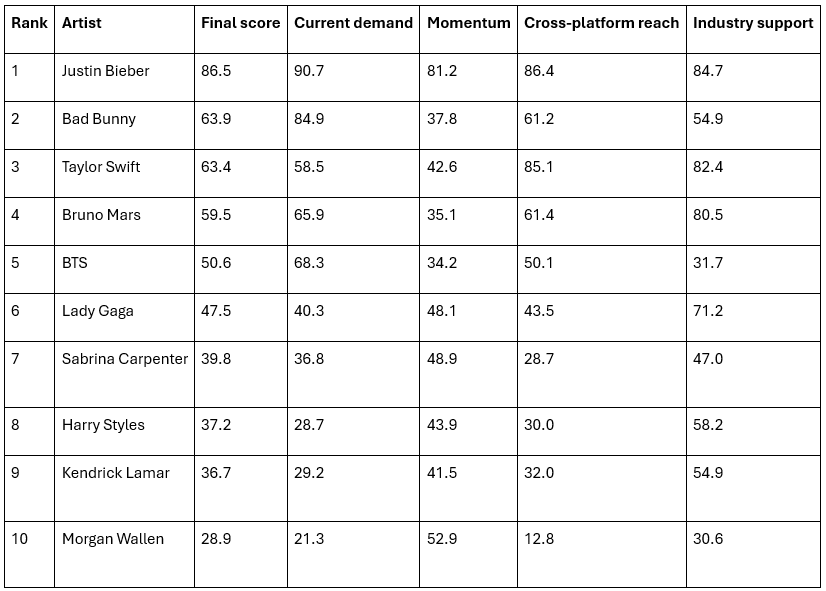
The final score combines four weighted pillars. Current demand accounted for 40% of the total, momentum for 25%, cross-platform reach for 20%, and industry support for 15%.
The ranking shows a clear difference between scale and all-around performance. Bad Bunny finished second largely because of his strength in current demand. His recent Spotify and YouTube activity placed him at the top of the field in consumption, but the broader model also considered whether audience activity was rising or slowing during the analysis window.
Taylor Swift finished third, less than a point behind Bad Bunny. Her strongest areas were reach and industry support, helped by large audience totals, strong playlist positioning, and the top radio score among the nominees. Her lower YouTube demand and weaker recent listener movement kept her behind Bieber and Bad Bunny in the combined ranking.
Bruno Mars ranked fourth. His strongest signal was audience scale, especially on Spotify, where he had the largest current monthly-listener base among the nominees. He also performed strongly in playlisting, but lower momentum kept him outside the top three.
BTS ranked fifth despite having the strongest Top 10 Spotify track total in the model. That distinction matters: track-level strength can be high even when the broader artist profile is weaker across reach, radio, playlisting, or momentum.
Lady Gaga, Sabrina Carpenter, Harry Styles, Kendrick Lamar, and Morgan Wallen filled out the second half of the ranking. Several of those artists had strong individual signals, especially in momentum or industry support, but none matched Bieber’s cross-category consistency.
The main takeaway is not that one artist controlled every platform. The data shows a more mixed field. Bad Bunny had the strongest consumption case. Taylor Swift had the strongest radio case. Bruno Mars had the strongest current Spotify listener case. BTS had the strongest Top 10 Spotify track case. Bieber ranked first because he combined high current activity with the strongest growth and playlist-reach signals in the overall model.
That makes the Artist of the Year field less one-sided than a simple ranking might suggest. Different nominees led different parts of the music economy, from streaming consumption to radio activity to playlist exposure. In a fan-voted award, those differences may play out in ways data alone cannot capture. But as a measurement of recent, cross-platform performance, the model points to Bieber as the strongest all-around candidate in the field.
The analysis used artist-level data exported from Viberate, a music analytics service, for the 10 American Music Awards 2026 Artist of the Year nominees. The exports included metrics related to Spotify, YouTube, Instagram, Spotify playlisting, and radio airplay.
The artists analyzed were Bad Bunny, Bruno Mars, BTS, Harry Styles, Justin Bieber, Kendrick Lamar, Lady Gaga, Morgan Wallen, Sabrina Carpenter, and Taylor Swift.
The available daily data covered Jan. 27-April 28, 2026. The main comparison window was the 30-day period ending April 28, 2026, using March 29 as the baseline date for 30-day change calculations. Short-term momentum compared the last seven days ending April 28 with the prior seven-day period.
The final score used four weighted pillars:
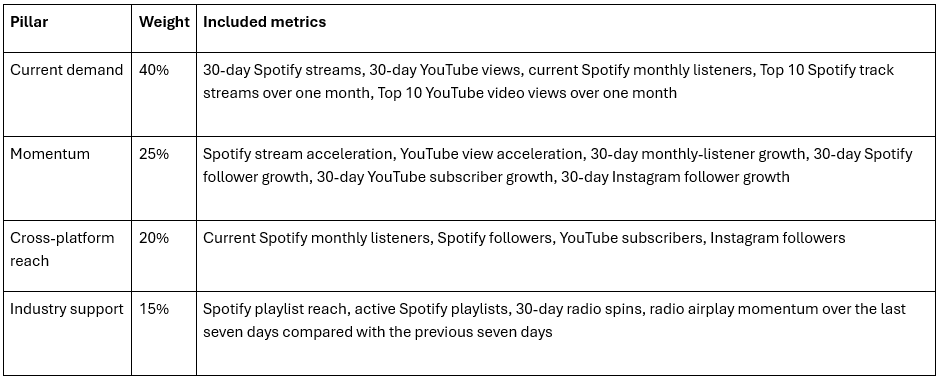
Scale metrics were normalized against the top-performing nominee, with the leader in each metric receiving 100 points. Growth and acceleration metrics were min-max normalized, so the strongest growth result received 100 points and the weakest received 0 points. This approach reduced distortion from artists whose audience counts declined during the period.
All growth metrics were calculated from total values rather than exported daily change fields. TikTok was excluded from the main score because not every nominee had comparable TikTok data. Instagram was used only for followers and follower growth because engagement fields were not consistently available. YouTube official-channel view changes and YouTube like changes were excluded because those fields were not suitable for consistent daily momentum scoring.
Collaborations were included when the nominated artist appeared in the exported artist field. The same rule was applied to all artists for Spotify tracks and YouTube videos.
No tie-breaker was needed because there were no tied final scores.
Source of music data: Viberate.com
-
📌 Viberate - Music Intelligence is the data & AI layer behind music analytics, connecting artist discovery, audiences, playlists, tracks, Spotify, TikTok, YouTube, streaming, and radio airplay.
 Next article
 Previous article
11M+ artists, 100M+ songs, 12M+ playlists, 6K+ festivals and 100K+ labels on one platform, built for industry professionals.