Vasja Veber
Aug 27, 2026

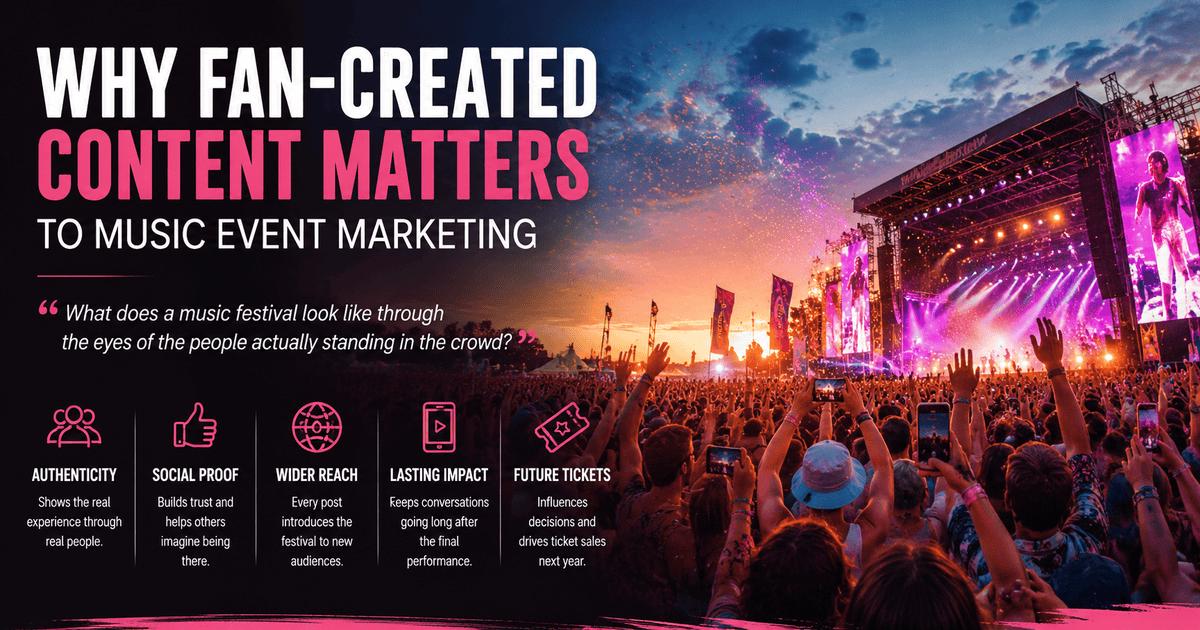

Why Fan-Created Content Matters to Music Event Marketing
“What does a music festival look like through the eyes of the people actually standing in the crowd?”
It rarely looks like the official campaign.
The organiser might publish perfectly framed stage photography, polished artist interviews, and professionally edited highlight films. Fans capture something different. The bass dropping as thousands of people move together. Friends discovering a new artist on a smaller stage. Festival outfits. Campsite moments. Food discoveries. Unexpected performances. The exhausted journey home.
Together, these photographs, videos, Stories, reactions, and posts document the event from hundreds or potentially thousands of individual perspectives.
For music event marketers, that content has become enormously valuable. It extends the festival beyond the venue, provides authentic social proof, keeps conversations moving after the final performance, and can even influence whether somebody buys a ticket the following year.
The opportunity is not to control what fans create. It is to understand why they create it, make sharing easier, and learn from the content that audiences respond to most strongly.
Why Fan-Created Content Has So Much Influence
Official marketing tells people how an event wants to be perceived. Fan-created content shows them how attending can actually feel.
That distinction matters.
Someone considering a festival ticket can already find the lineup, location, ticket information, and promotional video on the official website. What they cannot easily discover from those materials is what it feels like to spend a weekend there.
Fan content fills that gap.
A video filmed from inside a packed crowd provides a completely different perspective from professional stage photography. A group photograph shows the social side of attendance. A spontaneous clip from a smaller stage can communicate the excitement of discovering an artist unexpectedly.
This creates powerful social proof. Potential attendees see people like themselves participating and enjoying the event, making the experience easier to imagine.
The reach can also extend considerably beyond the ticket holders themselves. Every public post introduces the festival to another personal network, including people who may never previously have encountered the event.
Key Takeaway
Fan-created content gives music events authenticity, social proof, and access to audiences beyond those physically attending.
What Types of Fan Content Matter Most?
There is no single format that defines useful fan content.
Different formats capture different parts of the festival experience, which is precisely why collectively they can become so valuable.
Short-form video is particularly important for music events. Fans capture favourite songs, crowd reactions, artist entrances, dancing, stage production, and unexpected moments. These clips naturally suit platforms built around fast-moving video and can communicate the energy of a performance remarkably quickly.
Photography serves a slightly different purpose. Festival fashion, friendship groups, venue installations, food, camping, and scenic images help communicate the wider culture surrounding the music.
Stories and real-time updates provide another perspective. These document the event as it unfolds, from arriving at the site to waiting for a headline artist. They can create a sense of immediacy among people following from elsewhere.
Then there is commentary. Reviews, captions, artist recommendations, recap videos, and personal rankings provide something visual content cannot always offer, context. A fan explaining that an unknown afternoon act became their highlight of the weekend can influence how others discover that artist and perceive the festival.
Key Takeaway
Video, photography, live updates, and commentary each capture different elements of a music event, making a mixture of formats particularly valuable.
How Can Music Events Encourage More Fan-Created Content?
Telling people to post more content is unlikely to produce particularly interesting results.
A better strategy is to create an event people naturally want to document.
Festival design plays an important role here. Distinctive stages, artwork, lighting, installations, viewing areas, signage, and branded environments can all become recognisable visual elements within fan content.
Organisers can also create dedicated opportunities for attendees to produce something different from what they could capture using their phone alone.
Interactive photography installations, creator areas, branded capture stations, and Photo Booth experiences can provide professionally produced content without removing the spontaneity that makes fan participation appealing. Modern event photography software can support these installations by applying event graphics, processing captures, and delivering finished content quickly enough for attendees to share while they are still at the festival.
The practical side matters too. Clear social handles, memorable hashtags, straightforward downloads, and reliable connectivity can remove unnecessary friction from sharing.
The objective should be facilitation rather than control. Give fans interesting environments and useful tools, then allow them to interpret the experience themselves.
Key Takeaway
The strongest fan content comes from creating experiences worth capturing and making the journey from participation to sharing as simple as possible.
Why Fan Content Keeps Working After the Festival Ends
A music festival might last a weekend. Its digital footprint can last considerably longer.
The days immediately following an event often produce another wave of content as attendees upload photo collections, edit videos, post recaps, and discuss their favourite performances.
That period is particularly valuable because the content shifts from documenting what is happening to reflecting on what happened.
For people who did not attend, these posts provide a window into what they missed. That can become influential when tickets for the next edition eventually go on sale.
Fan content can therefore contribute to the next marketing cycle before an official campaign has properly begun.
It also helps maintain a sense of community between events. Festivals are often built around identities that extend beyond individual lineups. Fans follow one another, discuss previous years, share memories, and anticipate future announcements.
The content created during one weekend becomes part of that wider culture.
Key Takeaway
Fan content gives music events a longer marketing lifespan and can influence anticipation and ticket consideration for future editions.
How Can Fan-Created Content Be Measured?
The volume of posts surrounding a festival can be impressive, but raw numbers do not tell the whole story.
Organisers first need to determine what they are trying to achieve.
If awareness is the priority, total reach, impressions, mentions, hashtag activity, and the number of individual creators posting about the event can provide useful indicators.
Engagement adds another layer. Likes provide a simple signal, but comments, shares, saves, and video completion can reveal considerably more about whether content genuinely captured attention.
Content volume can also highlight specific moments that resonated with audiences. If one installation, artist, performance, or activation repeatedly appears in attendee posts, that pattern is worth investigating.
Commercial measurements should be considered where appropriate. Website visits from social platforms, mailing list registrations, tracked ticket links, and increases in searches following major moments can help connect online conversation with wider marketing objectives.
The most useful measurement therefore combines quantity with quality. Ten highly shared videos that introduce the festival to new audiences may ultimately be more valuable than hundreds of posts receiving little engagement.
Key Takeaway
Fan content should be evaluated through reach, engagement quality, participation, and its contribution to wider marketing objectives.
Fan Content Can Reveal What Audiences Actually Value
Fan-created content is not only a promotional asset. It can also function as a form of audience feedback.
What people choose to photograph tells organisers something.
If one piece of festival artwork appears repeatedly across social platforms, it clearly resonated visually. If a sponsor activation generates queues but almost no content, its physical popularity may not be translating into digital engagement.
Music provides similar insights. Unexpected levels of content around a smaller artist can indicate where audience enthusiasm is developing. Food areas, merchandise, campsite activities, and other parts of the festival can all be assessed through the same lens.
This does not mean every programming decision should be determined by social media. Festivals need creative identity and variety.
However, reviewing what attendees voluntarily choose to document provides a perspective that traditional feedback surveys cannot completely replicate. It shows what people considered interesting enough to capture without being asked.
Those insights can inform future site design, content opportunities, partnerships, programming, and marketing campaigns.
Key Takeaway
The content fans voluntarily create provides organisers with valuable clues about which parts of the festival experience resonate most strongly.
Turning Fan Content Into a Long-Term Marketing Asset
The value of fan content should not disappear once the event finishes.
With appropriate permissions, selected user-generated content can contribute to future social campaigns, event recaps, newsletters, website content, and promotional material.
There is an important strategic advantage here. Professional campaign imagery shows the festival at its most polished. Fan-created material shows the festival being experienced.
The two work particularly well together.
Organisers can also identify creators whose content consistently generates meaningful engagement and potentially develop relationships with them for future events.
Most importantly, reviewing fan content creates an opportunity to improve the festival itself. If organisers understand which experiences repeatedly inspire people to create, they can design future editions with stronger opportunities for participation without making the event feel engineered for social media.
Key Takeaway
Fan-created content can support future marketing while helping organisers understand how audiences genuinely experience their event.
Conclusion
Music events have always been built around shared experiences. Social platforms have simply given those experiences somewhere else to travel.
A festival audience is now simultaneously a crowd, a community, and a network of individual content creators. Their videos capture the energy of performances. Their photographs document festival culture. Their reactions provide social proof, and their posts introduce the event to people who may become future ticket holders.
For music event marketers, the lesson is not to replace professional content with fan content. Both serve different purposes.
The bigger opportunity is recognising that some of the most persuasive marketing material will never be created in the marketing office.
It will be created in the crowd.
Source of music data: Viberate.com
-
📌 Viberate - Music Intelligence is the data & AI layer behind music analytics, connecting artist discovery, audiences, playlists, tracks, Spotify, TikTok, YouTube, streaming, and radio airplay.
 Next article
 Previous article
11M+ artists, 100M+ songs, 12M+ playlists, 6K+ festivals and 100K+ labels on one platform, built for industry professionals.