Kristian Gorenc Z
Aug 3, 2026

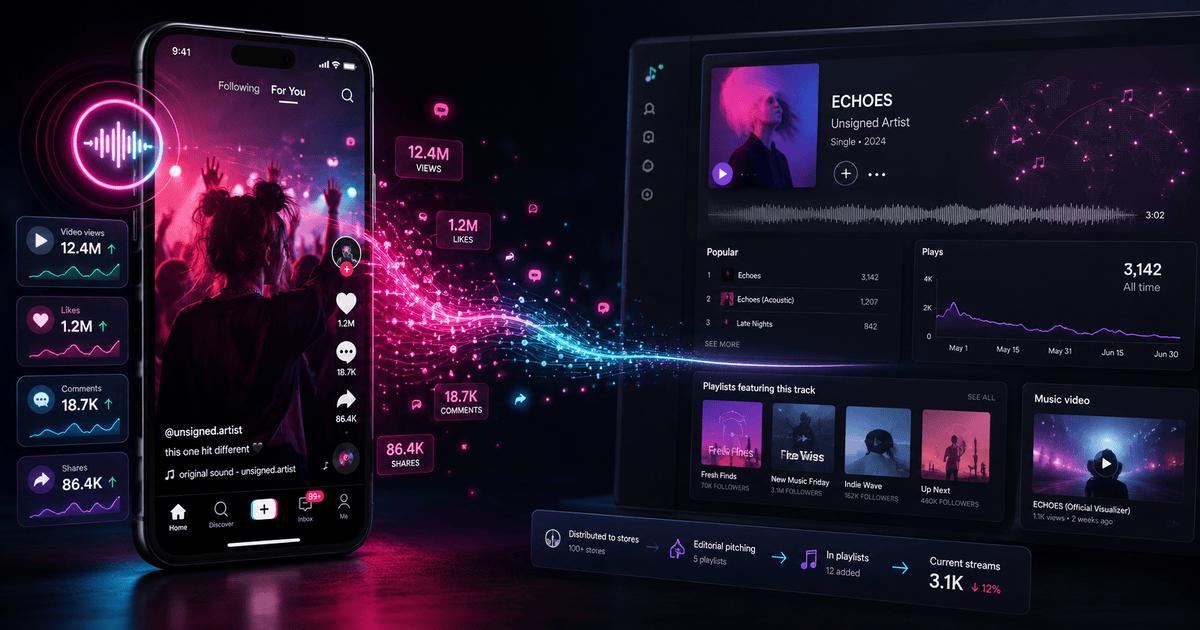

Your Song Went Viral on TikTok. So Why Isn't It Streaming?
Every few weeks, some unsigned artist wakes up to a sound of theirs blowing up on TikTok hundreds of thousands of clips, a comment section full of "what song is this," and a Shazam count climbing by the hour. And every few weeks, some of those same artists watch that moment evaporate, because when the curious listener tapped through to find the full track, there was nowhere for them to land.
That handoff from a 15-second clip to an actual stream is no longer a side detail of music marketing. It's the whole game. TikTok's own Add to Music App feature, which lets users save a sound straight to Spotify or Apple Music with a single tap, has now been used over 3 billion times. Taylor Swift topped the platform's global most-saved artist list in 2025 but the mechanism works exactly the same way for an artist with 4,000 monthly listeners as it does for one with 40 million. The tap is free. The infrastructure behind it isn't.
So the real question isn't "how do I go viral on TikTok." It's: when it happens, are you actually set up to catch the people who show up looking for you? Here's where most independent artists lose that moment and how to close the gaps before you need to.
Gap #1: Your Distribution Isn't Live Before the Sound Pops
This is the single most common and most avoidable failure point. An artist posts a snippet, a sound starts moving, and the full song isn't on streaming yet, or it's stuck in a distributor's review queue. By the time it goes live three days later, the algorithmic momentum has already cooled and a chunk of that "Add to Music App" traffic has nowhere to go.
The fix is boring but non-negotiable: your release needs to be live and searchable before you post the content that could drive people to look for it, not after. If you're testing a snippet or a sound to see what sticks, treat "is my distribution active" as step one, not step three.
(This is exactly the gap Boost Collective's distribution service is built to close getting a release live on Spotify, Apple Music, and everywhere else fast enough that you're never caught flat-footed by your own momentum.)
Gap #2: You Land Them on an Empty Profile
Someone saves your track. Curiosity gets the better of them and they tap through to your artist profile. What do they find? If it's one song, no playlist placements, and a follower count in the double digits, a lot of that curiosity dies right there. Listeners use social proof as a shortcut for "is this worth my time" a thin profile reads as a false alarm, even if the song itself is great.
This is where playlist placement earns its keep beyond the obvious "more streams" pitch. Being on a handful of relevant, real playlists means that when a new listener lands on your page, they see a track sitting in "Fresh Finds" or a genre-specific playlist next to artists they already trust not a song floating alone with three plays. It's the difference between "who is this" and "oh, this must be legit."
(Boost Collective's Spotify playlist promotion is designed specifically to build that kind of surrounding context real listeners, real playlists matched to your genre, no bots inflating a number that doesn't convert.)
Gap #3: You're Not Reinforcing the Save on YouTube
TikTok discovery habits don't stay on TikTok. A meaningful chunk of listeners who save a song will also search for it on YouTube for a lyric video, a lookup of "is there a full song," or just because that's where they consume music day to day. If there's nothing there, or what's there is a shaky phone-recorded snippet, you're leaving a second conversion opportunity on the table.
Having a clean version of the track, even a simple visualizer or lyric video live on YouTube at the same time your sound is circulating gives that cross-platform search traffic somewhere to go, and YouTube's own recommendation system a reason to start surfacing you elsewhere.
(This is the exact gap YouTube promotion is meant to fill, making sure the platform actually starts pushing your video to new viewers instead of it sitting at 40 views next to a viral sound.)
The Uncomfortable Truth About "Going Viral"
Virality is not a strategy. It's a moment. Most artists don't get to choose when it happens, which means the only thing you actually control is whether your infrastructure is ready for it before it does. The artists who convert a TikTok moment into a real streaming career aren't the ones with the catchiest 15 seconds plenty of forgotten sounds prove that's not sufficient on its own. They're the ones whose distribution, playlist presence, and YouTube footprint were already in place so that when someone tapped "add to music app," there was an actual artist career on the other side of that tap, not a placeholder.
If your next release is the kind of song that could catch fire on TikTok, the smartest move isn't waiting to see if it does it's making sure the rest of your presence would survive the moment if it did.
Ready to make sure your next release is set up to catch that traffic? Get your distribution and playlist promotion sorted before you post not after.
Source of music data: Viberate.com
-
📌 Viberate - Music Intelligence is the data & AI layer behind music analytics, connecting artist discovery, audiences, playlists, tracks, Spotify, TikTok, YouTube, streaming, and radio airplay.
 Next article
 Previous article
11M+ artists, 100M+ songs, 12M+ playlists, 6K+ festivals and 100K+ labels on one platform, built for industry professionals.