Kristian Gorenc Z
Sep 30, 2026

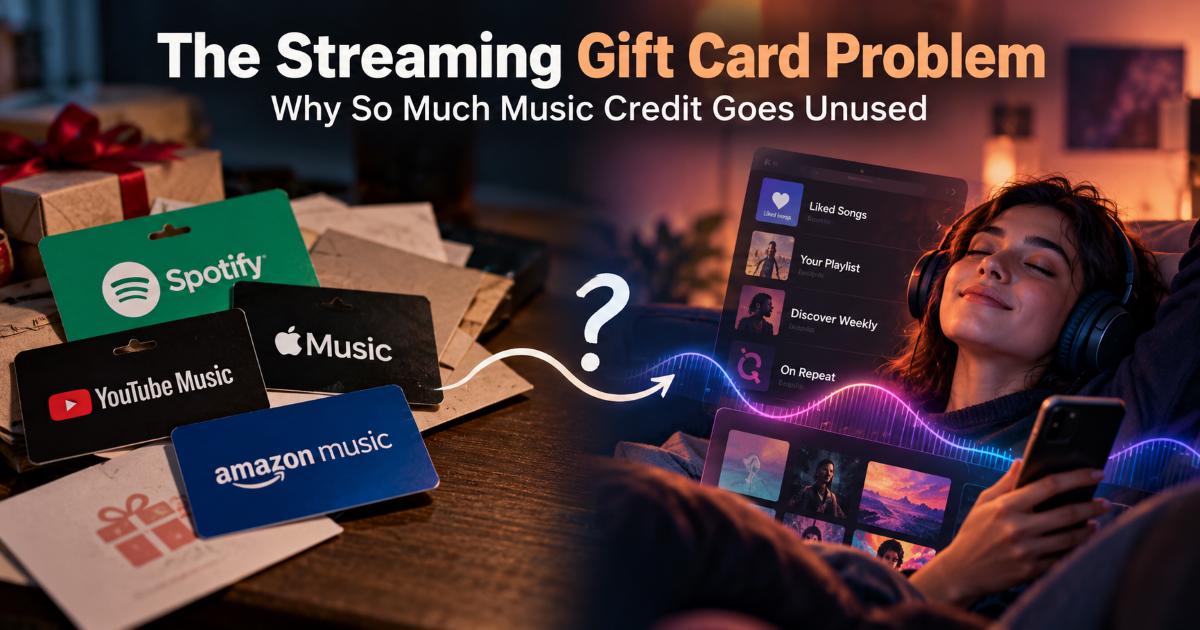

Music has always been one of the easiest things to give. A record, a concert ticket, a mixtape made by hand. In the streaming era the default version of that gift has become a card: credit for a subscription service or an app store, handed over in a birthday card or sent by email. It feels like the natural modern equivalent of buying someone an album.
In practice, a surprising share of that credit never gets used, and the reason has less to do with forgetfulness than with how people actually listen.
Loyalty runs deeper than it looks
Most listeners settle on one streaming service and stay there for years. The switching cost is not the subscription price. It is everything built up inside the account: playlists assembled over a decade, saved albums, liked songs, and a recommendation engine trained on thousands of hours of listening history.
Moving that library to another service is possible, but it is tedious and rarely complete. Playlists transfer imperfectly, and the algorithm on the new platform starts from nothing. Rebuilding that familiarity takes months of listening.
So when someone who has spent years on one platform receives a gift card for a rival service, the card asks them to give up something they value in exchange for a few months of a subscription they do not want. Most people simply do not redeem it.
The wrong-platform gift
The mismatch is common because the giver usually cannot see which service the recipient uses. From the outside, streaming apps look interchangeable. A relative choosing a gift picks the brand they recognize, or the one on the rack at the checkout, and hopes it fits.
Unified app store credit reduces the problem somewhat, since it can often be spent on music, apps or storage within the same ecosystem. But it still ties the value to one company's platform, and it does nothing for a listener who lives on a different ecosystem altogether.
The same pattern shows up beyond streaming. Credit for a particular ticketing platform is only useful if the artist you want to see sells through it. Store credit at an instrument retailer helps a working musician, but means little to a casual listener. Merchandise credit depends entirely on loyalty to a specific artist.
What to do with music credit you will not use
The first step is simply to find it. Digital music cards often arrive by email and disappear into an inbox, so search for gift card, redeem and promo code alongside the names of streaming and ticketing services.
If the card matches a platform you already use, redeem it promptly rather than saving it. Streaming credit usually applies straight to a subscription, and there is no benefit in waiting.
If the card is for a service you will not switch to, there are two sensible options. You can pass it to a friend or family member who already uses that platform, where it will be spent immediately. Or you can convert it. Marketplaces such as FlipGift let people exchange gift cards they cannot use, turning locked credit into value that can go toward the service they actually listen on, or toward anything else.
It is worth checking regional restrictions before either step. Many streaming and app store cards only work in the country where they were issued, which matters if you are passing a card to someone abroad.
Giving music well
For anyone buying a music gift, the lesson is to ask before choosing, or to pick something platform-neutral. A ticket to a specific show, a vinyl record, or credit at a general retailer avoids the problem entirely.
The listener's loyalty to a platform is a sign of how personal music has become. The best music gifts respect that, meeting people where they already listen rather than asking them to move.
Source of music data: Viberate.com
-
📌 Viberate - Music Intelligence is the data & AI layer behind music analytics, connecting artist discovery, audiences, playlists, tracks, Spotify, TikTok, YouTube, streaming, and radio airplay.
 Next article
 Previous article
11M+ artists, 100M+ songs, 12M+ playlists, 6K+ festivals and 100K+ labels on one platform, built for industry professionals.