Vasja Veber
Oct 19, 2026

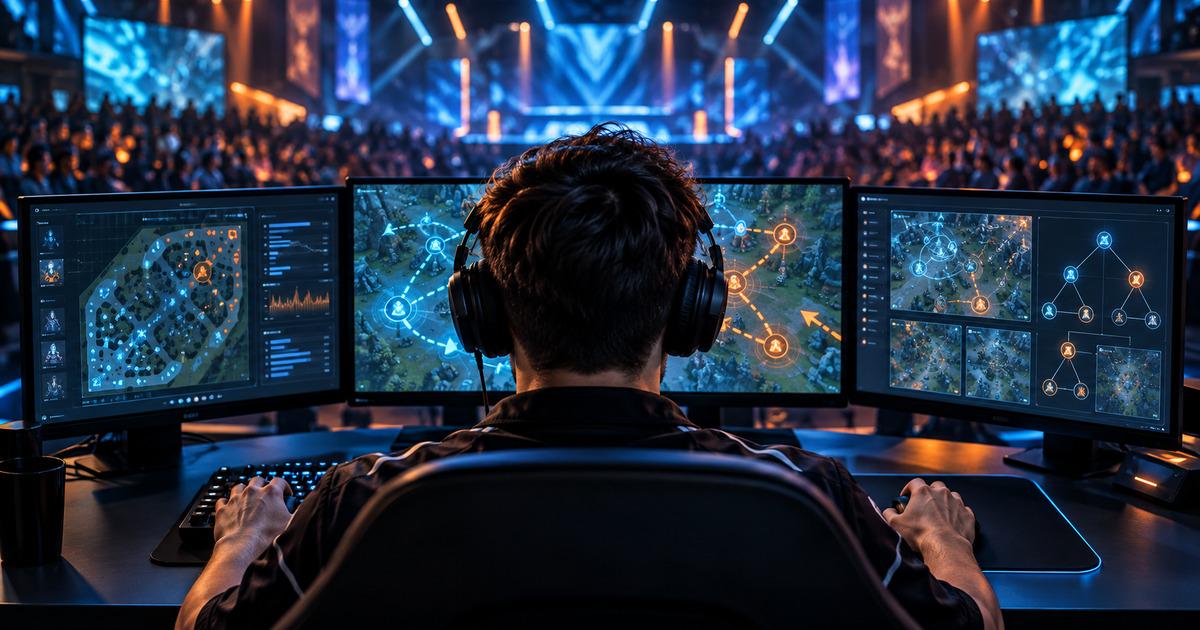

In competitive gaming, a fraction of a second can separate a winning play from a costly mistake. A Counter-Strike 2 player must decide whether to hold an angle or rotate. A Dota 2 captain has to interpret the enemy's movements while coordinating a team. In Valorant, a seemingly minor positioning choice can determine the outcome of an entire round.
Mechanical skill matters, but it is only part of the picture. Behind every accurate shot, successful rotation, and well-timed objective contest lies a constant process of interpreting information and choosing what to do next.
This is the less visible side of esports: the cognitive game unfolding alongside the game on screen.
Understanding that dimension can help players approach improvement more thoughtfully. Rather than treating every defeat as a mechanical failure, competitors can examine how they process information, respond to uncertainty, and make decisions under pressure.
Competitive games produce a continuous stream of signals. Players monitor opponents, teammates, cooldowns, resources, map positions, objectives, and changing win conditions. The challenge is not to notice everything equally. It is to identify what matters most at a particular moment.
A player may have excellent aim but still lose an engagement after overlooking a sound cue or misreading an opponent's likely position. A team may understand its strategy perfectly yet fail because players react to different information and lose coordination.
Three cognitive abilities are particularly relevant to this process:
These abilities interact with practice, game knowledge, communication, and technical execution. None operates in isolation, and no single cognitive score can explain a player's performance.
A common assumption is that better players simply process more information. In practice, effective competition also involves knowing what can safely be ignored.
Consider a CS2 player defending a bombsite. Watching every possible angle with equal intensity may create hesitation. An experienced player instead uses map knowledge, timing, sound, and teammate information to narrow the range of likely threats.
This is not necessarily a matter of raw intelligence. It is also learned expertise: repeated experience helps players recognize familiar situations and make decisions without consciously reconsidering every detail.
The lesson for training is important. Improvement should not focus exclusively on increasing speed. It should also develop the ability to recognize which decisions deserve attention.
One of the most valuable abilities in esports is knowing when to abandon an interpretation.
Suppose a Valorant team repeatedly encounters aggressive pushes from the opposing side. It may reasonably adjust its defensive setup. But if the opponent recognizes that adaptation and changes strategy, continuing to rely on the original assumption can become a weakness.
The same dynamic appears in Dota 2 drafting, Rocket League rotations, and League of Legends objective control. Strategies work within particular conditions, and those conditions can change.
Players can practice a simple reasoning cycle:
The fifth step is especially important. A successful play does not always prove that the reasoning was sound, just as a failed play does not automatically mean the decision was wrong. Reviewing the evidence helps players distinguish good decisions from fortunate outcomes.
Esports training already involves self-assessment through replay analysis, aim trainers, statistics, and performance reviews. Cognitive self-assessment can offer another perspective, provided its limitations are understood.
MyIQ provides an online IQ-testing experience and a way to explore mental abilities through structured exercises. For a competitive player, it may serve as a point of curiosity about reasoning rather than a direct measurement of gaming potential.
An IQ score cannot tell someone how well they will perform in a tournament, communicate during a clutch round, or coordinate with four teammates. Competitive success depends on game-specific expertise, practice, strategy, teamwork, emotional regulation, and many other factors.
The more useful approach is to treat cognitive assessment as one small part of a broader improvement routine.
Players who are interested in how they think can combine self-assessment with practical questions after each session:
These questions connect abstract cognitive curiosity to observable in-game behavior. Unlike a single score, replay reviews provide context about what happened in a specific competitive situation.
Players exploring personal experiences with MyIQ can also read this MyIQ discussion. An individual Reddit post should be treated as a personal account, not as scientific evidence about intelligence or esports performance.
Mental composure is often described as an emotional skill, but it also affects decision-making.
After a frustrating loss, players may start forcing engagements, ignoring team calls, or repeating a strategy that has already failed. Attention shifts from the current situation toward the previous mistake or the desire to recover lost ground.
A practical response is to introduce a brief reset between rounds or matches:
This routine does not eliminate frustration. It helps prevent frustration from controlling the next decision.
A useful esports training plan combines several layers rather than relying on one measure of ability.
The relative importance of each layer depends on the player, game, role, and level of competition. The point is not to turn esports into an intelligence test, but to avoid overlooking the mental processes that connect knowledge with execution.
Esports rewards visible outcomes: eliminations, objectives, scorelines, and tournament victories. Yet those outcomes emerge from hundreds of smaller judgments that often go unnoticed.
Players improve when they learn not only to execute faster, but also to interpret situations more accurately, revise assumptions, and recover from mistakes without carrying them into the next round.
Cognitive self-assessment tools such as MyIQ may encourage curiosity about mental abilities, but meaningful competitive progress still comes from deliberate practice, game-specific feedback, teamwork, and consistent reflection.
The strongest competitor is not necessarily the player who thinks about everything. It is the player who learns what to notice, when to adapt, and how to make the next decision with the information available.
Source of music data: Viberate.com
-
📌 Viberate - Music Intelligence is the data & AI layer behind music analytics, connecting artist discovery, audiences, playlists, tracks, Spotify, TikTok, YouTube, streaming, and radio airplay.
 Next article
 Previous article

11M+ artists, 100M+ songs, 12M+ playlists, 6K+ festivals and 100K+ labels on one platform, built for industry professionals.