Matic Magister
Dec 22, 2025

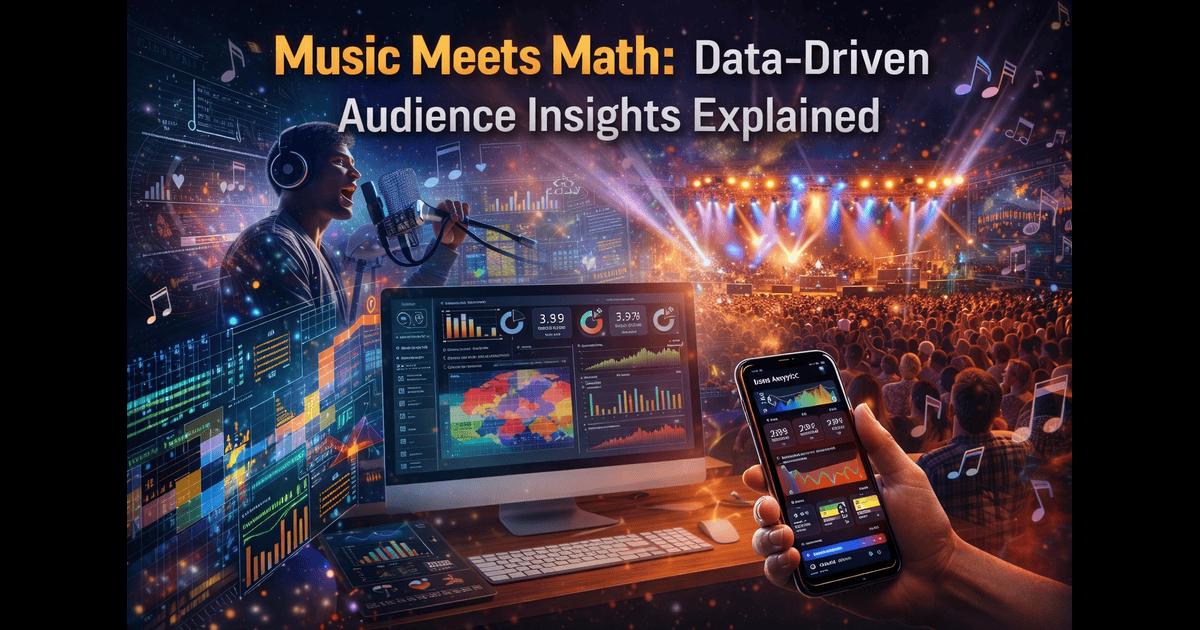

Music has always been about feeling. Rhythm, mood, memory.
But today, music also speaks in numbers.
Behind every stream, skip, replay, and share, there is data. Quiet. Constant. Useful.
This mix of sound and statistics is changing how artists, labels, and even fans understand music. The meeting point has a name many now recognize: music analytics. It is not about replacing creativity. It is about seeing patterns that the ear alone may miss.
This article explores how math helps decode audience behavior, why data trends matter, and how digital music tools turn raw numbers into real-world decisions.
For decades, success in music was judged by album sales, radio spins, and packed concerts. Those signals were slow and limited.
Now the picture is wider.
Streaming platforms collect billions of data points every day. According to industry reports, over 120,000 new tracks are uploaded daily to major platforms. In such volume, intuition alone is not enough.
This is where performance metrics enter the scene.
Common metrics include:
Each metric answers a small question. Together, they tell a story.
At the center of data-driven music is audience insight.
Who listens?
When do they listen?
Do they come back?
For example, data often shows that listeners decide whether to continue a song within the first 10–15 seconds. Some platforms report average skip rates of 20–35% for new releases. Analyzing this data with Google Maths Solver can help understand the best time to stream, what tempos are most popular, and more. This number alone can influence how intros are written or arranged.
Audience insight also reveals habits:
These are not rules. They are signals. Artists choose how to respond.
Some fear that numbers may limit creativity. In practice, the opposite often happens.
Artists use music analytics as a mirror, not a boss.
A songwriter might notice that songs under three minutes perform better for their audience. Another may see that live versions get more saves than studio cuts. These insights do not write the music. They guide focus.
Short sentence.
Long thought.
Both belong.
Producers also rely on data trends when testing demos. If three versions of a track show different engagement levels, math helps pick which one to release first.
Concerts are no longer offline experiences.
Ticket scans, crowd movement, merch sales, and even applause volume can be measured. Some touring acts report that data-led setlist planning increases crowd engagement by 10–20%.
Performance metrics for live shows include:
If a song causes a spike in streams after a concert, it signals strong emotional impact. That song may move higher in future setlists.
Math listens, too.
Raw data is useless without structure. This is where digital music tools play a key role.
Modern platforms offer dashboards that translate numbers into simple visuals. Charts. Heat maps. Timelines.
Common features include:
Some tools claim prediction accuracy rates of 70–80% when estimating early song performance. Not perfect. Still helpful.
Importantly, these tools are now accessible. Independent artists, not just major labels, use them daily.
One day of data means little. Patterns emerge over weeks and months.
Data trends help answer bigger questions:
For example, artists who release music consistently, at least once every six to eight weeks, often see listener retention rates up to 25% higher than those with long gaps.
Again, not a rule. A reference point.
Numbers are powerful. They are also incomplete.
Data cannot measure:
There is also the risk of chasing metrics too closely. When every decision is optimized, music can lose surprise.
Smart creators treat analytics as a compass, not a map. It shows direction. The journey is still human.
Music meets math not as rivals, but as partners.
Data-driven performance insights help artists understand reach, timing, and response. They support smarter releases, better tours, and clearer communication with fans. Through music analytics, audience insight becomes visible, and data trends turn chaos into context.
Yet the heart of music remains untouched.
A song still starts with an idea. A feeling. A moment.
Math helps it travel further.
📌 Viberate Analytics gives you the data behind the music industry. Built for A&R teams, managers, labels, and artists, it helps you find new talent, analyze audience insights, track Spotify playlists and stats, evaluate tracks and songs, and monitor Spotify, YouTube, streaming, and radio airplay analytics — all connected in one system.
 Next article
 Previous article
11M+ artists, 100M+ songs, 19M+ playlists, 6K+ festivals and 100K+ labels on one platform, built for industry professionals.