Vasja Veber
Nov 27, 2026

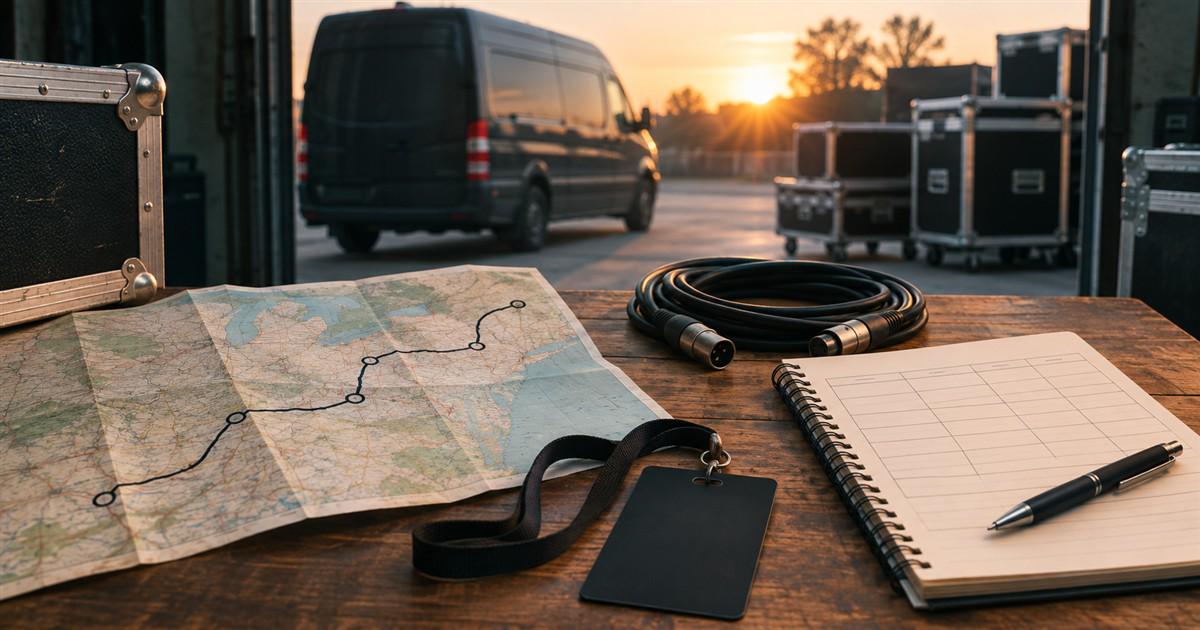

Touring in 2027 means turning scattered fan signals, shifting venue availability, and rising costs into a route that works in the real world. A great tour plan is not only a calendar of shows. It is a system for booking the right rooms, driving sustainable distances, controlling cash flow, promoting each date, and making sure show-night operations run without compromise.
By the end of this guide, you will have a complete framework: tour goals, timeline, market selection, routing rules, venue outreach, budget model, transportation planning, promotion cadence, and compliance checklist. Let us walk through how to plan a music tour with elegant simplicity — and enough operational detail to avoid the mistakes that derail first runs.
Before you touch a calendar or send a single booking email, decide what this tour is actually for. Skip this step and you risk chasing three incompatible goals at once — which is how bands end up with a tour that looks “successful” on paper but still feels like a loss.
Pick one primary goal for this run. Not three. One.
The classic options are:
These goals pull in different directions. A release-support run wants maximum visibility. A market-test run wants cheap risk and fast feedback. A revenue run wants the strongest guarantees, not the most adventurous routing. Trying to optimize for all four at once is how itineraries get bloated and unfocused.
Use this structure:
Writing down the non-goal matters as much as the primary goal. It is the line that stops a tour manager from adding “just one more city” three weeks before departure.
Once the goal is locked, define success with exactly three metrics, each paired with how you will capture the data:
Three metrics only. More than that and you spend more energy measuring the tour than running it.
Booking does not move in one motion. It moves in stages, and mixing those stages is where new acts lose weeks.
Separate the process into four phases:
This is not about email scripts or pitch wording. That comes later. This is about sequencing: knowing what internal artifact needs to exist before you move to the next stage.
Because early action drives everything downstream, use this critical path checklist:
Before committing to a full route, run a tight 3–4 day test. Choose cities using two criteria: close drive times and a mix of one known listener cluster plus one nearby unproven market. This gives you a comparison point instead of simply confirming what you already know.
Use the run to validate three things:
At the end of the run, make one of three calls: greenlight the full route, revise routing based on what underperformed, or postpone the larger tour if the fundamentals did not hold.
To keep that decision from becoming a gut call, use a stop/go rubric.
Go signals:
Stop signals:
Budget specifics belong in the dedicated budget section. This rubric stays focused on go/no-go signal reading, not financial deep-dives.
Timeline mistakes that derail first tours
Picking tour markets is not guesswork dressed up as strategy. It is a three-step workflow.
Step one: collect fan data signals across your owned platforms, streaming dashboards, and social channels.
Step two: translate those signals into candidate cities by identifying listener hubs — metro areas with enough concentrated, verified demand to anchor a date.
Step three: match each hub to a realistic venue size using capacity tiers and confidence levels, not wishful thinking.
The output should be two clear artifacts: a ranked city list ordered by signal strength, and a “target room size + confidence level” tag per city, such as “300-cap, high confidence” or “150-cap, medium confidence.” Everything downstream depends on getting these right before you touch a booking email.
Not all data points deserve equal weight. Build a signal strength ladder before you let any single number talk you into — or out of — a market.
The rule that keeps comparisons honest is simple: normalize before comparing. Use rate-based measures like listeners per 10k population, engagement per follower, or email/SMS density relative to list size instead of raw totals. Raw follower counts routinely mislead market picks because a city’s absolute numbers often reflect population size and platform reach, not actual buying intent.
Before you lock in any forecast, run it through a conversion assumption box. The three variables that swing conversion hardest are:
Adjust your confidence level based on these three, not on vibes.
A hub is a city with enough fan density to pull not only its own population but also listeners from nearby towns within a reasonable drive. Operationally, it is a market that can anchor a date and justify the venue hold on its own.
Pick your hubs first, based on the signal ladder above. Add 1–2 satellite markets only afterward — and only if they cut dead-head drive time between confirmed hubs or line up with a fan pocket you have already validated through behavioral proof.
Do not confuse streaming listener concentration with live-show propensity. They are related, but one is passive and one costs money. A city can look strong in your streaming dashboard and still underperform at the box office.
Cross-check before you commit:
Once a city clears both the signal ladder and the cross-check, drop it into a single spreadsheet row:
City | Why it is on the list (top 2 signals) | Comparable past market | Estimated draw range (low/likely/high) | Best day type | Notes on support opportunities |
|---|---|---|---|---|---|
Room size is a range decision, not a single-number guess. When your forecast carries real uncertainty, lean toward the smaller end of that range. A tighter room protects show energy and keeps your negotiating leverage intact for the next run.
Over-rooming leaves you staring at empty space that kills the room’s energy and spooks promoters for future dates. Under-rooming caps your upside and turns away paying fans at the door, which is its own kind of lost leverage.
For a multi-date or multi-city run, build a capacity tiering plan rather than booking every city at the same size:
Set one sell-through checkpoint partway through your promotional window. At that point, compare ticket pace against your expected curve and choose one of four moves:
That single checkpoint keeps routing decisions grounded in ticket scaling data instead of hope.
A ranked city list and capacity-matched venue tier only become a tour once they turn into a drivable itinerary, a prioritized venue target list, and an outreach pipeline you can track. This is where strategy becomes booking-ready mechanics: drive limits, venue targets, contact logs, and platform hygiene.
Before you plot a single leg, decide on five routing rules and write them into your itinerary doc. These are not vague preferences. They are constraints that protect your show quality and prevent reactive, exhausted decisions once the run begins.
Once those five rules are locked, run a routing sanity check before confirming anything:
If the route crosses a border, add connectivity to the same check. Advancing emails, navigation, and ticket-link updates all run through the band's phones, and roaming charges on a multi-country leg add up fast. Setting up a virtual SIM card for travel before departure keeps everyone online from the first border crossing, without swapping physical SIMs at every stop.
Outreach only works as a system if you treat it as a pipeline, not a pile of emails. Mirror these four stages directly in a spreadsheet or CRM.
Prospect — Log the venue name, capacity, genre fit, and routing position relative to your anchor date. No contact has been made yet.
Inquiry Sent — Record the contact’s role, outreach date, date options offered, routing constraints, and channel used.
Hold/Negotiation — Capture venue hold dates, offer terms under discussion, counteroffers, and the date of your last touch.
Confirmed/Contracted — Log final offer terms, signed contract date, deposit status, advancing contact details, and your next follow-up date for promo or production coordination.
How you pitch depends on leverage. Use this offer-positioning matrix instead of asking for the same deal everywhere:
Before you pitch, determine whether the venue books in-house or through an external promoter. Misdirecting your pitch wastes the inquiry.
Check the venue’s site and recent event history. If the same few acts or a recurring production name appears across unrelated genres, that is usually a promoter’s imprint, not the room’s own booking team.
Use an anchor date tactic to turn your fixed points into leverage. Pick 1–2 anchor dates or cities, ideally the markets with your strongest confidence rating, and build outreach to adjacent cities around a narrow window:
“We are routing through [city] on these two days, and can confirm [adjacent market] on either side.”
This framing signals real momentum instead of a speculative inquiry. It also gives the buyer a concrete, limited window to say yes.
Bandsintown and Songkick are discovery and notification tools, not booking channels. They are excellent for surfacing your tour to existing fans, triggering automated show alerts, and signaling legitimacy through consistent listings. They are not where you find a talent buyer or negotiate a venue hold.
Minimum listing hygiene before you post anywhere:
Run this event listing QA checklist before anything goes live:
Indie on the Move functions as a venue database: a searchable list of rooms with capacity, genre fit, and contact info. That is different from a promoter directory, where you search for individuals or companies who book events across multiple venues.
Databases help you find the room. Promoter directories help you find who controls the calendar when the room does not book in-house.
Build your target list with this workflow:
Once a venue clears that workflow, do contact enrichment before reaching out. Capture whether the venue takes direct email or requires a submission form, the buyer’s actual name, preferred submission method, lead-time expectations, and any radius clauses or market restrictions.
Use this combined routing and booking tracker row for every prospect:
Date | City | Venue | Capacity | Contact | Status (Prospect/Hold/Confirmed) | Deal Type | Drive Time From Previous | Load-in | Curfew | Notes
A tour budget is not a single number you pencil in before leaving. It is a living cash-flow model that has to work when you are three dates deep and when you are three weeks out. Done properly, it shows your burn rate before you ever load the van and helps you spot a cash crunch before it finds you.
Build your forecast in two layers. Lumping everything into one “tour costs” number is how bands underestimate the real shape of a run.
Layer 1 — Tour-wide fixed costs
These are one-time or weekly costs that apply regardless of how many shows you add:
Layer 2 — Per-show variable costs
These scale directly with the number of dates:
When you do not have an exact quote, do not leave the line blank and do not guess one number. Use a conservative low/high range and update it the moment a hold becomes a confirm. A placeholder range keeps your forecast honest. A wild guess hides risk until show week.
This structure also forces you to build a cash timing map, because fixed and variable costs do not hit your account on the same schedule:
That lag between upfront spending and delayed payout is where tours run dry. Map your projected balance night by night and flag the lowest point — your worst-week cash dip — before committing to the route.
Once the forecast and timing map are built, run every show through this break-even point mini-template:
Guarantee + Expected door/net split + Expected merch profit − Variable costs = Margin
If the margin is negative, act before the show, not after settlement. Options include:
Every offer falls into one of four payout structures. Keep the definitions clean, because confusion here is what causes settlement surprises.
Three details determine what the structure actually means:
Even with clean definitions, five friction points routinely change the number you walk away with. Confirm each in writing:
Where the money comes from matters as much as how much you spend. Run each option through a touring cash-flow lens.
Whichever combination you use, build a recoup waterfall before leaving. This is a simple written outline of who gets paid back first and from which income stream.
The conflict point that blindsides many bands is whether merch profit and guarantees recoup from the same shared pool or separate pools. Decide this in writing before the tour starts. Without that clarity, a financing model can become a band conflict in the middle of the run.
Merch is the revenue stream most directly in your control, which makes planning it in variables worth the extra half hour.
Build an inventory and margin block:
Tie this to a nightly merch reconciliation routine. Record start count, end count, and cash/card totals every night before leaving the venue. This is the only way to catch shrinkage, pricing errors, or a miscounted float before they compound across the tour.
Merch rate — the percentage the venue takes off your sales — deserves its own decision before you agree to anything. Evaluate it against what you get in return:
A higher merch rate at a well-trafficked, well-lit table can outperform a lower rate at a table nobody walks past. If lines are slow or time is tight, reduce SKU complexity. Fewer sizes, fewer colorways, and clearer pricing can convert more of the line before sales close.
Getting your music, merch, and bodies to the venue on time is the unglamorous backbone of touring. The bands that look “lucky” on the road are usually the ones that standardized the process before departure.
Your vehicle choice is not only a cost decision. It is a risk decision, and every setup trades one problem for another.
Once you choose a configuration, the decision should produce one line you can paste into your tour doc:
Vehicle type + who drives + nightly parking plan + fuel/toll payment method + daily departure time
If any piece is missing, you do not have a transport plan. You have a vague intention.
Before departure, run a pre-tour vehicle readiness checklist:
The output is a one-page roadside plan, stored offline. A dead phone or dead zone should not strand the whole tour.
Lodging decisions should not be made fresh every night on vibes. Build a rule-based allocation model with three tiers:
Build in one hard burnout constraint: cap the maximum number of consecutive nights without a private room. Cost-cutting is useful, but a band running on zero personal space for too long breaks down faster than a budget does.
Run a lodging risk controls block alongside the model. Address late check-in, unclear cancellation terms, surprise fees, and parking security at the lodging itself.
Booking hygiene checklist:
Use one arrival protocol every night:
Simple, repeatable, and effective.
Advancing a show properly means sending a packet that answers technical questions before you arrive. The minimum advancing packet includes:
Keep two standing versions: one “festival-style” version for shared-stage, fast-changeover situations, and one “club-tight” version for a single-headliner setup. This keeps you from rebuilding documents from scratch per venue.
When a venue offers shared backline, run this compatibility checklist:
Even with backline provided, bring critical personal items: cymbals, pedals, snare, and anything that directly shapes your sound. If venue backline does not match what was promised, document the discrepancy immediately and update your input list.
Use this micro-template when requesting shared backline:
BACKLINE ASK:
1. We can share: [items]
2. We cannot share: [items]
3. We need provided: [items]
4. Load-in/soundcheck constraints: [time windows, access needs]
Not every backup deserves the same bag space. Categorize backups by show-stopper risk.
Run a 5-step show-day failure protocol:
The goal is a 2-minute checklist the band runs every day. Short enough to use. Specific enough to prevent a dead channel mid-set.
Promotion works best as one reusable system: clear timing, clear ownership, and a day-of plan that survives weak cell service. Done well, it protects ticket sales from the boring problems that actually cost money — broken links, mismatched details, and nobody knowing who was supposed to post.
Anchor promotion to the on-sale date, not a vague “weeks before show” countdown. On-sale is the fixed point everything else measures against.
Use this cadence for every date:
Pair that cadence with a promo-to-operations handoff rule: once you are inside the final-week window, stop changing show details. Lock venue name formatting, set times if known, and ticket links across every platform. Late edits create mismatches between your page, the venue’s page, and the ticketing platform.
Outreach moves faster when you segment it into three buckets instead of blasting one generic pitch everywhere.
Build a lean press asset minimum pack:
Keep it in a shareable folder and reuse it market to market. You should not be rewriting a blurb from scratch three hours before a pitch deadline.
The most common promotion failure is not a missing asset. It is everyone assuming someone else posted it.
Fix that with a written responsibility split before the on-sale date:
Deliverable | Owner | Deadline | Format |
|---|---|---|---|
Event link accuracy | You | Before on-sale goes live | Verified URL across all platforms |
Poster/flyer | You, shared to Venue + Support | Announcement window | 1080x1350 feed image |
Short vertical video | Support Act | Mid-campaign window | 30–45s reel |
Email/newsletter mention | Venue | Final-week push | Text block + ticket link |
Pinned post/story | Venue, Support, You | Final-week push | 1080x1920 story |
Day-of reminder | You | Show day | 1080x1920 story |
Make cross-promotion fast with a cross-promo script kit:
Keep a lightweight UTM/tagging hygiene protocol underneath all of it. Use one canonical ticket URL for general use, with optional tracked variants per partner. Name variants consistently — artist-city-partner is enough — so you can see which partner helped ticket scaling.
Show day needs its own run-of-post plan. Do not simply repeat earlier-week content.
Run three posts, each with one call-to-action:
Weak cell service is a real constraint on tour. Pre-schedule at least one post before you lose signal, and keep your press/asset pack downloaded offline.
Before anything goes out, run a day-of conversion checklist:
Run that checklist once, early in the day. It closes the failure points that actually cost tickets.
Think of this as your show-night checklist, not a legal manual. The job is simple: capture what you played, understand where performance money comes from, and confirm that venue licensing and insurance are squared away before doors open.
Handled one night at a time, compliance stops being a separate burden and becomes part of how the tour runs.
Setlist reporting only works if it produces one consistent artifact per date: a saved setlist record.
Build that record the same way every night:
Real sets can be messy, so write down what actually happened in a format that still reports cleanly:
The failure mode to prevent is inconsistent song naming. A song logged as “Midnight Drive” one night and “Midnight (Drive Mix)” the next fragments reporting and makes royalty attribution harder. Adopt one canonical title per song and reuse that exact spelling and punctuation every night.
Keep these two money streams separate:
Royalty capture checklist for artists performing original material:
Originals and covers require different handling. Play an original, and accurate metadata is what gets you paid. Play a cover, and your main job is reporting accuracy and venue compliance. A correctly logged cover does not generate songwriter income for you, but it does help the royalty flow reach the right writer.
Three compliance buckets show up on most tours. Each needs a responsibility check.
Copy/paste these compliance questions before confirming a date:
If the venue says it is not covered or seems unclear on licensing, move in order:
An unclear compliance answer should never be the surprise waiting for you at load-in.
Readiness is not a vibe check. It comes down to two artifacts you should already have: a realistic per-show break-even snapshot and a drivable draft itinerary built around a max drive-time rule.
If either one is missing, do not jump straight to a full route. Run a short validation weekend first and use it to stress-test both documents.
Next step: build your per-show break-even snapshot today, even if some numbers are still rough estimates.
Keep the pipeline to four stages: prospect the room, send the inquiry, negotiate the hold, then confirm.
A date is not actually booked just because it feels locked in conversation. Booking is done only when the date is confirmed in writing and your deal terms plus settlement expectations are captured in the tracker.
Next step: open your tracker and verify every date marked “confirmed” has written confirmation and recorded deal terms attached.
Resist running five scattered documents. Build one shared tour spreadsheet that combines itinerary, contacts, deal terms, and advancing notes into a single source of truth.
Assign ownership clearly: one person updates booking and routing changes, another owns the budget, and someone else owns advancing details. This keeps one change from silently breaking another part of the plan.
Next step: create that shared spreadsheet today and assign an owner to each section before your next booking call.
Two income channels run in parallel: show pay and merch.
Show pay comes through a guarantee, door split, backend deal, or hybrid structure depending on what you negotiated. Merch should always be tracked as its own separate stream because it moves differently.
Show pay is typically settled the night of the performance, while merch cash gets counted on the spot and card-based sales may post days later. What you walk away with depends on your deal type and how carefully the settlement sheet is filled out.
Next step: compare tonight’s settlement sheet against your own ticket and merch counts before you pack up the van.
Source of music data: Viberate.com
-
📌 Viberate - Music Intelligence is the data & AI layer behind music analytics, connecting artist discovery, audiences, playlists, tracks, Spotify, TikTok, YouTube, streaming, and radio airplay.
 Next article
 Previous article

11M+ artists, 100M+ songs, 12M+ playlists, 6K+ festivals and 100K+ labels on one platform, built for industry professionals.