Kristian Gorenc Z
Jul 27, 2026

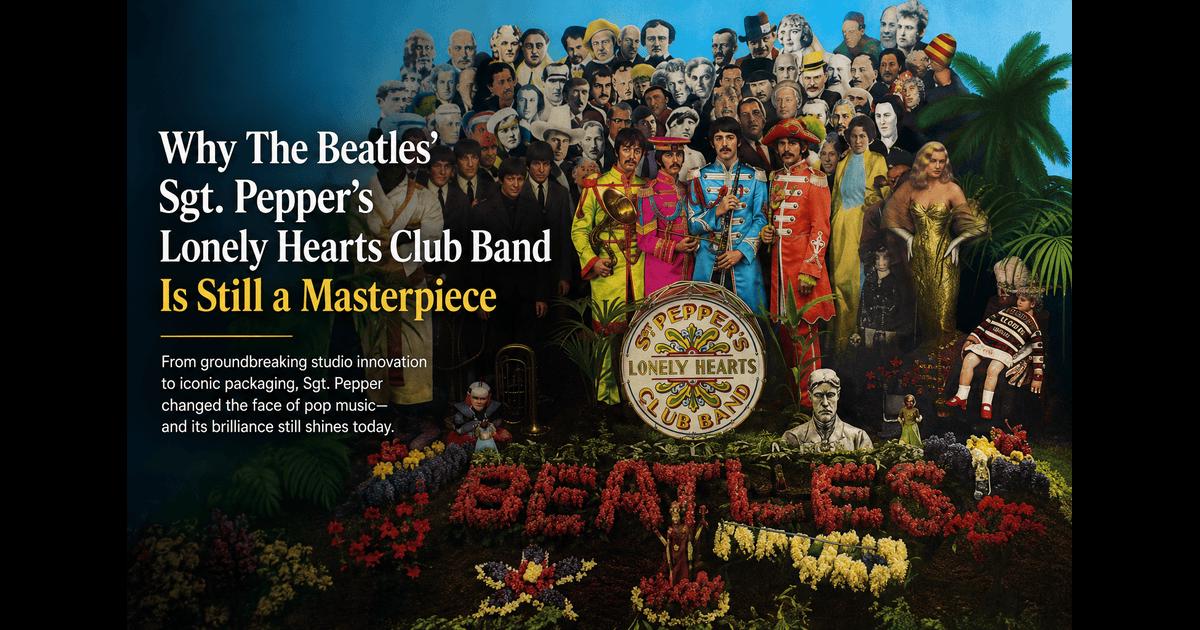

The Beatles’ Sgt. Pepper’s Lonely Hearts Club Band is one of the most famous albums of all time, but since taking the pop world by storm in 1967, its reputation has taken a hit in the decades since. It’s no longer considered the Beatles’ finest hour, and it’s often described with that horrible epithet no great work of art wants to carry: “overrated.” At this point, anyone reviewing Sgt. Pepper from a 21st-century perspective has to either launch an impassioned defense of the album or bury it as a lesser Beatles record.
In fairness, it doesn’t have quite the cultural hold it once did, and there’s a case to be made that it isn’t the best Beatles album. But “overrated”? Absolutely not. It is one of the most important albums in the history of recorded music, preserved in the Library of Congress National Recording Registry precisely because it changed the face of pop music, and wider pop culture with it.
A “New” Beatles
Sgt. Pepper was the first album the Beatles released after deciding to stop playing live, once years of Beatlemania left them exhausted by a punishing touring schedule and unable to hear themselves over thousands of screaming fans. Primarily the brainchild of Paul McCartney, who by then had taken the baton from John Lennon as the group’s de facto leader, the album was designed to be a full-on experience for fans, a substitute of sorts for the live performances that would never happen.
Doing this required a number of innovations.
The First Concept Album?
Despite being neither the first concept album nor an album with a particularly concrete concept, Sgt. Pepper is still mostly remembered as the first conceptual pop album. That isn’t just a function of the Beatles being the Beatles. Aside from the Beach Boys’ Pet Sounds, it was the first of its kind to come from within the rock and roll idiom. Its “concept” was loose; the fictional persona the Beatles adopted really only applies to the opening and closing songs, unlike the fully committed The Who Sell Out from the same year. But it genuinely represented a new kind of album: one that presents the pop record as more than a collection of songs, as a complete work of art.
A Cohesive Journey
The most obvious revolution Sgt. Pepper committed was presenting its songs so they flowed naturally from one to the next, creating a tapestry of music greater than the sum of its parts. And many of those parts were brilliant, the greatest band of all time at its most creative. The songs didn’t need to tell one story or even share a genre; every part of the album enhances and is enhanced by every other part. What Brian Wilson achieved with Pet Sounds was clearly an influence, and yet Pet Sounds coheres as a single work without matching the diversity or stylistic breadth of what the Beatles managed here.
The Studio As Stage
Another thing Sgt. Pepper takes from Pet Sounds is its use of the studio as an instrument. Most pop records until that point were, at best, polished approximations of an artist’s live performance, including the Beatles’ own earlier albums. In the same way Brian Wilson turned his retreat from touring into a reason to do more in the studio, Paul McCartney treated the studio as the Beatles’ new stage. The majestic sprawl of A Day in the Life is the most obvious example, but every song features adventurous arrangements or unexpected instrumentation. The album seldom rocks hard, yet it helped transition good old rock and roll into the more expansive rock music that would dominate the charts for the next two decades.
The Album as the Star
McCartney effectively wanted the album to tour in place of the band, and that meant treating the record as a product, not just a program of music. Sgt. Pepper changed how music would be packaged and presented to the world at least until the age of digital downloads. This was a vinyl record packed to the nines: the first major rock album to print its lyrics on the back cover, a specially designed psychedelic inner sleeve, a sheet of cardboard cut-outs, and a front cover that remains probably the most iconic of all time. The printed inner sleeve alone started a tradition; browse the classic sleeves catalogued at Vinyl Pickup and you can trace how much of vinyl packaging culture leads back to this one release.
Why It Still Rules
Yes, most of this was only revolutionary for its moment, as all revolutions are. But Sgt. Pepper is as vital today as ever. The inventiveness, the unforgettable melodies, the perfect sequencing all still land in 2026, and modern pressings reproduce the original packaging, which keeps it a must-buy for vinyl lovers. It rewards good playback, too: those dense, layered mixes reveal more through a properly set-up deck, and even a modest upgrade from a list of the best turntable cartridges will pull details out of A Day in the Life that earbuds never find. There may be better Beatles albums, but none are quite like it.
Source of music data: Viberate.com
-
📌 Viberate - Music Intelligence is the data & AI layer behind music analytics, connecting artist discovery, audiences, playlists, tracks, Spotify, TikTok, YouTube, streaming, and radio airplay.
 Next article
 Previous article
11M+ artists, 100M+ songs, 12M+ playlists, 6K+ festivals and 100K+ labels on one platform, built for industry professionals.