Kristian Gorenc Z
Sep 9, 2026

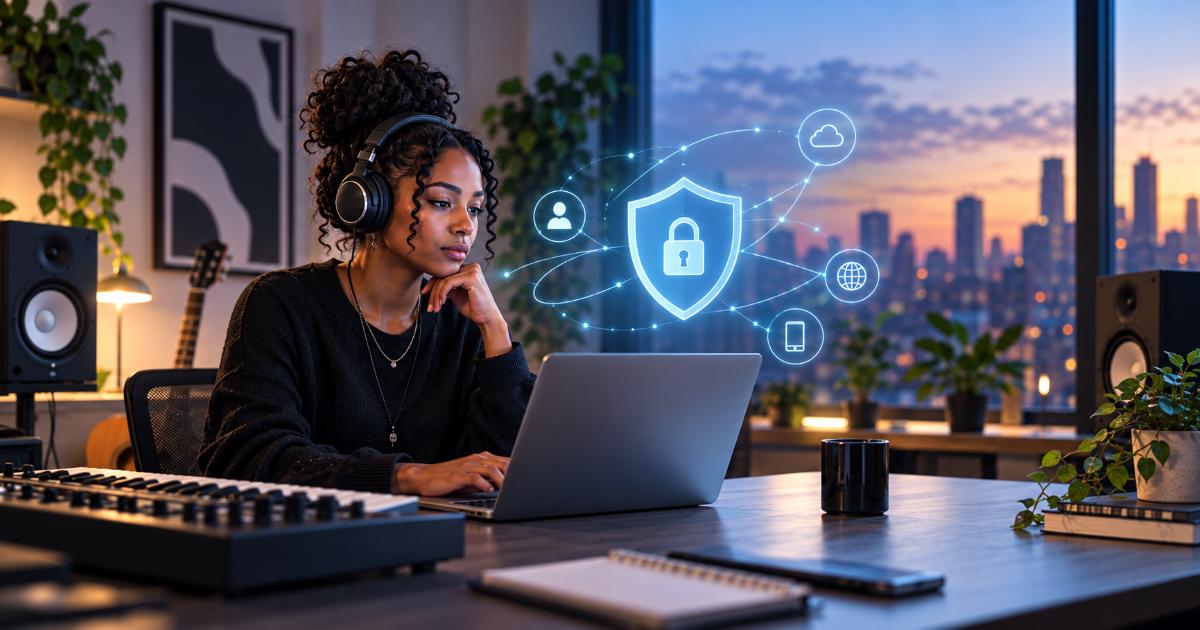

Being an independent artist today means doing much more than writing and recording music.
Artists manage social media accounts, streaming profiles, websites, newsletters, collaborations, merchandise, bookings, and sometimes entire businesses on their own. All of these activities create digital accounts and communication channels that need to be protected.
For a musician who has spent years building a reputation online, losing access to an account or having someone impersonate their brand can be more than an inconvenience. It can affect relationships with fans, business partners, venues, labels, and other people in the industry.
The good news is that improving digital security doesn't have to be complicated. A few practical habits can make a significant difference.
The first step is knowing which accounts are actually important.
An artist might have dozens of online accounts, but some are much more valuable than others. An email account used for business communication, for example, could provide access to password resets for other services. A social media account may represent years of audience growth. A music distribution account could control access to releases and royalties.
Start by making a list of the accounts that would cause the biggest problems if they were compromised.
These should receive the strongest protection first.
It is also worth checking whether old accounts are still active. Artists often create accounts for temporary projects, promotional campaigns, or platforms they no longer use. Closing unnecessary accounts reduces the number of places that need to be monitored.
Password reuse is one of the easiest mistakes to make.
It is understandable. When someone manages social media, streaming platforms, email, websites, banking, and other services, remembering a different password for everything can feel impossible.
That's where a password manager can help.
Instead of trying to remember dozens of passwords, an artist can use one secure password manager to generate and store unique credentials. If one service suffers a breach, the same password won't automatically give an attacker access to everything else.
Long, unique passwords are especially important for the main email account because email is often connected to password recovery for other services.
Two-factor authentication adds another layer of protection beyond a password.
Even if someone obtains a password, they may still be unable to access the account without the second authentication factor.
Artists should enable two-factor authentication wherever it is available, particularly for email, social media, cloud storage, website administration, and financial services.
Authenticator applications or hardware security keys can provide stronger protection than relying only on text messages, although any additional authentication layer is generally better than using a password alone.
The important thing is consistency.
Security works best when it becomes part of the normal workflow rather than something an artist remembers only after a suspicious login notification appears.
Phishing remains one of the simplest ways for attackers to target artists.
A message might appear to come from a streaming platform, record label, festival organizer, manager, journalist, or potential business partner. It may ask the recipient to open a document, click a link, confirm account information, or log into a website.
Some messages are easy to recognize as fake. Others are surprisingly convincing.
Before clicking anything, check the sender's address and consider whether the request makes sense. If someone claims there is an urgent problem with an account, it is often safer to open the official website directly rather than using a link in the email.
The same principle applies to collaboration offers.
An unexpected message promising a major opportunity should be treated carefully, especially when the sender asks for credentials, payment, or sensitive information.
Email is particularly important for artists because it is often used for business communication.
A professional email address can be connected to a website, social profiles, booking inquiries, press communication, sponsorship discussions, and relationships with industry professionals.
There is another issue that many small teams overlook: someone can potentially send messages that appear to come from a legitimate domain if the domain's email authentication is not configured correctly.
This is where technologies such as SPF, DKIM, and DMARC become important.
DMARC helps domain owners specify how receiving email systems should handle messages that fail authentication checks. It can also provide reporting that helps organizations understand how their domain is being used.
For anyone managing a professional domain, a can be a useful starting point for checking whether the domain has a DMARC record and understanding its current configuration.
This isn't only a concern for large corporations. An independent artist with a growing brand can also benefit from knowing whether their domain is properly protected.
An artist's website is often treated as a digital business card, but it can contain much more than basic contact information.
It might include an online store, mailing-list forms, booking information, music players, downloadable files, or links to external platforms.
Keeping the website's software and plugins updated is therefore important.
Artists who use content management systems should regularly install security updates and remove plugins or themes that are no longer needed. Website administrators should also use strong passwords and limit administrative access to people who actually need it.
Regular backups are equally important.
If a website is compromised, having a recent backup can make recovery much easier.
Social media accounts are often among an artist's most valuable digital assets.
A musician may spend years building an audience on Instagram, TikTok, YouTube, or another platform. Losing access to that account can mean losing direct communication with thousands or millions of followers.
Account recovery information should therefore be kept current.
Artists should also be careful about granting access to managers, agencies, freelancers, or collaborators. When someone no longer works on a project, their access should be removed.
Where platforms support different permission levels, it is better to give someone only the access they actually need rather than sharing the main account password.
As an artist becomes more visible, the line between personal and professional life can become increasingly blurred.
Using separate email addresses for personal communication and business activity can make account management easier and reduce the consequences if one account is compromised.
It is also worth thinking carefully about what information is publicly available.
Home addresses, personal phone numbers, travel plans, recovery information, and other private details don't necessarily need to be visible to everyone online.
Being intentional about what gets published can reduce unnecessary risks.
There is no single tool that can make an artist completely secure.
Digital security is more like maintaining an instrument. It requires occasional checks, updates, and adjustments.
Every few months, artists and their teams can review their important accounts, remove old access, update passwords, check authentication settings, review connected applications, and look for suspicious activity.
This doesn't need to take an entire day.
A simple checklist can be enough.
The most important thing is developing the habit of checking before something goes wrong.
Independent artists put enormous amounts of work into building their careers. A song can take months to write and produce. A social audience can take years to develop. A professional reputation can take even longer.
Digital security protects the infrastructure behind all of that work.
Strong passwords, two-factor authentication, careful email habits, secure websites, and properly configured domain authentication may not be as exciting as releasing a new song or announcing a tour, but they are part of running a modern music career.
The goal isn't to become a cybersecurity expert.
It is simply to make it harder for someone else to take control of the digital identity you've worked so hard to build.
Source of music data: Viberate.com
-
📌 Viberate - Music Intelligence is the data & AI layer behind music analytics, connecting artist discovery, audiences, playlists, tracks, Spotify, TikTok, YouTube, streaming, and radio airplay.
 Next article
 Previous article
11M+ artists, 100M+ songs, 12M+ playlists, 6K+ festivals and 100K+ labels on one platform, built for industry professionals.