Kristian Gorenc Z
Sep 12, 2026

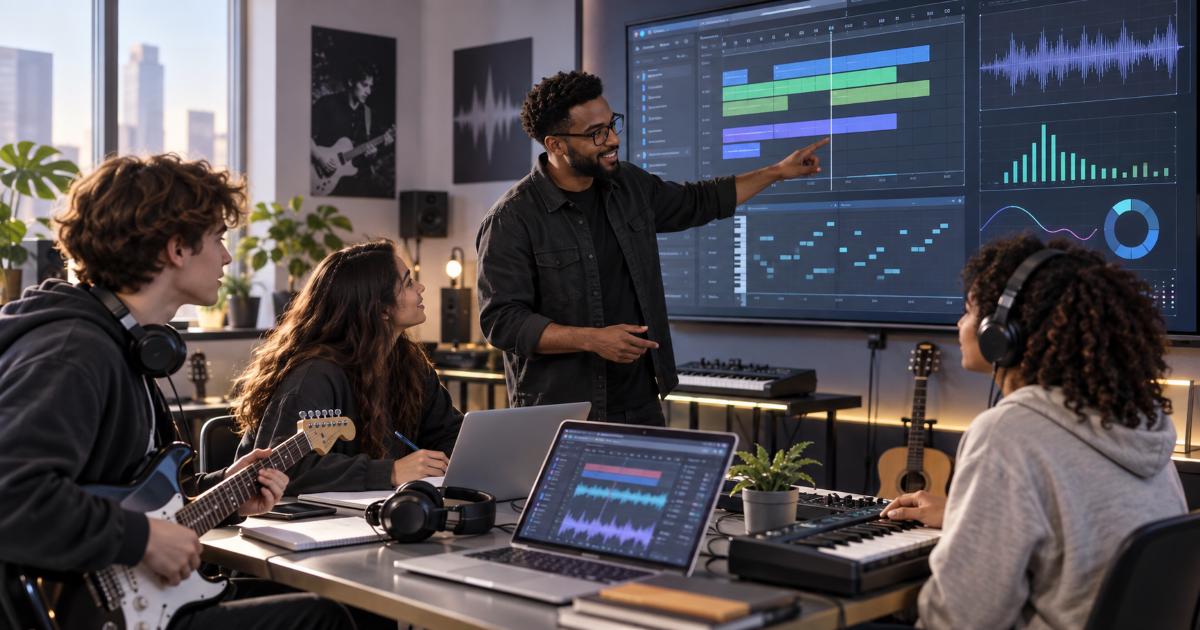

Music education has changed dramatically over the last decade.
A classroom with a teacher, a whiteboard, and a few instruments is still an important part of learning, but today's students are growing up in a much more connected environment. They discover artists through social media, watch tutorials on YouTube, attend virtual events, experiment with music software, and communicate with other musicians online.
For schools and educational institutions, this creates both an opportunity and a challenge.
Students are already surrounded by digital experiences outside the classroom. The question is how educators can bring some of that same energy into their learning environments without allowing technology to become a distraction.
Digital tools, interactive displays, streaming platforms, and music analytics can all play a role. When used thoughtfully, they can make music education more engaging while helping students understand how the modern music industry actually works.
Learning music used to follow a relatively predictable path.
Students learned an instrument, studied music theory, practiced with their teacher, and eventually performed in front of an audience. Those fundamentals remain valuable, but students today have access to an almost unlimited amount of information.
A teenager interested in producing electronic music can find tutorials from professionals around the world. Someone interested in songwriting can study the work of successful artists. Students can explore different genres, discover emerging musicians, and even publish their own recordings without waiting for permission from a traditional gatekeeper.
This access changes the role of the educator.
Instead of simply providing information, teachers can help students understand how to evaluate what they find online, experiment with different tools, and turn information into practical knowledge.
Technology becomes a bridge between what students experience online and what they learn at school.
One of the biggest advantages of digital technology is its ability to make information visual.
Imagine a music class where students aren't simply reading about the history of a genre. They can explore artists, compare their careers, examine how audiences have changed over time, and look at the different ways music reaches listeners.
An interactive display can make those discussions much more engaging.
Instead of a static presentation, teachers can show videos, images, charts, timelines, and other digital material. Students can participate in discussions and respond to what they see rather than simply listening to a lecture.
This approach can be especially useful for subjects that naturally involve a lot of visual information, including music history, artist branding, concert production, and the business side of the music industry.
Educational institutions also have an opportunity to use digital displays outside traditional classrooms.
A hallway screen can highlight upcoming concerts, student performances, music club activities, competitions, or achievements by students and alumni. It can also introduce students to important events happening in the wider music industry.
Schools looking to create more engaging environments can use to share announcements, educational content, event information, and multimedia experiences throughout campus.
The benefit is not simply that the information looks better.
Digital displays can make the school environment feel more connected to what students actually care about. A music department could use a screen to showcase student projects, promote performances, or introduce a weekly artist discovery feature.
Small ideas like these can turn otherwise unused spaces into opportunities for communication and engagement.
Music education doesn't have to stop at performing and composition.
The modern music industry includes streaming platforms, social media, digital marketing, artist management, public relations, playlist promotion, analytics, touring, merchandising, and many other areas.
Students who are interested in building careers in music can benefit from understanding these areas before they enter the industry.
For example, a class could examine why one artist's song becomes popular on a streaming platform while another receives very little attention. Students could discuss the role of playlists, social media content, fan communities, release timing, and promotional campaigns.
Music analytics platforms can make these conversations much more concrete.
Instead of discussing success as something mysterious, students can look at measurable indicators and ask questions about what the data might actually mean.
Of course, numbers don't explain everything.
A song isn't successful simply because it has a high number of streams, and an artist's career cannot be reduced to a chart. But learning to interpret data gives students another perspective on the industry.
Technology should not only be used to show students information.
It should also give them opportunities to create.
A music class could ask students to develop a complete release campaign for an imaginary artist. They might choose a genre, create an artist identity, plan a release schedule, develop social media ideas, and decide which audiences they want to reach.
Another project could involve analyzing an existing artist and presenting a strategy for growing their audience.
These exercises combine creativity with practical skills.
Students learn that music careers require more than talent. They also require communication, organization, research, and an understanding of audiences.
That doesn't mean every student needs to become a music marketer. The same skills can be useful for people interested in management, event production, media, design, technology, or entrepreneurship.
One of the easiest ways to make education more relevant is to connect lessons with real examples.
Instead of teaching digital marketing only through theoretical definitions, educators can examine how actual musicians promote new releases.
Students can ask questions such as:
These questions encourage students to think critically about the digital environment they already use every day.
They also show that the music industry isn't something happening somewhere far away. It is directly connected to the platforms, technologies, and communities students interact with.
There is sometimes a concern that increasing technology in education will reduce the importance of teachers.
In practice, the opposite can be true.
Technology can provide information and interactive experiences, but teachers provide context. They can explain why something matters, challenge assumptions, encourage discussion, and understand when students are struggling.
A digital screen cannot replace the experience of a teacher who knows how to motivate a student who has lost confidence.
The best educational technology therefore tends to work alongside educators rather than attempting to replace them.
The same principle applies to music.
Software can help someone create a beat, analyze a song, or explore an audience, but creativity still comes from people. Technology provides possibilities; students and teachers decide what to do with them.
The music industry will continue to evolve.
New platforms will appear, existing ones will change, and technologies such as artificial intelligence will create new ways to produce and distribute music.
Students entering the industry in the future will need to be comfortable with this constant change.
They will need creativity, but also adaptability.
They may need to understand data without becoming obsessed with numbers, use digital tools without losing their individual voice, and build an audience without treating every interaction as a marketing opportunity.
Education can help prepare them for that balance.
By bringing more interactive technology and real-world music examples into classrooms, schools can help students understand not only how music is created, but also how it travels from an artist to an audience.
The future of music education doesn't have to mean replacing traditional teaching with screens and software.
It can mean adding useful digital experiences to the things that already work.
A student can still learn an instrument from a teacher while using digital tools to explore new artists. A music history lesson can still involve books while also using interactive media. A school concert can still take place on a physical stage while digital displays help promote it and connect students with the wider community.
The goal is balance.
Technology is most valuable when it makes learning more accessible, more engaging, and more connected to the world outside the classroom.
For the next generation of musicians and music professionals, that connection could be particularly important. The industry they enter will be increasingly digital, and understanding that environment will be just as valuable as understanding music itself.
Source of music data: Viberate.com
-
📌 Viberate - Music Intelligence is the data & AI layer behind music analytics, connecting artist discovery, audiences, playlists, tracks, Spotify, TikTok, YouTube, streaming, and radio airplay.
 Next article
 Previous article
11M+ artists, 100M+ songs, 12M+ playlists, 6K+ festivals and 100K+ labels on one platform, built for industry professionals.