Matic Magister
Aug 6, 2026

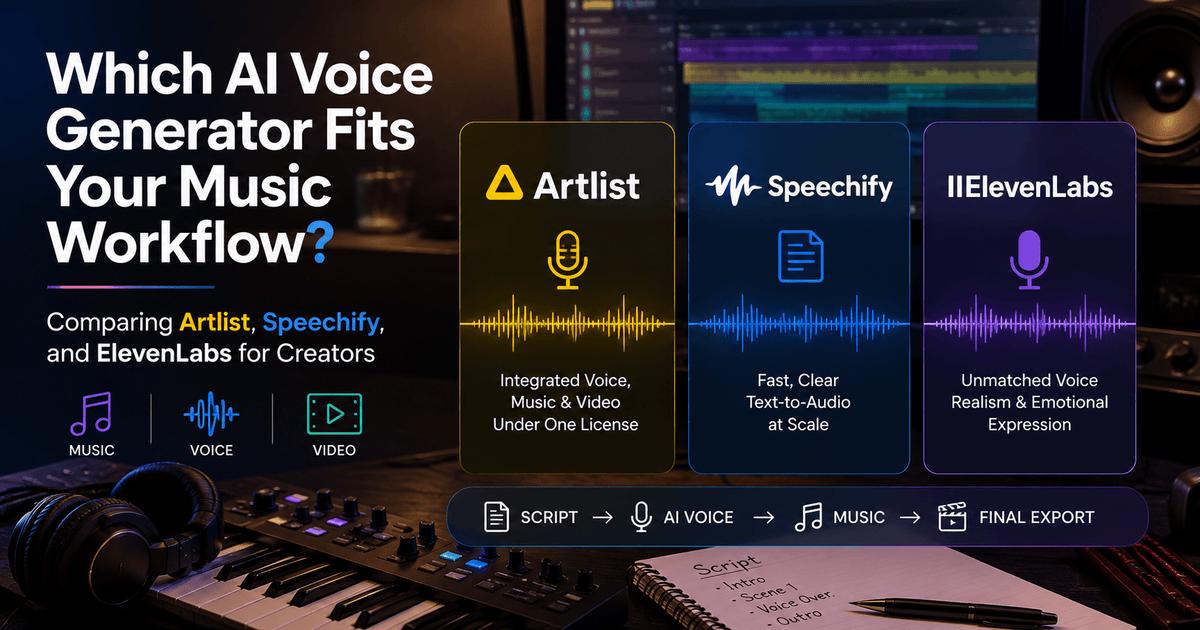

For creators working in and around music, an AI voice generator is rarely a standalone need. It is one thread in a larger fabric that already includes tracks, sound design, and the tools used to assemble a finished piece. That context changes how these tools should be judged, because the best voice generator for a podcaster reading long-form scripts is not necessarily the best one for a creator scoring a video or building content around music. Comparing Artlist, Speechify, and ElevenLabs through the lens of a real music-adjacent workflow reveals that the deciding factor is often not voice quality in isolation but how naturally the tool fits alongside everything else a creator is already using.
Three tools with different centers of gravity
ElevenLabs built its reputation on the sheer realism and expressiveness of its AI voices, becoming a favorite among creators who need lifelike narration, character voices, and emotional nuance. Its strength is the raw quality and control of the voice itself, with fine adjustment over tone and delivery that appeals to audio-first creators. Speechify grew from a different root, focused originally on text-to-speech for reading and accessibility, and evolved into a tool prized for turning long documents and scripts into clear, listenable audio efficiently.
Artlist arrives from the world of music and creative media, treating AI voice generation as one instrument within a full production suite. Because its voice tools sit beside a world-class library of licensed music, sound effects, and video generation tools, the question shifts from how good the voice sounds alone to how well it integrates into a finished, scored piece of content. For a creator whose projects already revolve around music and video, that difference in center of gravity shapes which tool actually saves time rather than adding another disconnected step.
Voice quality versus workflow fit
There is a natural temptation to pick a voice generator purely on how convincing its voices sound, and by that narrow measure ElevenLabs sets a high bar. But voice quality only translates into value if the tool fits the way you actually work. A creator producing music-driven videos does not just need a good voice; they need that voice to sit cleanly against a soundtrack, mixed and balanced within the same environment where the rest of the audio lives.
This is where Artlist's AI voice generator offers a distinct advantage for music-oriented workflows. Because the generated voice lands in the same platform as licensed tracks and sound effects, pairing narration with the right music and balancing the two happens without exporting files between disconnected apps. Speechify excels when the priority is converting large volumes of text into audio quickly, and ElevenLabs excels when the voice itself must carry maximum emotional realism. For creators whose work is fundamentally about combining voice with music, integration frequently outweighs a marginal difference in raw voice fidelity.
The licensing layer creators overlook
When voice and music come together in a published piece, licensing quietly becomes one of the most important considerations, and one of the most commonly ignored. A creator can secure a perfectly licensed AI voice and still run into trouble if the accompanying music is not cleared for their use, or vice versa. Assembling a project from multiple tools means juggling multiple sets of usage terms, each with its own fine print and its own potential for an expensive mistake in a commercial or monetized context.
Artlist's origins in licensed media give it a coherent answer to this problem, extending clear commercial rights across both its generated voices and its extensive music and sound libraries. For a creator building monetized content, having voice and music covered under a unified, clear license removes a real source of risk. ElevenLabs and Speechify each have their own commercial licensing structures for their generated audio, which are worth understanding fully, though a creator using them still needs to source and clear their music separately. The consistent advice is to know exactly what rights you hold across every element of a project before it goes live.
Where each tool earns its place
The strengths of these three platforms map cleanly onto different kinds of creators. ElevenLabs is the natural choice when the voice is the star, for audiobook narration, character work, or any project where emotional realism and fine vocal control are the top priority. Its depth in pure voice generation is difficult to match, and audio-first creators will feel that advantage immediately.
Speechify is the efficient pick for creators and professionals who need to convert large amounts of text into clear, usable audio at speed, where throughput and clarity matter more than expressive nuance. Artlist earns its place with creators whose work lives at the intersection of voice, music, and video, offering an integrated environment where all three come together under clear licensing. The right choice depends entirely on whether your project centers on the voice alone, on processing text efficiently, or on weaving voice into a larger, music-driven creative whole.
Choosing for the whole project, not just the voice
The most common mistake creators make is evaluating a voice generator in isolation, judging it solely on a sample clip without considering everything else the finished project requires. A voice that sounds perfect in a demo can still create friction if getting it into your actual workflow means exporting, importing, and reconciling licenses across three separate tools. The smarter approach is to map out the entire project, from script to voice to music to final export, and choose the tool that minimizes friction across that whole path.
For a creator working with music, that often means valuing integration and licensing clarity as highly as voice quality itself. If your projects are voice-only, ElevenLabs or Speechify may serve perfectly. But if voice is one element in a music-and-video production, an all-in-one platform like Artlist can turn a fragmented, multi-tool process into a single coherent workflow. Decide based on the shape of your complete project rather than the appeal of any single feature, and the right fit becomes clear.
The best voice is the one that fits
As AI voice technology advances, the gap in raw voice quality between the leading tools continues to narrow, and every serious platform now produces genuinely convincing output. That makes the surrounding factors, integration, licensing, and workflow fit, the ones that increasingly determine real value for creators. For anyone building content around music and video, those factors point toward tools that live in the same environment as the rest of their creative assets.
The practical question is not simply which voice sounds best, but which tool helps you finish complete, publishable, properly licensed projects with the least friction. ElevenLabs offers unmatched voice realism, Speechify offers efficient text-to-audio, and Artlist offers integrated voice, music, and video under clear commercial terms. Match the tool to your whole workflow rather than a single voice sample, and you will choose the one that genuinely serves your music-driven creative work.
Source of music data: Viberate.com
-
📌 Viberate - Music Intelligence is the data & AI layer behind music analytics, connecting artist discovery, audiences, playlists, tracks, Spotify, TikTok, YouTube, streaming, and radio airplay.
 Next article
 Previous article
11M+ artists, 100M+ songs, 12M+ playlists, 6K+ festivals and 100K+ labels on one platform, built for industry professionals.