Kristian Gorenc Z
Sep 4, 2026



The MTV Video Music Awards are usually decided by fans, but what if the numbers had the final say? Instead of relying on votes, we looked at the streaming, audience, social, radio, and playlist data behind this year's nominees to see which artists and songs are performing strongest.
The 2026 MTV Video Music Awards will take place Sept. 27 in Los Angeles, with fans voting for winners across categories including Artist of the Year, Song of the Year, and Best New Artist. Voting is open now, with fans able to cast up to 10 votes per category each day.
Viberate, a music analytics platform, analyzed the nominees in those three categories to see who would win if music performance data determined the outcome. The analysis used streaming, audience, social, radio, and playlist data available through Aug. 30, 2026.
Each category used a separate 0-to-100 score.
Artist of the Year combined 12-month Spotify streams, YouTube views, and radio airplay with current audience size and 30-day audience growth.
Song of the Year measured the nominated recording rather than the artist behind it. The score combined 12-month Spotify streams, YouTube views, and airplay with recent monthly performance and current Spotify playlist exposure.
Best New Artist used a current-footprint model because comparable historical data was unavailable across the full nominee field. Current Spotify, YouTube, TikTok, and Instagram audience accounted for 60% of the score. Spotify playlist reach and active playlist presence made up the remaining 40%, using an average from Aug. 27 through Aug. 30.

Taylor Swift leads Viberate's Artist of the Year ranking with a score of 77.7, followed by Bruno Mars at 68.5 and Ariana Grande at 66.2.
Swift's advantage came from the 12-month performance portion of the model. She generated about 19.4 billion Spotify streams, 3.6 billion YouTube views, and 6.4 million radio spins during the period analyzed.
Grande had much stronger recent audience growth. Her Spotify monthly listeners increased by roughly 6.1 million during the latest 30-day period, while her TikTok following grew by about 1.8 million.
The result shows the difference between sustained performance and short-term momentum. Swift did not lead every recent-growth measure, but her year-long streaming, YouTube, and radio totals gave her a much larger performance base. Mars landed between those two profiles, pairing strong annual consumption with more positive recent audience movement than Swift.
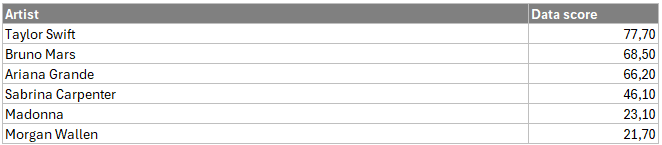
Viberate's analysis therefore puts Taylor Swift first for Artist of the Year.
The Song of the Year ranking is closer, though “Golden” by HUNTR/X: EJAE, Audrey Nuna, and REI AMI still finishes first. The track scored 84.5, ahead of Olivia Dean's “Man I Need” at 79.9 and Ella Langley's “Choosin' Texas” at 79.6. All three are among the seven official Song of the Year nominees.
“Golden” generated about 1.46 billion Spotify streams, 1.57 billion YouTube views, and 1.1 million radio spins across the 12-month analytical window.
The other leading tracks reached similar final scores in different ways. “Man I Need” had the strongest Spotify discovery score, including playlist reach of nearly 200 million. “Choosin' Texas” led the recent-momentum portion of the model.
That contrast is important to the ranking. “Golden” did not need to lead every subcategory because its consumption performance was strong across several channels. “Man I Need” benefited more from current playlist exposure, while “Choosin' Texas” gained ground through recent performance.
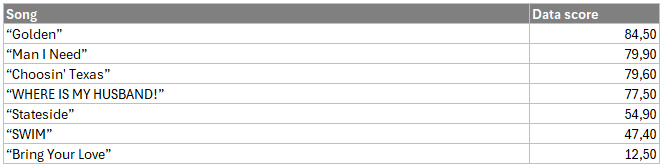
Based on Viberate's analysis, “Golden” would take Song of the Year under the data-only model.
Best New Artist produced the closest result.
CORTIS scored 76.85, only 0.28 points ahead of Malcolm Todd at 76.57. Sienna Spiro placed third with 73.74.
CORTIS had the strongest cross-platform audience footprint among the nominees. As of Aug. 30, the group had approximately 5.4 million Spotify followers, 6.7 million YouTube subscribers, 16.9 million TikTok followers, and 15.7 million Instagram followers.
Malcolm Todd led several Spotify measures. He had about 39.5 million monthly listeners, the highest total in the nominee field, while his average Spotify playlist reach during the final four-day measurement window was roughly 175.5 million.
The narrow result shows how differently the two artists are performing. CORTIS has the larger fan footprint across social and video platforms, while Todd has the stronger Spotify listening and playlist profile. Because the model gives 60% of the score to current audience and 40% to discovery, CORTIS finishes ahead by a fraction.
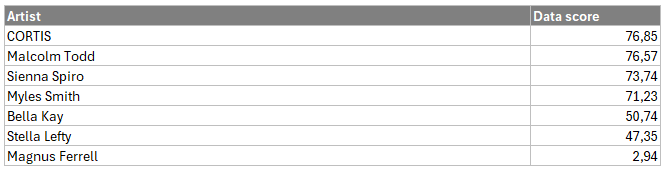
Viberate's data gives CORTIS a narrow Best New Artist lead, though the result is less decisive than the other two category predictions.
Across the three categories, the strongest candidates reached the top in different ways. Swift's result rests on sustained year-long scale, “Golden” leads through broad song consumption, and CORTIS wins a much closer contest built around current audience and discovery.
Under Viberate's models, Taylor Swift leads Artist of the Year, “Golden” leads Song of the Year, and CORTIS finishes just ahead of Malcolm Todd for Best New Artist.
The official VMAs will still be decided by fans rather than streaming or audience metrics. Voting remains open ahead of the Sept. 27 ceremony, which will air on CBS and MTV and stream on Paramount+.
Source of music data: Viberate.com
-
📌 Viberate - Music Intelligence is the data & AI layer behind music analytics, connecting artist discovery, audiences, playlists, tracks, Spotify, TikTok, YouTube, streaming, and radio airplay.
 Next article
 Previous article
11M+ artists, 100M+ songs, 12M+ playlists, 6K+ festivals and 100K+ labels on one platform, built for industry professionals.