Kristian Gorenc Z
Sep 10, 2026

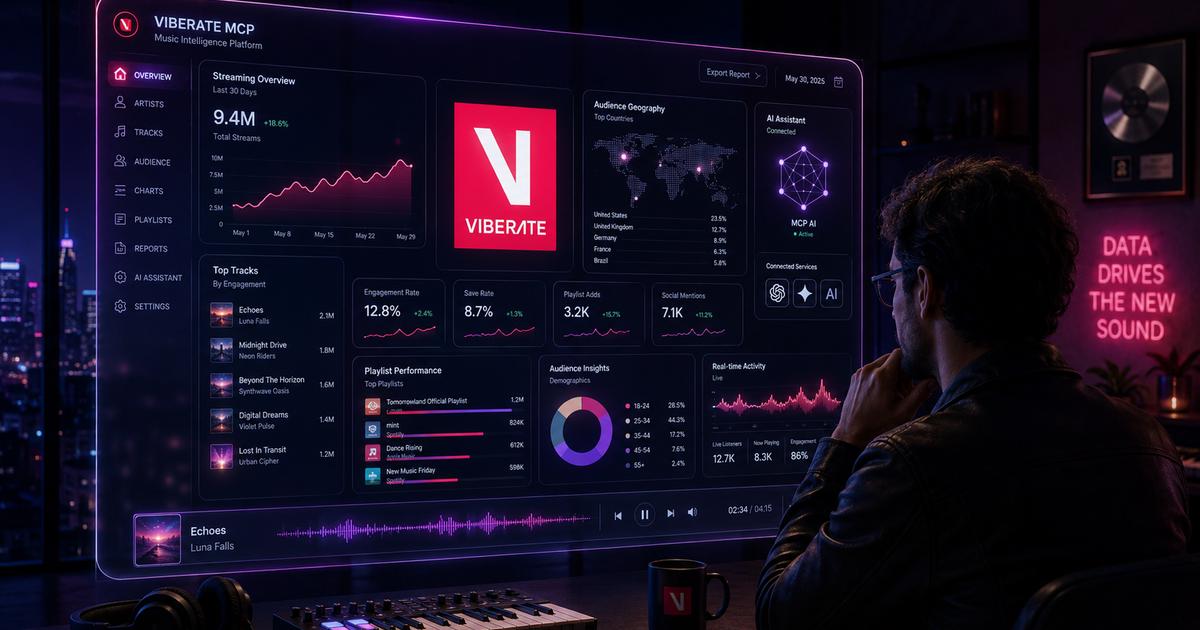

AI assistants are becoming useful for professional work, but they still need access to reliable data. A general AI tool can summarize, explain, draft, and organize information, but it cannot reliably answer current business questions if it is not connected to the right source.
That is why many music professionals are starting to ask: technology, and how can it help with music data?
An MCP server connects an AI assistant to an external tool, product, or database through the Model Context Protocol. It gives compatible AI services a structured way to request information and use that information in their responses. Instead of answering only from general AI knowledge, the assistant can work with connected data.
For the music industry, this is important. Artist momentum, playlist movement, audience location, social signals, track performance, label activity, and live event context can all change quickly. If an AI assistant cannot access structured music data, its answers may be too general for serious research.
To answer the question directly, what is mcp server access? It is a way for an AI assistant to communicate with a connected data source.
MCP stands for Model Context Protocol. The protocol creates a standard connection between AI tools and external systems. This means compatible AI assistants can request information from connected services instead of depending only on the model’s built-in knowledge.
In practice, the user asks a question inside an AI assistant. The assistant checks what connected data or tools are available. If the task requires external information, it can request the right context through the MCP server and use that context to shape the answer.
This matters because AI can sound confident even when it is working without current data. In professional music decisions, that is not good enough. A team evaluating artists, campaigns, markets, or audience fit needs answers based on real signals, not broad assumptions.
Music research rarely depends on one metric. A useful answer often combines several signals.
A manager may want to know whether an artist is gaining momentum compared to similar acts. That question can involve Spotify followers, monthly listeners, playlist reach, YouTube activity, audience cities, and recent growth. An A&R team may want to find rising artists in a specific genre and region. A brand team may want to understand whether an artist’s audience matches a target market.
These questions are easier to ask in natural language than to rebuild manually every time in a dashboard or spreadsheet.

With Viberate’s MCP server, users can connect compatible AI assistants such as Claude, ChatGPT, Gemini, Grok, and other AI services to Viberate music data. They can then ask questions about artists, tracks, playlists, audiences, labels, charts, events, and markets directly inside the AI tool they use.
The benefit is not that the AI replaces expert judgment. It gives users a faster way to reach a structured starting point.
Viberate’s music analytics data covers many parts of the music ecosystem, including artists, tracks, playlists, audiences, labels, charts, events, and markets. The MCP server adds another way to work with that data.
Users can still use the Viberate platform when they want visual dashboards, saved views, and repeatable workflows. Technical teams can still use the API when they need direct integration into internal systems. The MCP workflow adds a conversational option for users who want to ask music data questions inside an AI assistant.
The free version gives users basic access, including artist search, essential artist information, headline artist metrics, and limited chart access. This allows users to test the workflow before using deeper research features.
The paid version supports more advanced music industry work. It includes richer artist analytics, historical views, audience and geographic insights, track and playlist data, label information, live event data, comparisons, and other advanced workflows.
This structure is practical because different users need different levels of access. Some may only want to test a few basic artist questions. Others may need the connector for A&R research, artist management, campaign planning, brand evaluation, market checks, reporting, or internal analysis.
A&R teams can use this workflow to find artists based on more specific criteria. Instead of searching only by popularity, they can ask for artists in selected genres and markets with recent growth, playlist momentum, or audience activity.
Artist managers can use it for benchmarking. A manager could ask how one artist compares with three similar artists across streaming growth, playlist reach, YouTube views, and top audience cities. This can help with team updates, campaign reviews, and planning.
Brands and sync teams can use it to review audience fit. Before a partnership, they may need to understand top countries, top cities, age and gender breakdowns, social signals, and recent growth.
Developers and data teams can use the workflow to test music data questions before building a deeper API integration or internal report. The MCP server does not replace the API for technical access, but it can make early exploration faster.
So, what is mcp server technology for music data? It is a connection layer that lets AI assistants work with structured music analytics.
The value is practical. Music teams can start with a business question and use the AI assistant as a working interface. They can reduce manual research, move faster from question to answer, and use music data in a more flexible way.
The user still needs to review the answer and apply professional judgment. But the workflow can shorten the path between curiosity and insight.
For music professionals, this is the real opportunity. AI is not only useful for writing and summarizing. When connected to reliable data, it can help teams research artists, compare markets, check audience fit, and prepare structured answers for real decisions.
Source of music data: Viberate.com
-
📌 Viberate - Music Intelligence is the data & AI layer behind music analytics, connecting artist discovery, audiences, playlists, tracks, Spotify, TikTok, YouTube, streaming, and radio airplay.
 Next article
 Previous article
11M+ artists, 100M+ songs, 12M+ playlists, 6K+ festivals and 100K+ labels on one platform, built for industry professionals.