Miha Prebil
Aug 12, 2026

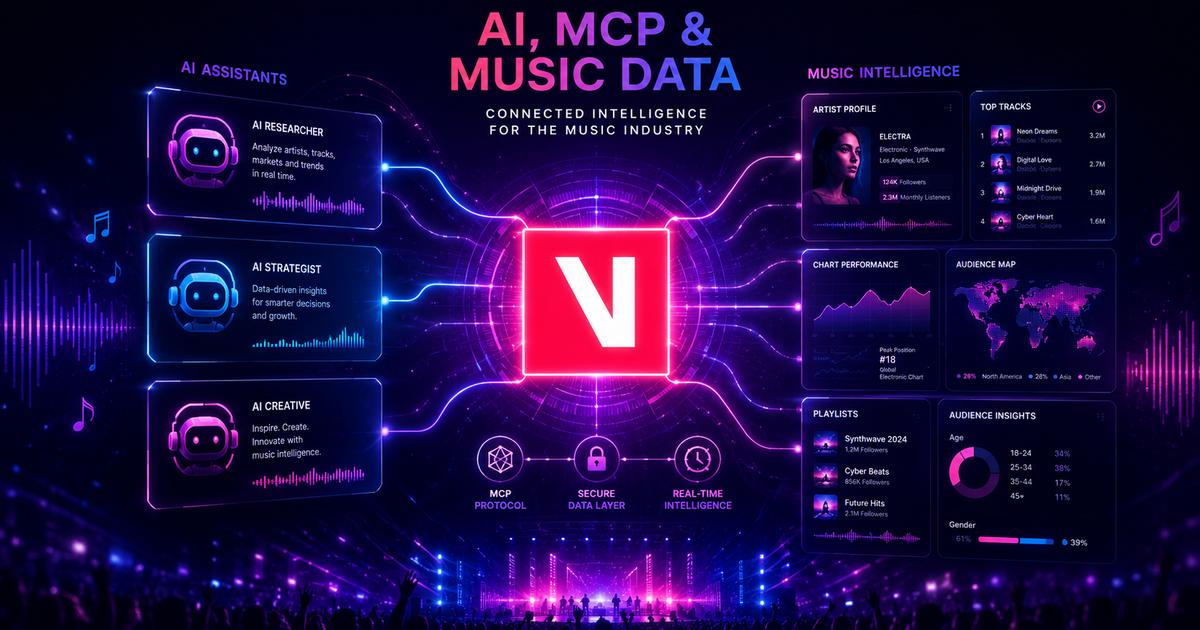

AI assistants are becoming more useful in professional work, but their value depends on the information they can access. A general AI tool can explain ideas, summarize documents, help structure reports, and support planning. But if it is not connected to the right data source, it cannot reliably answer current business questions.
That is why more professionals are asking: and why does it matter?
MCP stands for Model Context Protocol. In simple terms, it is a connection layer that allows AI assistants to interact with external tools, services, and databases. Instead of relying only on what the AI model already knows, the assistant can request relevant information from a connected source and use it in the response.
For music teams, this is important because music industry decisions depend on current data. Artist growth, audience geography, playlist activity, track performance, social signals, labels, events, and market context can change quickly. If an AI assistant cannot access structured music data, its answers may be too general for professional use.
To answer the question directly, what is mcp in ai? It is a way for AI assistants to work with external context.
A normal AI assistant can help with reasoning and language. It can organize information, compare options, and explain concepts. But it does not automatically have access to every live or private data source. MCP gives compatible AI systems a standard way to connect with outside services.
That means the user can ask a question inside the AI assistant, and the assistant can request the data needed to answer it. The result is a workflow where the AI does not only generate text. It can also work with structured information from connected tools.
In Viberate’s case, the MCP server connects compatible AI assistants such as Claude, ChatGPT, Gemini, Grok, and other AI services with Viberate music data. Users can then ask questions about artists, tracks, playlists, audiences, labels, charts, events, and music markets directly inside their preferred AI assistant.
Music research is rarely based on one number. Most useful questions combine several signals.
A manager may want to compare an artist with similar acts across streaming growth, playlist reach, YouTube activity, and top audience cities. An A&R team may want to find rising artists in a specific country and genre. A brand team may want to evaluate whether an artist’s audience fits a campaign. A label may want to review track performance and market movement before making a decision.
These questions are easier to ask in natural language than to rebuild manually every time inside a dashboard or spreadsheet.
That is where MCP can change the workflow. Instead of first finding the right dashboard section, applying filters, exporting numbers, and then writing a summary, the user can begin with the question. The AI assistant can use connected data to help return a structured answer.
This does not remove the need for human judgment. Music professionals still need to review the response, understand the market, and decide what matters. But the path from question to useful starting point can become faster.

Viberate’s music analytics data covers artists, tracks, playlists, audiences, labels, charts, events, and markets. The Viberate MCP server adds another way to access that data.
Users can still use the Viberate platform when they want visual analysis, saved views, and repeatable workflows. Technical teams can still use the API when they need direct integration. The MCP workflow creates a third path: asking music data questions inside an AI assistant.
The free version gives users basic access, including artist search, essential artist information, headline artist metrics, and limited chart access. This makes it possible to test the workflow before going deeper.
The paid version supports more advanced music industry research. It includes richer artist analytics, historical views, audience and geographic insights, track and playlist data, label information, live event data, comparisons, and other advanced workflows.
This structure is useful because not every user needs the same level of access. Some users may want to test simple artist queries. Others may need deeper data for A&R research, artist management, brand evaluation, campaign planning, reporting, or internal analysis.
The easiest way to understand the value is to look at real tasks.
An A&R user could ask an AI assistant to find emerging artists in selected markets with strong Spotify growth, rising playlist reach, and increasing audience momentum. A manager could ask for a comparison between one artist and several similar acts, focused on audience cities, streaming growth, and playlist movement. A brand team could ask whether an artist’s audience is a good fit for a specific campaign market.
Those are not generic questions. They require structured music data.
With a connected AI workflow, the assistant can help turn those questions into useful responses. It can organize the answer, compare signals, and highlight points that may deserve further review.
The benefit is not only speed. It is also flexibility. Users are not limited to one fixed dashboard path when the question is specific or exploratory.
A normal AI answer can sound polished, but it may not be grounded in current data. That is a problem for music industry work.
If a user asks a general AI assistant to suggest rising artists, the answer may rely on broad public knowledge or outdated examples. If the assistant is connected to a structured music data source, the workflow becomes more useful. The assistant can request relevant information and shape the answer around actual data.
That is the difference between general AI output and AI-supported research.
For music professionals, this difference matters. Decisions around scouting, partnerships, campaigns, and artist strategy should not be based only on generic suggestions. They need context from real signals.
So, what is mcp in ai for music teams? It is a way to connect AI assistants with music data, so users can ask better questions and receive more useful answers.
For Viberate, it means music professionals can work with Viberate data inside the AI tools they already use. The platform remains useful for visual exploration. The API remains useful for technical integrations. The MCP server adds a conversational layer for flexible research.
As AI becomes part of daily work, connected data will matter more. The most useful AI tools will not only write or summarize. They will help teams work with the information that supports real decisions.
For the music industry, that means moving from general answers to data-backed workflows. MCP is one of the ways that shift becomes practical.
Source of music data: Viberate.com
-
📌 Viberate - Music Intelligence is the data & AI layer behind music analytics, connecting artist discovery, audiences, playlists, tracks, Spotify, TikTok, YouTube, streaming, and radio airplay.
 Next article
 Previous article
11M+ artists, 100M+ songs, 12M+ playlists, 6K+ festivals and 100K+ labels on one platform, built for industry professionals.