Kristian Gorenc Z
Nov 6, 2026

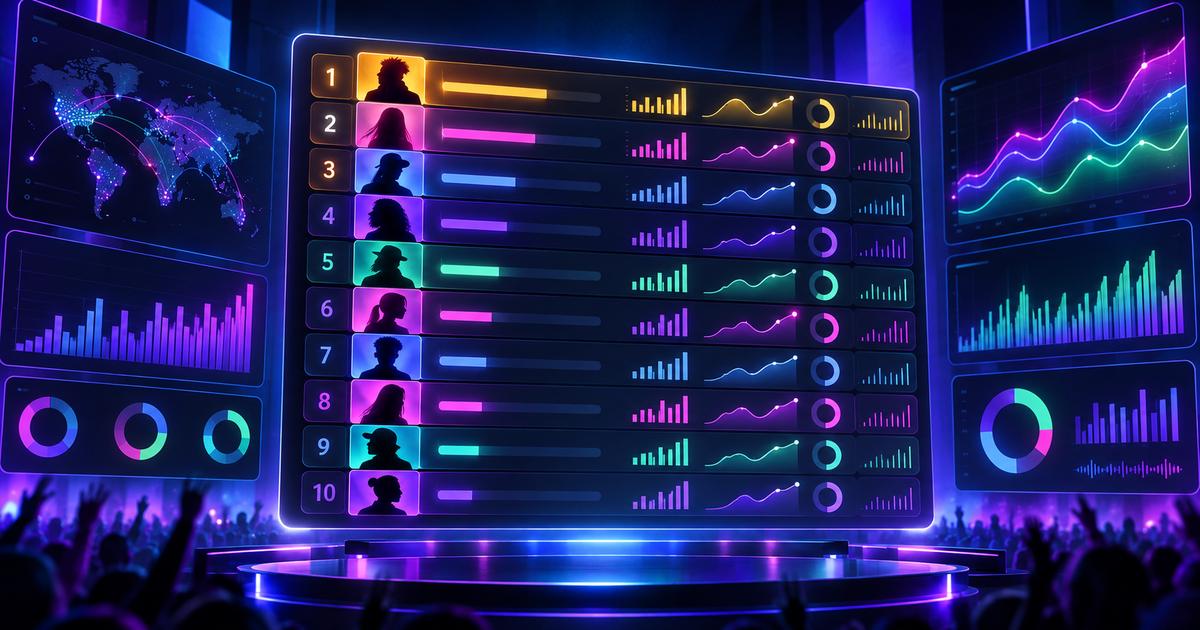

Spotify artist rankings provide a useful snapshot of music popularity, but the results depend on which metric is being measured. An artist with the most monthly listeners may have fewer followers than another musician, while a performer with a smaller current audience could have generated more streams throughout their career.
For music industry professionals, understanding these differences is essential when evaluating artist performance, researching market leaders, or comparing musicians across genres.
The top Spotify artists can be ranked according to monthly listeners, followers, total streams, playlist exposure, or recent growth. Each measurement reveals a different aspect of an artist's popularity.
Using data retrieved from Viberate on October 16, 2026, this article examines the ten leading artists by Spotify monthly listeners, explores how alternative rankings differ, and explains how music professionals can investigate individual performers in greater detail.
According to Viberate's Spotify artist chart, the following performers had the highest monthly listener counts in the dataset retrieved in October 2026.
The ranking covers artists globally, without genre or country restrictions.
1. Bruno Mars — 130,987,587 monthly listeners. The American pop and R&B performer leads the ranking, reaching approximately 131 million unique listeners within Spotify's rolling 28-day reporting period.
2. Rihanna — 116,238,031 monthly listeners. Rihanna ranks second with approximately 116.2 million listeners, demonstrating the substantial audience reach of her recorded catalog.
3. The Weeknd — 115,023,740 monthly listeners. The Canadian artist occupies third place with around 115 million listeners and also ranks among Spotify's most-followed performers.
4. Justin Bieber — 113,622,274 monthly listeners. Bieber ranks fourth, maintaining an audience of more than 113.6 million monthly listeners.
5. Taylor Swift — 105,504,888 monthly listeners. Swift holds fifth position with approximately 105.5 million listeners. Her Spotify following and cumulative streaming figures are particularly significant when compared with her position on this ranking.
6. Lady Gaga — 100,359,750 monthly listeners. Gaga ranks sixth and exceeds the 100 million monthly listener threshold.
7. Coldplay — 95,099,422 monthly listeners. The British band occupies seventh place with approximately 95.1 million monthly listeners.
8. Drake — 94,300,545 monthly listeners. Drake ranks eighth by current listener reach, despite leading the retrieved cumulative Spotify streaming ranking.
9. Bad Bunny — 93,872,246 monthly listeners. The Puerto Rican performer ranks ninth, with approximately 93.9 million monthly listeners.
10. Ariana Grande — 93,735,310 monthly listeners. Grande completes the top ten with approximately 93.7 million listeners.
Source: Viberate Artist Chart, sorted by Spotify monthly listeners, retrieved October 16, 2026. All figures represent a dated snapshot and may change as Spotify audience activity develops.
Several observations emerge from this ranking.
Bruno Mars holds a substantial lead over the second-ranked artist, while Rihanna, The Weeknd, and Justin Bieber have relatively similar audience sizes.
The differences become narrower toward the bottom of the list. Drake, Bad Bunny, and Ariana Grande each have approximately 94 million monthly listeners, meaning that comparatively small changes could affect their positions.
However, rankings based on monthly listeners measure recent audience reach. They do not necessarily identify the performers with the largest accumulated listening activity or the most established Spotify follower bases.
Spotify artist rankings can be organized using several metrics.
Each one measures a different aspect of performance, making the ranking methodology particularly important.
Monthly listeners measure the number of unique listeners who have streamed an artist's music during a rolling 28-day period.
This metric indicates recent audience reach.
An artist can increase monthly listeners through a successful release, playlist exposure, collaborations, or other forms of music discovery.
Because the reporting window moves forward every day, monthly listener counts fluctuate as listening activity enters and leaves the period.
An artist's position on a monthly listener chart can therefore change even when their overall career popularity remains substantial.
For research focused on current audience reach, this metric provides a useful starting point.
Spotify followers measure how many users have chosen to follow an artist.
Unlike the rolling monthly listener count, the follower total represents an accumulated audience relationship.
An artist may attract millions of monthly listeners through playlists and recommendations without receiving proportionally similar follower growth.
Another performer could have a large established follower base while attracting fewer unique listeners during the current month.
Follower rankings therefore reveal a different dimension of audience development.
Spotify streams measure qualifying plays of recordings.
Cumulative streaming figures represent listening activity accumulated over time.
Artists with extensive catalogs and long histories of successful releases can generate very large totals.
A musician may lead a cumulative streams ranking without having the largest monthly listening audience.
Recent streaming activity provides another perspective, revealing which performers are generating substantial consumption during a particular reporting period.

For professional analysis, cumulative and period-specific streaming figures should be clearly distinguished.
The rankings change substantially when artists are sorted by their Spotify follower counts.
Viberate's data retrieved on October 16, 2026, identifies Arijit Singh as the most-followed artist in the results.
The Indian singer has 194,387,008 Spotify followers, equivalent to approximately 194.4 million.
Taylor Swift occupies second place with 165,074,155 followers, followed by Billie Eilish with 131,190,426.
Ed Sheeran and The Weeknd complete the top five, with 128,585,035 and 128,400,825 followers respectively.
Bad Bunny, Drake, Ariana Grande, Eminem, and Justin Bieber occupy the remaining positions in the retrieved top ten.
The results demonstrate why monthly listeners and followers should be analyzed separately.
Arijit Singh leads the follower ranking but has approximately 53.3 million monthly listeners, placing him outside the current monthly listener top ten.
Meanwhile, Bruno Mars leads the monthly listener chart with almost 131 million listeners but has approximately 89.3 million Spotify followers.
Both performers have substantial audiences, but their relative positions differ depending on the measurement.
For music professionals, these differences can provide context when comparing recent listening reach with accumulated following.
They do not independently establish how frequently followers listen or how strongly individual listeners engage with an artist.
Spotify streaming rankings reveal another perspective on audience activity.
According to Viberate's retrieved cumulative streaming data, Drake leads with approximately 144.9 billion Spotify streams.
Taylor Swift follows with around 130.9 billion, while Bad Bunny has approximately 130.4 billion.
The Weeknd has generated about 98.5 billion cumulative streams, followed by Justin Bieber with approximately 76.7 billion.
These figures illustrate the scale of listening activity accumulated across major artist catalogs.
They also demonstrate that current audience reach and lifetime listening totals can produce different rankings.
Drake ranks eighth by monthly listeners in the October 2026 snapshot but leads the retrieved cumulative streams ranking.
Taylor Swift ranks fifth by monthly listeners while occupying second place by cumulative streams.
Cumulative streaming comparisons require careful interpretation.
Some artist databases can contain unusual profiles or catalog associations that produce exceptionally high totals relative to other available indicators.
In the retrieved Viberate results, two profiles with very small monthly audiences appeared among the top cumulative streaming positions despite reporting tens of billions of streams.
These anomalies warrant further validation before those accounts are treated as comparable mainstream performing artists.
For that reason, the figures above focus on identifiable major performers rather than presenting an unqualified top ten based exclusively on raw cumulative streaming values.
Historical reporting periods and catalog attribution can also affect comparisons.
An analyst should verify which recordings and available data contribute to a streaming total before using it for major commercial decisions.
Lifetime streams reveal accumulated consumption across an artist's catalog.
Recent streaming figures describe activity during a defined period.
These measurements can lead to different conclusions.
For example, Viberate's October 2026 data shows that Bad Bunny generated approximately 22.9 billion Spotify streams over the preceding twelve months, while Drake generated approximately 22.2 billion.
Drake leads their cumulative streaming comparison, but Bad Bunny generated more streams during that recent twelve-month period.
This distinction matters for evaluating current music consumption.
An artist with an extensive historical catalog may maintain exceptional lifetime totals while another performer generates stronger recent activity.
The largest Spotify artists dominate audience rankings, but established popularity represents only one part of the music market.
For A&R professionals and artist managers, recent growth can be particularly informative.
An emerging performer may have a relatively small audience while expanding much faster than established musicians.
Consider two hypothetical artists.
The first has 5 million monthly listeners and maintains approximately the same audience over several months.
The second grows from 100,000 to 300,000 monthly listeners during the same period.
The established artist remains substantially larger, while the emerging performer has achieved 200% growth between the two measurements.
Both figures are relevant.
Audience size helps establish current reach, while growth rates help identify recent momentum.
Absolute growth measures the numerical difference between two values.
Percentage growth measures that change relative to the starting value.
These measurements should be evaluated together.
An artist who gains 50,000 listeners from a starting audience of 25,000 has experienced substantial relative growth.
A performer who gains 500,000 listeners from an existing audience of 50 million has achieved a much larger absolute increase but a considerably smaller percentage change.
Comparing both types of growth helps researchers understand the scale and direction of audience development.
A current chart position cannot explain how an artist arrived there.
Historical performance can reveal whether an audience has grown consistently, experienced short-term increases, or remained relatively stable.
Sudden growth may coincide with a release, prominent playlist placement, collaboration, or promotional campaign.
Continued increases across several reporting periods may provide stronger evidence of sustained development.
Follower history, streaming activity, and playlist exposure add further context.
For emerging talent research, examining these patterns can be more useful than focusing exclusively on performers with the largest audiences.
Viberate provides artist charts that allow music professionals to research performers according to Spotify and other available performance metrics.
Users can identify leading musicians, investigate rankings within specific genres or countries, and examine artists at different audience levels.
After identifying performers through chart research, professionals can analyze them in greater detail using Spotify analytics.
This connects the initial ranking with historical audience development, streaming activity, playlist exposure, and other relevant indicators.
Begin with Viberate's Artist Chart.
Select a Spotify-based ranking metric, such as monthly listeners, followers, or streams.
A global ranking provides an overview of the largest performers according to that measurement.
Researchers can then narrow the results using available filters.
For example, an A&R team may want to examine leading Hip Hop performers in the United States.
A record label could investigate popular electronic musicians across selected European markets.
Genre, country, and audience-size filters help make these comparisons more relevant.
A current ranking shows where an artist stands at the time of measurement.
Historical analytics reveal how their performance has developed.
Viberate provides Spotify monthly listener and follower histories for supported performers, alongside available streaming metrics.
These measurements can help professionals distinguish sustained growth from temporary changes.
For instance, a manager researching two artists could compare their monthly listener development over the preceding quarter.
One might have the larger current audience, while the other demonstrates faster growth.
Historical comparisons provide context for deciding which artist warrants further research.
Artist rankings summarize overall performance, but individual recordings contribute differently to that result.
Track-level analytics help establish which songs generate substantial listening activity.
Professionals can examine whether an artist's audience is concentrated around a single successful recording or supported by activity across multiple releases.
This is especially relevant when researching emerging talent.
One viral track can increase an artist's visibility substantially, while consistent performance across the catalog may suggest a different pattern of audience development.
Playlist analytics provides information about where an artist's music appears and how that exposure changes.
Relevant indicators include playlist placements, potential reach, additions, and removals.
An artist with substantial playlist exposure may have additional opportunities to reach listeners outside their existing following.
However, playlist reach represents potential exposure rather than confirmed streams.
Comparing playlist activity with listening performance helps provide context for evaluating the relationship between the two.
Viberate supports artist comparisons using available music performance indicators.
A professional researcher can examine performers with similar audiences, genres, or market positions.
For example, two pop artists might have comparable monthly listener counts but substantially different follower totals.
Another performer may have a smaller audience while generating faster recent streaming growth.
These differences help professionals understand current popularity and changes in performance.
Spotify artist rankings support different kinds of decisions across the music business.
A&R teams can use genre-specific rankings to identify performers showing measurable audience activity.
Growth-focused analysis can help uncover emerging candidates who do not yet appear near the top of overall Spotify charts.
Comparisons of streaming, followers, and historical listener development help narrow the research process.
Artistic evaluation and commercial considerations remain important before signing decisions.
Managers can use rankings to understand their artists' positions within relevant markets.
Comparing performers with similar audiences provides useful context for streaming development, follower growth, and playlist performance.
Historical measurements can also support research into changes following new releases or promotional activities.
Labels can use Spotify rankings to investigate genre popularity and artist performance.
Marketing teams can compare audience reach across performers and research where promotional opportunities may exist.
Geographic audience information and available historical trends can help identify markets for further investigation.
Booking teams may examine Spotify rankings when researching potential performers.
Audience size and geographic distribution provide an initial perspective on artist recognition.
However, streaming metrics do not directly predict ticket demand.
Previous concert attendance, local market conditions, venue characteristics, and ticket pricing remain important considerations.
According to Viberate's global artist chart retrieved in October 2026, Bruno Mars ranks first by Spotify monthly listeners, with approximately 131 million. Rankings change over time and depend on the selected metric.
Viberate's October 2026 data places Arijit Singh first by Spotify followers, with approximately 194.4 million.
Among major performers in the retrieved cumulative streaming data, Drake leads with approximately 144.9 billion streams. Raw rankings can contain unusual catalog profiles, so streaming totals should be checked for data consistency.
No. Monthly listeners measure unique listeners within a rolling 28-day period, while followers represent users who have chosen to follow an artist's Spotify profile.
Compare current monthly listeners, follower counts, streaming performance, and historical growth across equivalent reporting periods. Genre, market, playlist activity, and audience size provide further context.
The top Spotify artists vary depending on how popularity is measured.
Monthly listeners describe recent audience reach. Followers provide information about accumulated following, while streaming metrics reveal music consumption over different periods.
Viberate's October 2026 data illustrates these distinctions.
Bruno Mars leads the retrieved monthly listener ranking, Arijit Singh ranks first by followers, and Drake has the highest cumulative streams among the major performers examined.
These results reflect different dimensions of music popularity.
For record labels, managers, A&R teams, and music marketers, the most useful analysis combines current rankings with historical performance and relevant audience information.
Viberate supports this process by connecting artist rankings with detailed Spotify analytics, allowing professionals to investigate individual performers and compare their development across the music market.
Source of music data: Viberate.com
-
📌 Viberate - Music Intelligence is the data & AI layer behind music analytics, connecting artist discovery, audiences, playlists, tracks, Spotify, TikTok, YouTube, streaming, and radio airplay.
 Next article
 Previous article

11M+ artists, 100M+ songs, 12M+ playlists, 6K+ festivals and 100K+ labels on one platform, built for industry professionals.