Matic Magister
Aug 29, 2026



For developers and companies building tools around streaming and audience metrics, a reliable data source is essential. Viberate provides a dedicated interface for use cases, allowing structured access to artist, track, and playlist data that can be integrated directly into applications and internal systems.
A music data API is an interface that allows software systems to exchange structured music-related information in an automated way. Instead of collecting artist profiles, track metadata, playlist statistics, and performance indicators manually, companies and developers can retrieve this data programmatically and integrate it directly into their own tools and workflows. In practice, this means that charts, dashboards, artist profiles, and reporting systems can stay up to date without human intervention.
The music industry has become heavily data-driven. Streaming platforms, social media networks, and live event databases generate vast amounts of information every day. Artists build their audiences across multiple platforms at once, and their performance is measured through streams, followers, playlist placements, and engagement metrics. Without a unified way to access and process these data points, teams would need to work with scattered sources and inconsistent formats. A music data API solves this by acting as a bridge between raw platform data and the systems that rely on it.
From a business perspective, this type of infrastructure supports faster decision-making and more reliable analysis. Labels can evaluate which artists are gaining traction, publishers can track catalog performance, and application developers can create user-facing features based on verified statistics. A single, structured source of music data also reduces the risk of duplication, outdated profiles, and mismatched identities across platforms.
Modern artists rarely operate on just one channel. Their audience may discover them through Spotify playlists, follow them on TikTok, and watch their videos on YouTube Music. Each platform has its own metrics and update cycles, which makes it difficult to form a complete picture of an artist’s reach when relying on one source alone.
A music data API designed for industry use brings these channels together. By aggregating streaming data and social performance into one dataset, it becomes possible to compare growth patterns, measure momentum, and understand how different platforms influence each other. This is particularly important for companies that manage large catalogs of artists or tracks and need consistent data structures across all of them.
Another important role of a music API is normalization. Artist names are often spelled differently across services, collaborations can be listed in various ways, and remixes or alternate releases may appear as separate entries. A curated API reduces this complexity by maintaining a single identity per artist and connecting all related data to that profile. This makes long-term tracking and reporting more accurate.
Viberate’s music data API is built to provide daily-refreshed data on millions of industry entities. The database includes information from Spotify, YouTube Music, and social media platforms, covering not only artists and tracks but also playlists, festivals, labels, and venues. This scope allows users to work with the entire music ecosystem rather than isolated segments of it.
The scale of the dataset is a defining feature. The API provides access to more than 11 million artists, over 100 million tracks, 19 million playlists, around 6,000 festivals, and 100,000 labels. These numbers matter because they indicate coverage across genres, regions, and career stages. Emerging artists and global stars are part of the same structured system, which supports analysis that goes beyond a single market or scene.
All data is refreshed daily, which is essential for applications that depend on up-to-date metrics. Streaming counts, social media followers, and playlist placements change continuously. When these values are updated automatically, downstream systems such as dashboards or artist profiles remain current without manual intervention. This is particularly useful for organizations that rely on real-time or near-real-time insights.
One of the main technical challenges in music databases is duplication. The same artist can appear multiple times under slightly different names or with inconsistent metadata. Over time, this leads to fragmented statistics and unreliable reporting. Viberate addresses this problem by assigning unique artist IDs and maintaining a curated database with no double entries.
This principle is summarized as one artist equals one profile. In practice, this means that all known releases, playlists, and performance metrics are connected to a single identity. The benefit is twofold. First, historical tracking becomes more accurate because changes are measured against one continuous profile rather than scattered duplicates. Second, integrations built on top of the API can trust that the data they receive represents a real, verified entity.
High data integrity also supports automated workflows. When a system can rely on stable identifiers, it becomes easier to sync internal databases, map external references, and avoid mismatches. For companies that manage thousands of artists or tracks, this reduces the cost of maintenance and the risk of errors.
A music career does not exist only on streaming platforms. It also involves live performances, label relationships, and promotional activity across social networks. For this reason, an API that focuses on only one type of data limits its usefulness. Viberate’s API maps and ranks artists, tracks, playlists, venues, labels, festivals, and events in a single structure.
This broad coverage allows users to monitor both recorded music performance and live activity. Festival lineups, for example, can be connected to artist profiles and popularity metrics. Labels can be linked to their rosters and releases. Playlists can be evaluated not only by follower count but also by the artists they feature. All of this information can be processed together instead of being stored in separate silos.
Access to multiple channels also means that users can work with raw data points or choose to rely on processed indicators. Developers building analytical tools can retrieve detailed statistics, while business users can focus on higher-level measures such as popularity or growth trends. The same underlying dataset supports both use cases.
Music data APIs are used by a wide range of organizations, from small start-ups to established international companies. For this reason, pricing and access models need to support different levels of scale. Viberate positions its API as suitable for early-stage projects as well as large enterprises by offering packages designed for different usage volumes and business needs.
This approach reflects the reality of modern music technology development. A new application might start with a limited number of queries and a small user base, while a mature platform may require constant access to large portions of the dataset. By structuring access around these differences, the API can serve as a long-term data source rather than a short-term experiment.

Music data APIs are not abstract technical tools. They are used in concrete workflows that affect how companies operate and how artists are presented to the public.
Talent agencies can use an API to feed signature content, gig dates, and key performance metrics directly into artist profiles. This removes the need for manual updates and ensures that public-facing pages reflect current information. Over time, this also creates a consistent archive of activity that can be used for reporting and evaluation.
Collecting societies, publishers, and distributors rely on accurate data for internal reporting and client services. By integrating an API into their systems, they can automatically update artist profiles, offer analytics to rights holders, and improve their internal tools for ranking and presentation. Popularity metrics and performance indicators can be applied across catalogs in a uniform way.
Labels use music data APIs to support A&R work. Advanced filters make it possible to identify artists who are gaining traction based on streaming and social signals. Instead of relying solely on manual scouting or anecdotal evidence, teams can apply quantitative criteria to large datasets and focus their attention on the most promising profiles.
App developers represent another important group of users. Applications that display artist information, festival lineups, or playlist data require a steady flow of structured content. Through an API, this content can be fed directly into the app and kept in sync with daily updates. For developers who need access to Spotify-related information and festival data at the same time, a unified source simplifies both development and maintenance. In this context, Viberate’s API can function as a data backbone for applications that would otherwise depend on multiple separate integrations.
The value of a music data API is not only in the data itself but in what can be built with it. Dashboards, discovery tools, recommendation systems, and reporting platforms all rely on structured inputs. When those inputs are consistent and comprehensive, developers can focus on user experience and analytical logic rather than data cleaning.
A curated dataset also supports long-term projects. Because the same artist IDs are used over time, historical trends can be calculated reliably. Growth rates, seasonal patterns, and the impact of campaigns can be measured against stable reference points. This is especially important for services that aim to provide strategic insights rather than just raw numbers.
From a technical standpoint, an API-based approach also improves scalability. As new artists, tracks, or festivals are added to the database, they become available to all connected systems without additional integration work. This makes it easier for companies to expand their coverage or enter new markets without redesigning their data pipelines.
Developers working in music technology often look for ways to combine platform-specific information with broader industry context. For implementation details and dataset access, see spotify web developer. A tool might start with streaming data but later require social media metrics or live event information. An API that already includes these elements reduces the need for multiple contracts and technical implementations.
For teams that are building tools related to Spotify and other major platforms, the ability to work with a single, normalized dataset is a practical advantage. Instead of stitching together different APIs with different update schedules and data formats, they can rely on one source that already aggregates and processes this information. This is where the role of a dedicated music data provider becomes central to application design.
Viberate’s API, which can be explored further through its documentation for spotify web developer use cases, illustrates how industry-focused data services can support both technical and business objectives. By combining streaming and social data with curated identities and daily updates, it offers a foundation for tools that require accuracy and scale.
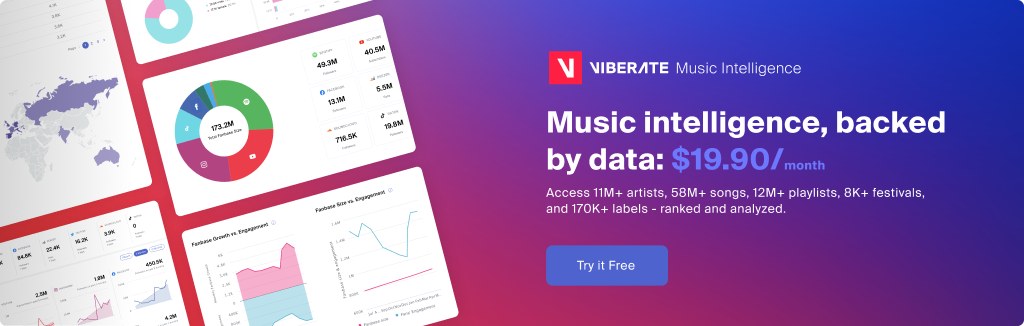
As the music industry continues to digitalize, the amount of available data will only increase. At the same time, competition for attention and revenue will intensify. Organizations that can interpret data quickly and reliably will have an advantage over those that depend on fragmented or outdated sources.
Music data APIs respond to this environment by providing structured, automated access to information that would otherwise require extensive manual work. They allow different parts of the industry to speak a common data language, whether the goal is artist development, rights management, or application design.
In this sense, a music data API is not just a technical convenience. It is part of the infrastructure that connects platforms, companies, and creators. By enabling consistent measurement and integration, it supports more transparent and informed decision-making across the ecosystem. For businesses and developers alike, this makes such services an increasingly important component of modern music operations.
Source of music data: Viberate.com
-
📌 Viberate - Music Intelligence is the data & AI layer behind music analytics, connecting artist discovery, audiences, playlists, tracks, Spotify, TikTok, YouTube, streaming, and radio airplay.
 Next article
 Previous article
11M+ artists, 100M+ songs, 12M+ playlists, 6K+ festivals and 100K+ labels on one platform, built for industry professionals.