Kristian Gorenc Z
Jul 19, 2026



Data has become a core part of how the music industry operates. Streaming platforms generate large volumes of information every day, and knowing how to read that data can directly impact decision-making. Spotify metrics help professionals understand how artists grow, how songs perform, and where audiences are located.
For artists, managers, and A&R teams, tracking Spotify metrics is not optional anymore. It is the foundation for planning releases, identifying trends, and evaluating performance across different markets. When used correctly, these insights reduce guesswork and replace it with measurable signals.
Platforms like provide a structured way to analyze performance across millions of artists. Instead of looking at isolated numbers, you can connect audience behavior, streaming performance, and playlist exposure into a single view.
Viberate offers Spotify analytics across more than 11 million artists. The platform is designed for professionals who need a deeper level of insight than standard tools provide. While Spotify for Artists focuses on your own profile, this system allows you to analyze any artist on the platform.
You can track monthly listeners, followers, playlist placements, and streaming performance in one place. This creates a clear overview of how an artist is performing over time and how they compare to others in the same space.
Streaming stats are organized so you can quickly identify patterns. Whether you are analyzing a single track or an entire catalog, the data is structured to support fast decision-making.
Monthly listeners remain one of the most widely used indicators of artist reach. With Viberate, you can track the full history of an artist’s monthly listeners and compare it to industry averages. This gives you context, which is critical when evaluating growth.
Follower data adds another layer. It shows how stable the fanbase is and whether listeners convert into long-term followers. By combining both metrics, you can separate short-term spikes from sustainable growth.
This type of tracking is especially useful when planning campaigns. If listener growth is tied to specific releases or playlist placements, you can replicate successful strategies in future rollouts.
Understanding how songs perform requires more than looking at total streams. Viberate ranks every Spotify song by performance and allows filtering by release date. This helps you identify which tracks are gaining traction and which ones are losing momentum.
You can sort songs by all-time streams, as well as shorter timeframes such as 12 months, 1 month, and 7 days. This makes it easier to spot emerging hits early.
The ability to play songs directly within the analytics section speeds up the evaluation process. Instead of switching between tools, you can review both data and content in the same workflow.
Playlist placement is one of the main drivers of streaming growth. Viberate provides detailed playlist analytics for every artist on Spotify, allowing you to track where songs are placed and how those placements evolve over time.
This data helps you identify which playlists contribute the most to streams and which ones are worth targeting. It also reveals patterns in how songs move between playlists, giving you insight into how exposure builds.
For professionals working on promotion, this is critical. Instead of guessing which playlists matter, you can focus on those that consistently drive results.

Beyond raw numbers, performance ratios provide a clearer picture of how audiences behave. Viberate includes metrics such as listener-to-follower ratios and streams-to-listener ratios.
These indicators help you understand engagement levels. For example, a high number of listeners with low follower conversion may signal weak audience retention. On the other hand, strong ratios suggest that listeners are actively engaging with the artist.
Tracking these values over time allows you to measure the effectiveness of marketing efforts and content strategies.
Knowing where listeners are located is essential for both digital promotion and live events. Viberate maps audience data across cities and countries, allowing you to pinpoint where an artist is gaining traction.
This information supports better decision-making when planning tours or targeting specific regions with marketing campaigns. If a song performs well in a certain country, you can focus promotional efforts there to maximize impact.
Geolocation data also helps identify new markets. Instead of relying on assumptions, you can use actual listener data to guide expansion strategies.
Collaboration plays a major role in audience growth. Viberate allows you to identify artists with overlapping fanbases, making it easier to plan collaborations or bookings.
By analyzing shared audience interests and sorting artists by monthly listeners, you can find partners that align with your target audience. This reduces the risk of mismatched collaborations and increases the chances of reaching new listeners.
For event organizers, this feature also simplifies booking decisions by highlighting artists with compatible audiences.
Talent discovery requires a structured approach. Viberate provides charts that rank every artist and song based on Spotify and other performance metrics. These charts are refreshed daily, ensuring that you are always working with up-to-date data.
You can customize rankings by country, genre, follower range, and other filters. This flexibility allows you to narrow down results and focus on the segments that matter most.
The inclusion of trending filters makes it easier to identify artists who are gaining momentum. This is particularly useful for A&R teams looking for early signals of growth.
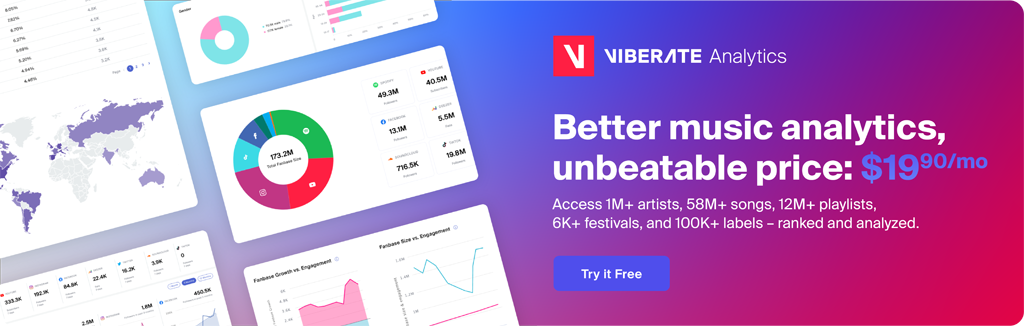
Spotify metrics are not just numbers. They represent audience behavior, content performance, and market trends. When combined into a single system, they provide a clear framework for decision-making.
Viberate brings these elements together into one platform, allowing professionals to analyze streaming data, audience insights, and playlist performance without switching between tools.
For anyone working in the music industry, the ability to interpret these metrics can define the difference between reactive and proactive strategies. By relying on structured data, you can make decisions based on evidence rather than assumptions.
As the industry continues to evolve, the role of data will only grow. Those who understand how to use Spotify metrics effectively will be better positioned to adapt, compete, and succeed.
Source of music data: Viberate.com
-
📌 Viberate - Music Intelligence is the data & AI layer behind music analytics, connecting artist discovery, audiences, playlists, tracks, Spotify, TikTok, YouTube, streaming, and radio airplay.
 Next article
 Previous article
11M+ artists, 100M+ songs, 12M+ playlists, 6K+ festivals and 100K+ labels on one platform, built for industry professionals.