Kristian Gorenc Z
Oct 11, 2026



Getting your songs on the radio has always been one of the most effective ways for artists to gain exposure. Even with the rise of streaming and social media, radio still plays a significant role in building a reputation, reaching new audiences, and signaling credibility to industry professionals. For independent artists, the process of getting spins may seem difficult, but with the right approach and tools, it becomes much more manageable.
For new or relatively unknown artists, the first step is to create professional-quality recordings. Radio stations receive countless submissions daily, and only well-produced tracks stand a chance of being added to playlists. Once you have a track ready, it’s crucial to build connections. Many independent artists begin by reaching out to local stations, college radio, or community broadcasters, where competition is lower and programmers are more open to emerging talent.
Another proven method is collaborating with established promoters or plugging services. These professionals already have relationships with program directors and can help you secure those first plays. However, hiring a promoter can be costly, which is why many artists first test their potential by contacting smaller stations directly. Sending personalized emails, including your story, and showing how your song fits their format can often yield positive results.
Success stories exist across different genres. Countless artists have built strong followings after consistent spins on niche or regional stations. Hip hop and electronic artists often break through on college radio before being picked up by bigger channels. Country and folk musicians may find their first audience on regional FM stations in smaller towns. Each genre has its path, but they all share one common point: persistence and tracking where your music is actually being played.

Once you start gaining airplay, keeping track of it is essential. Without data, you can’t know which stations are supporting you, how your spins evolve over time, or where your audience is growing. This is why state-of-the-art tools such Viberate airplay analytics are indispensable for independent musicians.
Radio Airplay Analytics from Viberate covers more than 11 million artists worldwide. The platform sources information from over 64,000 stations, making it one of the most complete solutions for monitoring your presence on the airwaves. Instead of manually checking playlists or waiting for feedback from promoters, you get all the relevant data in one place.
With Viberate, you can monitor the radio airplay performance of every artist and song. You can see not just whether your track was played, but also where, when, and how often. This gives you a complete overview and allows you to make informed decisions on your next promotional steps.
One of the most useful features is audience geolocation. You can identify the countries and cities where your music is receiving spins. Knowing this helps you adapt your promotional strategies. For example, if you notice that your track is receiving attention in a certain city, you might consider booking a show there or targeting ads to that region.
Another important aspect is the spin growth trend. Tracking how your song performs over time shows whether your promotion is working. A consistent upward trend indicates momentum, while a plateau or decline signals that you may need to adjust your approach.
The tool also provides insights into charts that are customizable by trending artists, genres, and countries. This isn’t only helpful for monitoring your own performance but also for discovering other rising artists and potential collaborators. It gives a clear picture of what is resonating across different regions and genres.
Analytics don’t just show you where your music has been played. They also reveal which songs are receiving the most attention, what stations are spinning them, and at what times they are broadcast. For example, if one of your songs consistently gets airplay during peak hours, that’s a strong signal to promote that track more aggressively.
By analyzing total spins over different timeframes, you can identify long-term trends and see how one release compares to another. This helps in choosing which songs to push in future campaigns. If you notice that one track is outperforming others, you can use it as the centerpiece of your marketing.
Geolocation data is particularly useful for planning tours or promotional activities. If your analytics show strong support in specific countries, you can prioritize those areas for booking gigs, targeting playlists, or connecting with local media outlets. Efficient promotional strategies always rely on identifying and leveraging target markets.
Another advantage of using airplay analytics is the ability to analyze radio stations and airtimes. This allows you to identify which stations are most supportive, what genres they specialize in, and the time slots that bring the most exposure. Once you have this information, you can strengthen relationships with those stations and build a solid foundation for future releases.
Viberate’s radio tracker makes this process straightforward. You can filter results by station, genre, and timeframe, then drill down into when and where your songs are being played. This enables a data-driven approach to promotion that replaces guesswork with clear insights.
Additionally, the Artist Chart on Viberate allows you to sort and compare artists by various radio airplay metrics. This feature is valuable not only for musicians but also for labels, managers, and booking agents who want to identify promising acts for signings or events. Seeing every musician and song ranked by radio airplay performance, refreshed daily, provides context and competitiveness that can guide decisions.
Radio remains one of the strongest platforms for exposure, and independent artists can achieve meaningful results if they approach it strategically. Starting with high-quality recordings, personal outreach to smaller stations, and eventually scaling to larger campaigns creates a path toward sustainable growth. However, the most important element is tracking your progress with reliable analytics.
Using Viberate’s Radio Airplay Analytics means you can finally understand where your songs are played, who is listening, and how your popularity is shifting over time. Instead of guessing, you’ll be equipped with concrete data to make the right moves. For any artist serious about building their career, using analytics to is no longer optional—it’s essential.
Source of music data: Viberate.com
-
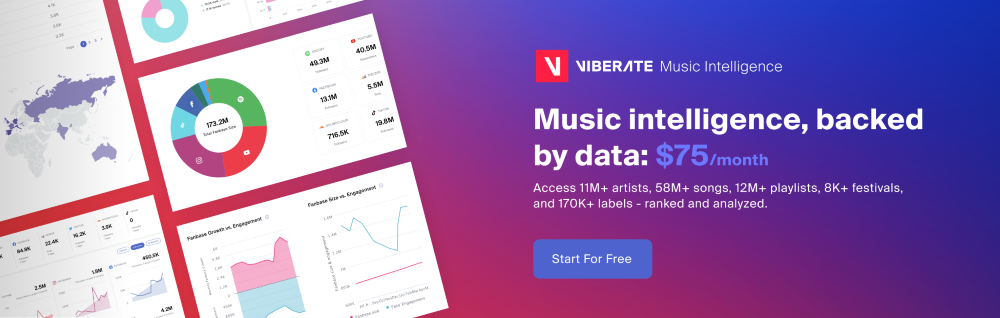
📌 Viberate - Music Intelligence is the data & AI layer behind music analytics, connecting artist discovery, audiences, playlists, tracks, Spotify, TikTok, YouTube, streaming, and radio airplay.
 Next article
 Previous article
11M+ artists, 100M+ songs, 12M+ playlists, 6K+ festivals and 100K+ labels on one platform, built for industry professionals.