Matic Magister
Nov 19, 2026

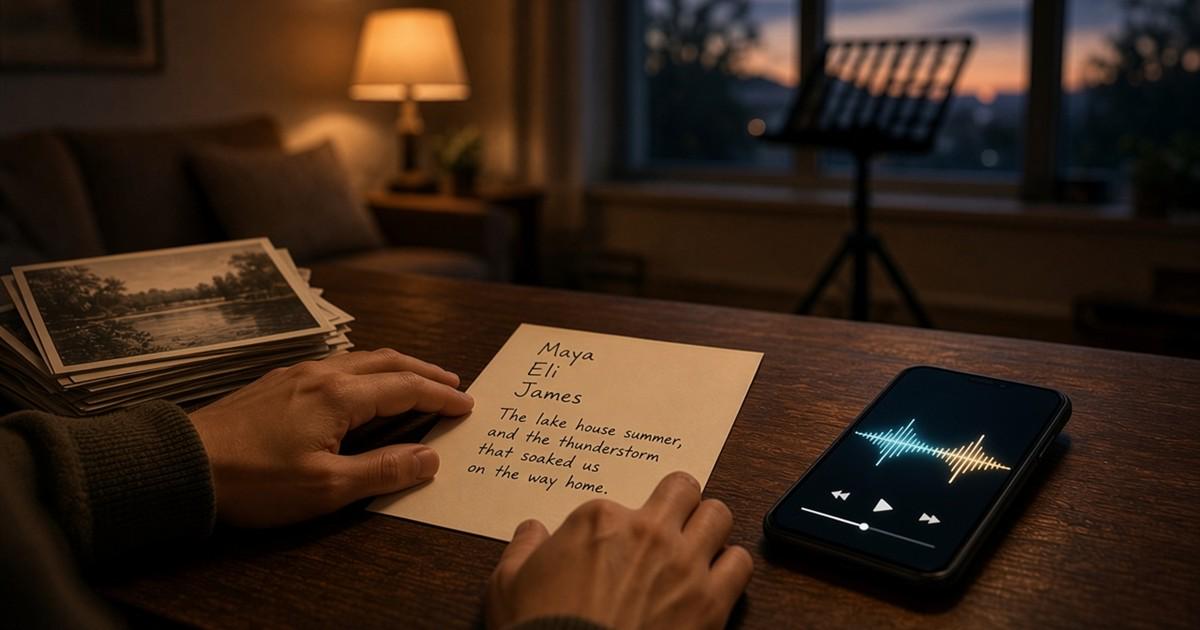

Personalized songs went from a novelty gift to a measurable category in under five years. The search data shows it clearly — and it also exposes a blind spot in how the music industry counts demand.
Keyword research rarely tells you when a new product category is born. Occasionally it does.
In the US, "custom song" averaged about 1,600 monthly searches in 2026, with the most recent quarter running roughly 88% above the previous one. The plural form, "custom songs," holds around 1,000 a month and is up more than 40%. Birthday-specific phrasing follows the same pattern: "custom birthday song" sits near 880 a month and has been stable, not fading.
Now compare that with the vocabulary the category was built on. "Personalized birthday song" holds about 880 monthly searches but has flattened, edging down roughly 4% over the year. The plural version is more revealing: it averaged around 1,000 searches a month across 2024 and 2025, yet its most recent single month registered 70. That is not a product losing to a competitor. That is a phrasing going out of use.
The vocabulary migrated from "personalized" to "custom." For anyone maintaining keyword sets, content taxonomies, or catalog tags, that is an operational detail worth checking: the two phrases now behave like different markets, and only one of them is growing.
Volume tells you how many people are looking. Bids tell you what advertisers think those people will do.
Top-of-page bids on the custom-side terms we examined sit between $2 and $16. On the birthday-side phrasing that carries comparable volume, bids sit between $0.03 and $0.07.
That is a gap of two orders of magnitude on nearly identical traffic. It describes two entirely different intentions sitting behind almost the same words: someone looking for a birthday song wants to listen to one, and someone looking for a custom song wants to buy one. Only the second group converts, and the bidding market figured that out before most content strategies did.
A commissioned song used to mean a studio booking, a session musician, a lyric rewrite, and a wait measured in weeks. The new pipeline is shorter and has a different bottleneck.
The structural change is not that machines can write songs. It is that the constraint moved from production capacity to input quality. Studios were expensive and scarce; a good story is neither. Services like CelebrateYou are built entirely around that inversion — the buyer's memory does the work, and the software handles everything downstream of it.
The transaction structure is different from anything in the recorded-music business. There is no distributor, no DSP, no per-stream rate. A buyer pays once for a single file and owns it. Revenue does not scale with plays; it scales with occasions.
For artists, three effects are worth watching:
Here is the part that matters if you work with music data.
Personalized songs are delivered as files. They are not released to streaming platforms, so they carry no ISRC, appear in no chart, and register in no royalty statement. A growing share of the music being made is structurally invisible to the systems the industry uses to measure music.
Two gaps follow from that. First, there is no metadata schema for the attributes that make these tracks meaningful — occasion, relationship, named entities in lyrics. Without one, the segment cannot be segmented. Second, disclosure around AI-generated vocals is still voluntary in most markets, which means the industry currently cannot distinguish a synthesized vocal from a recorded one inside its own data.
Neither gap is a technology problem. Both are taxonomy problems, and taxonomy problems get solved when someone decides it is worth solving.
Quality will be decided by lyrics, not melody. Arrangement is commoditized. Verse that contains a specific, true detail is not, and that is the axis every service in this category is competing on right now.
Disclosure will become mandatory in some market. When it does, the services that captured provenance data from the start will have an advantage.
The category may be absorbed rather than expanded. General-purpose generation platforms can add a personalization flow at any time. Whether "personalized song" survives as its own category, or becomes a feature inside a larger platform, is the open question — and the answer will show up in the search data before it shows up in any press release.
Source of music data: Viberate.com
-
📌 Viberate - Music Intelligence is the data & AI layer behind music analytics, connecting artist discovery, audiences, playlists, tracks, Spotify, TikTok, YouTube, streaming, and radio airplay.
 Next article
 Previous article

11M+ artists, 100M+ songs, 12M+ playlists, 6K+ festivals and 100K+ labels on one platform, built for industry professionals.