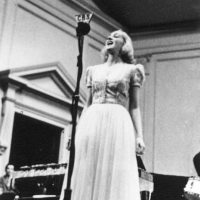
Helen O'Connell

Jazz
Big band Jazz
Mainstream Pop
 Viberate Rank: 162260
 Viberate Rank: 162260
 Monthly ListenersFollowers
 Subscribers
 Followers
 Followers
 FansTop Spotify Songs
| Track | 7-Day Streams | |
|---|---|---|
1 | 19.67K | |
2 | 9.08K | |
3 | 9.08K | |
4 | 6.01K | |
5 | 5.20K |
Top YouTube VideosMonthly ListenersFeatured in Playlists| Playlist | Followers | |
|---|---|---|
1 | 1940s Hits platoc | 41.61K |
2 |  Creepy Old Songs ttk trevor.editss | 37.87K |
3 |  Love Island 2017 Love Island | 29.75K |
4 | songs to slow dance to in the kitchen at 2 a.m. with the one you love yves ain't laurent | 21.33K |
5 | 20s, 30s, 40s, 50s Alexandra Tashman | 20.00K |
Audience| City | Monthly Listeners | |
|---|---|---|
1 |  | 597 |
2 |  | 574 |
3 | | 551 |
4 |  | 448 |
5 | | 436 |
See full performance history, audience data, playlist activity, rankings, comparisons, and more in Viberate music analytics. Start with a free trial, then continue with a paid plan.
Helen O'Connell’s Spotify BioHelen O'Connell, who had a fairly long career, will always be best remembered for her squeals on "Green Eyes" and her work with Jimmy Dorsey. She originally left her native Toledo with Jimmy Richards' nine-piece group, gigging and touring for a year and a half. O'Connell appeared on a regular radio show in St. Louis until she agreed to tour with Larry Funk's band (which was billed as "Band of a Thousand Melodies"). After the outfit started working in New York, she was discovered and quickly signed up by Jimmy Dorsey in 1938. O'Connell soon had a hit rendition of "All of Me," which was followed by popular recordings of "Embraceable You," "Brazil," "Jim." and "When the Sun Comes Out" (which she introduced). However, it was in December 1940, when she started sharing recordings with ballad singer Bob Eberly, that O'Connell for a time became a household name. Eberly generally took a slow chorus, Jimmy Dorsey would have a brief instrumental interlude, and then O'Connell would finish up the… record with a swinging chorus. This combination worked very well on hit versions of "Amapola," "Yours," "Green Eyes" and "Tangerine." After appearing in the 1943 movie I Dood It with Dorsey (singing "Star Eyes"), O'Connell retired to get married; she would eventually have four daughters. In 1950 she began a successful solo career, making occasional records, appearing regularly on television (she spent a period as co-host of The Today Show), toured as part of Four Girls Four (which also included Kay Starr, Rosemary Clooney and Rose Marie) and made guest appearances with the Jimmy Dorsey ghost band, singing in an unchanged style. Although her voice was limited, she made her deficiencies into assets and carved out her own place in musical history. Helen O'Connell was active up until shortly before her death from cancer. ~ Scott Yanow, Rovi
Viberate is a music analytics platform built for A&Rs, artist managers, labels, booking agents, marketers, and artists.
It helps music professionals track artist growth, analyze audience data, monitor playlist activity, compare artists, follow song performance, and identify opportunities across the music market.
Public artist pages provide a free preview of selected artist data. Paid plans provide access to deeper analytics, historical data, charts, comparisons, playlist tools, exports, alerts, reports, and additional professional features.
Yes. Public Viberate artist pages provide selected artist analytics and music data for free.
Viberate also offers a 7-day free trial of the full platform. A credit card is required to start the trial. The trial includes access to the complete product so users can test deeper artist analytics, historical views, playlist insights, comparisons, charts, exports, alerts, and reporting features before choosing a paid plan.
Viberate provides artist analytics across streaming, playlists, social media, video, radio airplay, songs, and audience markets.
Users can analyze Spotify performance, Spotify and Apple Music playlists, YouTube activity, TikTok and Instagram growth, radio spins, song performance, audience locations, demographics, rankings, and overall artist momentum.
Artist profiles also connect to music charts, similar artists, and comparison tools, helping users benchmark performance and evaluate artists in context.
Viberate updates key artist and track data daily.
For followed artists and tracks, selected data is refreshed multiple times per day. This helps teams monitor playlist changes, streaming movement, audience growth, releases, and campaign performance with more current data.
Update frequency can vary depending on the metric and data source.
Yes. Viberate lets users compare up to five artists side by side across streaming, social media, audience, and engagement metrics.
Users can compare fanbase growth, audience demographics, locations, Spotify performance, social metrics, and other artist data over selected time periods.
Artist comparison can be used for A&R scouting, benchmarking, booking decisions, campaign planning, and evaluating artists with similar audiences or market positions.