Cliff Nobles

R&B
Soul
Dance
 Viberate Rank: 227804
 Viberate Rank: 227804
 Monthly ListenersFollowers
 Subscribers
 Followers
 Followers
 FansTop Spotify Songs
| Track | 7-Day Streams | |
|---|---|---|
1 | 4.08K | |
2 | 2.03K | |
3 | 1.37K | |
4 | 709 | |
5 | 45 |
Top YouTube VideosMonthly ListenersFeatured in Playlists| Playlist | Followers | |
|---|---|---|
1 | Classic Rock Greatest Hits Scott Pruden | 341.38K |
2 |  Northern Soul Classics Spotify | 152.99K |
3 |  I Love My 60s Funk Spotify | 111.08K |
4 | wicks Brennan McDowell | 43.73K |
5 |  Cooking & Drinking Focuszero | 24.14K |
Audience| City | Monthly Listeners | |
|---|---|---|
1 |  | 484 |
2 | | 306 |
3 | | 288 |
4 | | 203 |
5 | | 197 |
See full performance history, audience data, playlist activity, rankings, comparisons, and more in Viberate music analytics. Start with a free trial, then continue with a paid plan.
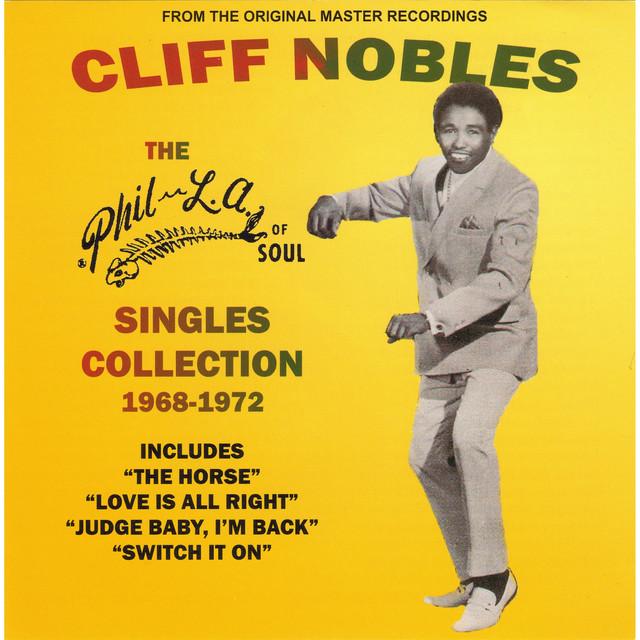
Cliff Nobles’ Spotify BioThough born in Grove Hill, AL, in 1944, Cliff Nobles' family moved to Mobile when he was a terrible two-year-old. He never showed any inclination toward music until high school, when he joined the school choir and started singing lead for a popular local group called the Delroys. After school, he moved to Philadelphia, PA, to seek fame and fortune. Nobles found the competition a lot stiffer than the Mobile scene and had to support himself by living commune-style with some musical friends in Norristown, a small town 18 miles from Philadelphia. Before the move, Nobles cut three singles for Atlantic Records that went unnoticed. In Norristown, he formed Cliff Nobles & Co., which consisted of Benny Williams (bass), Bobby Tucker (lead guitar), and Tommy Soul (drums). The outfit made tapes for Jimmy Rogers (not to be confused with the country singer of the same name), who made them available to producer/writer/singer Jesse James (not to be confused with the famous outlaw of the same name),… who resided in the community. James had already heard something in Nobles' voice when he heard him sing in a local church. Loving their energy, James started writing songs for Nobles and the band, and secured a contract for the group with Phil La of Soul Records. The first release bombed. The second featured "Love Is All Right," backed with "The Horse." "The Horse" became a huge hit and established Nobles as a legit one-hit wonder. Ironically, "The Horse" was simply "Love Is All Right" without Nobles' vocal -- Nobles isn't even featured on "The Horse." He neither sings nor plays an instrument on the track; the brass playing on the song would become famous years later as MFSB. The whole incident was an accident, the side with the vocal was supposed to be the side that was plugged, but DJs kept playing the non-vocal version. The record would have gone to number one, but another instrumental, "Grazin' in the Grass" by Hugh Masekela, was even more popular and occupied the top spot for two weeks. The week of July 29, 1968, had to be the first time in modern pop music history that two instrumentals were ranked at numbers one and two, respectively, on the charts. Shamelessly, Phil La of Soul released two more instrumentals -- "Horse Fever" and "Switch It On," -- and credited them as being by Cliff Nobles, though Nobles didn't play an instrument. A later single on Roulette actually featured Nobles' singing and nearly cracked the R&B Top 40, stalling at number 42. Phil La issued an album entitled The Horse that consisted of mostly instrumentals and dance tunes like "The Mule," "The Camel Walk," and "Judge Baby I'm Back," a tune sounding like a hit that Nobles sings with a feel similar to a Berry Gordy, Jr. production for the Contours. Moonshot Records released an LP one year later, in 1969, where Nobles sang three songs, the rest being instrumental. The Atlantic material remains in the vaults. Supposedly, Nobles was an excellent entertainer and a gifted dancer, but, in essence, he was the Milli Vanilli of the '60s. ~ Andrew Hamilton, Rovi
Viberate is a music analytics platform built for A&Rs, artist managers, labels, booking agents, marketers, and artists.
It helps music professionals track artist growth, analyze audience data, monitor playlist activity, compare artists, follow song performance, and identify opportunities across the music market.
Public artist pages provide a free preview of selected artist data. Paid plans provide access to deeper analytics, historical data, charts, comparisons, playlist tools, exports, alerts, reports, and additional professional features.
Yes. Public Viberate artist pages provide selected artist analytics and music data for free.
Viberate also offers a 7-day free trial of the full platform. A credit card is required to start the trial. The trial includes access to the complete product so users can test deeper artist analytics, historical views, playlist insights, comparisons, charts, exports, alerts, and reporting features before choosing a paid plan.
Viberate provides artist analytics across streaming, playlists, social media, video, radio airplay, songs, and audience markets.
Users can analyze Spotify performance, Spotify and Apple Music playlists, YouTube activity, TikTok and Instagram growth, radio spins, song performance, audience locations, demographics, rankings, and overall artist momentum.
Artist profiles also connect to music charts, similar artists, and comparison tools, helping users benchmark performance and evaluate artists in context.
Viberate updates key artist and track data daily.
For followed artists and tracks, selected data is refreshed multiple times per day. This helps teams monitor playlist changes, streaming movement, audience growth, releases, and campaign performance with more current data.
Update frequency can vary depending on the metric and data source.
Yes. Viberate lets users compare up to five artists side by side across streaming, social media, audience, and engagement metrics.
Users can compare fanbase growth, audience demographics, locations, Spotify performance, social metrics, and other artist data over selected time periods.
Artist comparison can be used for A&R scouting, benchmarking, booking decisions, campaign planning, and evaluating artists with similar audiences or market positions.