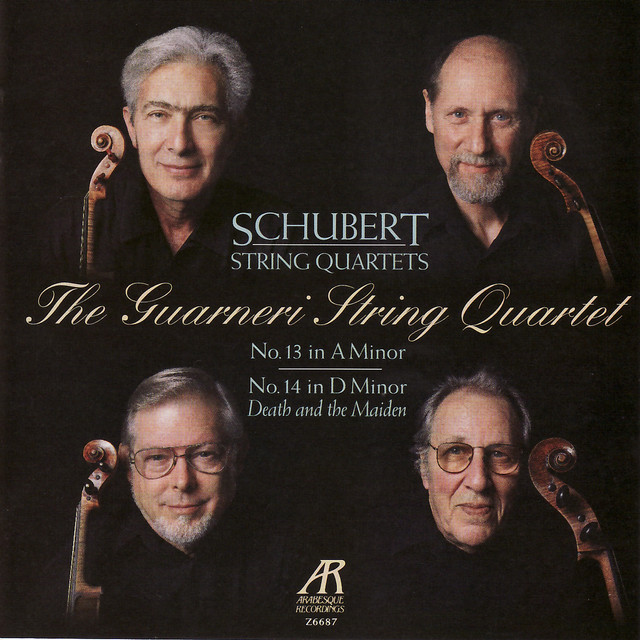
Guarneri Quartet

Classical
Chamber Music
 Viberate Rank: 293039
 Viberate Rank: 293039
 Monthly ListenersFollowers
 Subscribers
 Followers
 Followers
 FansTop Spotify SongsTop YouTube VideosMonthly ListenersFeatured in Playlists
| Playlist | Followers | |
|---|---|---|
1 |  This Is Sibelius Spotify | 33.46K |
2 |  Year of Wonder : Classical Music for Every Day - Clemency Burton-Hill lilham | 16.11K |
3 |  The Grand Tour Soundtrack Victor Romero Sánchez | 11.67K |
4 |  Mozart - Complete Chronological Catalogue based on Köchel catalogue K6 Ulysses' Classical | 9.54K |
5 |  Classical and Instrumental Music Soft and Slow CalColoredGlasses | 8.80K |
Audience| City | Monthly Listeners | |
|---|---|---|
1 | | 144 |
2 |  | 122 |
3 |  | 83 |
4 | | 73 |
5 | | 72 |
See full performance history, audience data, playlist activity, rankings, comparisons, and more in Viberate music analytics. Start with a free trial, then continue with a paid plan.
Guarneri Quartet’s Spotify BioUntil the year 2000, the New York City-based Guarneri Quartet consisted of the same four players who comprised the group at its 1964 founding: Arnold Steinhardt (violin), a former assistant concertmaster under Szell in the Cleveland Orchestra; John Dalley (violin), a one-time member of the Oberlin Quartet; Michael Tree (viola), formerly a highly respected concert violinist who converted to the viola; and David Soyer (cello), previously a member of several chamber ensembles, including the Bach Aria Group. Few chamber groups have maintained both the same personnel and such a consistent level of renown for so enduring a period. In 2000, Peter Wiley replaced David Soyer as the group's cellist. He is a former member of the Beaux Arts Trio.
The Guarneri Quartet's roots date to the 1964 Marlboro Festival, where as individual musicians they appeared with various ensembles and with pianist Rudolf Serkin. At the urging of violinist Alexander Schneider, the group collectively agreed to form a… string quartet, taking their name from the famous Italian family of violin makers. It quickly achieved critical acclaim with 1965 appearances at the Spoleto Festival and Metropolitan Museum of Art. The group has since regularly appeared at the latter venue and have established other such recurring events, such as the Lincoln Center-based series entitled Guarneri and Friends, which began in 1973. The Guarneri Quartet also made immediate headway in the recording venue, with its traversal of the 16 Beethoven quartets (and Grosse Fugue) for RCA, issued from 1966-1969, which received several prestigious awards. The group gave highly acclaimed performances of all the Beethoven quartets in a historic 1970 series of concerts in London. For the first decade or so of its existence, the Guarneri players had developed a reputation largely associated with eighteenth and nineteenth century repertory staples, but in the mid-'70s, the group shifted its focus to include important works from the twentieth century, like the six quartets of Béla Bartók, which the quartet also recorded to critical acclaim. Its repertory would later broaden to include not only works by Stravinsky, but Henze (piano quintet) and Rorem (String Quartet No. 3). Most of the group's early recordings appeared on RCA, but they moved to Philips in 1986, their first issue coming late that year with the Smetana String Quartet No. 1, "From My Life." They re-recorded much of their repertory for Philips including the Beethoven quartets. In the late 1990s, the group also started issuing recordings on the Arabesque label and in 2001, they made their first compact disc for a new label, Surrounded by Entertainment.
The Guarneri Quartet has also garnered numerous awards apart from those associated with its many recordings. In 1982, New York's Mayor Edward Koch gave the group the New York Seal of Recognition and the State University of New York (S.U.N.Y.) issued members honorary doctorate degrees in 1983, their second such citation, the first coming in 1976 from the University of South Florida.
The Guarneri Quartet has also reached its audiences via numerous broadcasts over radio and several appearances on television, including a particularly notable one from 1990 on the CBS Network's Sunday Morning program, hosted by Charles Kuralt, which featured an interview with the players. The group was also the subject of a 1989 film entitled High Fidelity -- The Guarneri String Quartet. Several books have focused on their artistry, as well, including the 1986 Alfred A. Knopf publication The Art of Quartet Playing: The Guarneri in Conversation with David Blum. In 1998, Farrar, Straus, and Giroux published Arnold Steinhardt's own book Indivisible By Four: A String Quartet in Pursuit of Harmony.
Viberate is a music analytics platform built for A&Rs, artist managers, labels, booking agents, marketers, and artists.
It helps music professionals track artist growth, analyze audience data, monitor playlist activity, compare artists, follow song performance, and identify opportunities across the music market.
Public artist pages provide a free preview of selected artist data. Paid plans provide access to deeper analytics, historical data, charts, comparisons, playlist tools, exports, alerts, reports, and additional professional features.
Yes. Public Viberate artist pages provide selected artist analytics and music data for free.
Viberate also offers a 7-day free trial of the full platform. A credit card is required to start the trial. The trial includes access to the complete product so users can test deeper artist analytics, historical views, playlist insights, comparisons, charts, exports, alerts, and reporting features before choosing a paid plan.
Viberate provides artist analytics across streaming, playlists, social media, video, radio airplay, songs, and audience markets.
Users can analyze Spotify performance, Spotify and Apple Music playlists, YouTube activity, TikTok and Instagram growth, radio spins, song performance, audience locations, demographics, rankings, and overall artist momentum.
Artist profiles also connect to music charts, similar artists, and comparison tools, helping users benchmark performance and evaluate artists in context.
Viberate updates key artist and track data daily.
For followed artists and tracks, selected data is refreshed multiple times per day. This helps teams monitor playlist changes, streaming movement, audience growth, releases, and campaign performance with more current data.
Update frequency can vary depending on the metric and data source.
Yes. Viberate lets users compare up to five artists side by side across streaming, social media, audience, and engagement metrics.
Users can compare fanbase growth, audience demographics, locations, Spotify performance, social metrics, and other artist data over selected time periods.
Artist comparison can be used for A&R scouting, benchmarking, booking decisions, campaign planning, and evaluating artists with similar audiences or market positions.