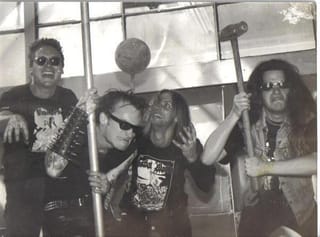
Burning Witch

Metal
Doom/Sludge Metal
 Viberate Rank: 214695
 Viberate Rank: 214695
 Monthly ListenersFollowers
 Subscribers
 Followers
 Followers
 FansTop Spotify Songs
| Track | 7-Day Streams | |
|---|---|---|
1 | 2.69K | |
2 | 789 | |
3 | 486 | |
4 | 476 | |
5 | 321 |
Top YouTube VideosMonthly ListenersFeatured in Playlists| Playlist | Followers | |
|---|---|---|
1 |  Ultimate Sludge Metal Loudwire | 30.11K |
2 |  The Sound of Sludge Metal The Sounds of Spotify | 7.44K |
3 |  The Heaviest Doom/Sludge/Drone Metal 𝕰𝖒𝖕𝖊𝖎𝖗í𝖆_𝕬𝖇𝖆𝖉𝖉𝖔𝖓 | 5.41K |
4 |  The Sound of Drone Metal The Sounds of Spotify | 4.21K |
5 |  psych stoner doom blues rock metal chris | 3.77K |
Audience| City | Monthly Listeners | |
|---|---|---|
1 | | 151 |
2 | | 125 |
3 | | 116 |
4 |  | 109 |
5 |  | 100 |
See full performance history, audience data, playlist activity, rankings, comparisons, and more in Viberate music analytics. Start with a free trial, then continue with a paid plan.
Burning Witch’s Spotify BioWhen it became apparent that underground metal favorites Thorshammer had to shut down their operation, the group re-formed intact (except for vocalist Ozma and bassist James Hale) and charted a musical course both slower and heavier than their previous partnership. The resulting project became Burning Witch, one of extreme music's all-time slowest, lowest bands. Darker than doom metal, spookier than sludge, Burning Witch explored the most secluded corners of negativity and depression. Subsequent artists have matched this group's minimal approach to metal in terms of beats-per-minute and ridiculously detuned instrumentation, but Burning Witch recordings will perhaps always be known for their unmatched reach into the maudlin depths of fear, paranoia, and the entire range of sour human emotion.
After putting the cult success that was Thorshammer to rest in 1995, guitarists Stephen O'Malley and Greg Anderson (the latter formerly of the post-rock Engine Kid) along with drummer Jamie Sykes… formed Burning Witch with the explicit intention of topping their previous unit in terms of heaviness. The trio came one step closer to its lofty goal when bassist G. Stuart Dahlquist and vocalist Edgy 59 signed on to the project. Anderson left to form the stoner group Goatsnake before the completion of any meaningful Burning Witch recordings. The band then carried on with only one guitarist and in 1996, they recorded their debut EP, Towers, with white-hot "alternative" producer Steve Albini (the Pixies, Big Black, PJ Harvey, Nirvana, etc.) Like the work of Thorshammer before, Towers was an instant sensation all along the hard music fringe. Doom/sludge fans were obsessed with the record's challenge to the concepts of rock structure and form. The band followed up their debut with another EP the following year entitled Rift.Canyon.Dreams, an even more experimental effort. This 1997 release utilized complex but still heavy and repetitive riffing to achieve a more mature but equally punishing sound. Sykes was replaced by drummer B.R.A.D. for the Rift.Canyon.Dreams sessions. Then, just after their second disc was finished, Burning Witch disbanded in 1997. A year later, both of the group's recordings were combined on one CD and released on O'Malley's and former guitarist Anderson's new Southern Lord stoner/doom specialty label. The strength of this compilation -- entitled Crippled Lucifer (Seven Psalms for Our Lord of Light) -- was a key factor that lead to the label's commercial viability. Surprised by the success, Southern Lord's founders began signing more bands and subsequently grew to become one of their genre's most important musical hubs. This fact alone secures Burning Witch a certain amount of historical significance within the stoner/doom community. A couple of the defunct group's tracks that hadn't been released were put on a Hydra Head Records split with Goatsnake in 2000, pretty much completing Burning Witch's discography. Besides running Southern Lord, O'Malley and Anderson keep busy with their ambient/doom experimental project Sunn 0))). Anderson also continued on with Goatsnake, with whom Dahlquist hooked up with in 2000. Edgy 59 also moved on to form Sinisstar. ~ Vincent Jeffries, Rovi
Viberate is a music analytics platform built for A&Rs, artist managers, labels, booking agents, marketers, and artists.
It helps music professionals track artist growth, analyze audience data, monitor playlist activity, compare artists, follow song performance, and identify opportunities across the music market.
Public artist pages provide a free preview of selected artist data. Paid plans provide access to deeper analytics, historical data, charts, comparisons, playlist tools, exports, alerts, reports, and additional professional features.
Yes. Public Viberate artist pages provide selected artist analytics and music data for free.
Viberate also offers a 7-day free trial of the full platform. A credit card is required to start the trial. The trial includes access to the complete product so users can test deeper artist analytics, historical views, playlist insights, comparisons, charts, exports, alerts, and reporting features before choosing a paid plan.
Viberate provides artist analytics across streaming, playlists, social media, video, radio airplay, songs, and audience markets.
Users can analyze Spotify performance, Spotify and Apple Music playlists, YouTube activity, TikTok and Instagram growth, radio spins, song performance, audience locations, demographics, rankings, and overall artist momentum.
Artist profiles also connect to music charts, similar artists, and comparison tools, helping users benchmark performance and evaluate artists in context.
Viberate updates key artist and track data daily.
For followed artists and tracks, selected data is refreshed multiple times per day. This helps teams monitor playlist changes, streaming movement, audience growth, releases, and campaign performance with more current data.
Update frequency can vary depending on the metric and data source.
Yes. Viberate lets users compare up to five artists side by side across streaming, social media, audience, and engagement metrics.
Users can compare fanbase growth, audience demographics, locations, Spotify performance, social metrics, and other artist data over selected time periods.
Artist comparison can be used for A&R scouting, benchmarking, booking decisions, campaign planning, and evaluating artists with similar audiences or market positions.