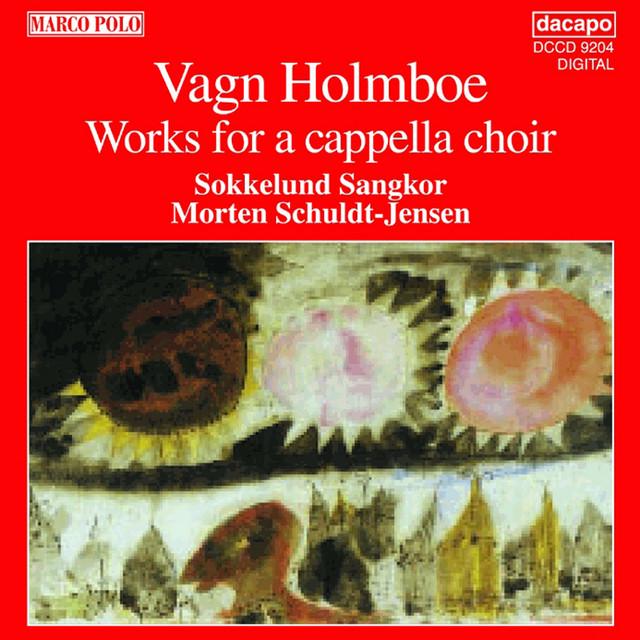
Vagn Holmboe

Classical
Orchestral
 Viberate Rank: 757457
 Viberate Rank: 757457
 Monthly ListenersFollowers
 Subscribers
 Followers
 Followers
 FansTop Spotify SongsTop YouTube VideosMonthly ListenersFeatured in Playlists
| Playlist | Followers | |
|---|---|---|
1 |  NPR Classical NPR Music | 14.43K |
2 |  Best Trombone Music Benjamin | 6.61K |
3 |  Christian Mystical Music stevengelberg | 1.42K |
4 | Penguin Guide Rosette Winners Ulysses' Classical | 1.27K |
5 |  Ultimate Dark/Sad Classical brilliantos | 1.20K |
Audience| City | Monthly Listeners | |
|---|---|---|
1 | | 36 |
2 | | 15 |
3 | | 12 |
4 |  | 10 |
5 |  | 9 |
See full performance history, audience data, playlist activity, rankings, comparisons, and more in Viberate music analytics. Start with a free trial, then continue with a paid plan.
Vagn Holmboe’s Spotify BioFew Scandinavian composers other than Sibelius and Nielsen have succeeded in claiming international attention. Holmboe was an exception and is becoming widely recognized as the most important Danish composer since Nielsen. His 13 symphonies (1935 - 1982), 20 string quartets (1949 - 1975) and other compositions, including three operas, Requiem for Nietzsche (1964), 13 chamber concertos and Epilogue (1962), are increasingly shown to be significant contributions to twentieth century music.
Holmboe's musical development was cosmopolitan. He studied in Denmark, with Toch in Berlin and in Romania, where he came into contact with Balkan folk music and heard the works of Béla Bartók whose style he assimilated. On returning to his homeland he continued to work as a composer and critic and was professor at the Royal Danish Conservatory from 1950 - 1965 where he became immersed in Medieval church music. Holmboe's approach, with its free use of melodic and diatonic patterns was, however, basically… neo-Classical, though more austere and inward-looking than either Nielsen or Sibelius, whose influence is less evident than that of Stravinsky and Bartók.
The First Symphony (1935) is a work of chamber proportions, while the third and fourth (a choral work), respectively subtitled "Sinfonia rustica" and "Sinfonia sacra," are precursors of a later, darker style in which the idea of "metamorphosis" -- themes that evolve through subtle tonic and thematic relationships -- is reminiscent of Hindemith, and at times, even Wagner.
International attention came when his Fifth Symphony was performed at the International Society for Contemporary Music Festival in Copenhagen in 1947, after which Holmboe received commissions in various parts of Europe. The seventh and ninth symphonies are the most intense of Holmboe's orchestral output, and the Fourth Quartet the most intimate of his chamber works.
In some sense, Holmboe is more "main-line" than his Scandinavian contemporaries are. After his marriage in 1931 to the pianist Meta Graf, he traveled to her homeland, Romania, to collect folk tunes, and later to the Faeroe Islands on a similar quest though, except in the Rustic Symphony, folk elements are not prominent in Holmboe's major works. It remains for Holmboe to receive the consistent programming and advocacy that brought Sibelius to prominence in the '50s, and Nielsen in the '60s.
Viberate is a music analytics platform built for A&Rs, artist managers, labels, booking agents, marketers, and artists.
It helps music professionals track artist growth, analyze audience data, monitor playlist activity, compare artists, follow song performance, and identify opportunities across the music market.
Public artist pages provide a free preview of selected artist data. Paid plans provide access to deeper analytics, historical data, charts, comparisons, playlist tools, exports, alerts, reports, and additional professional features.
Yes. Public Viberate artist pages provide selected artist analytics and music data for free.
Viberate also offers a 7-day free trial of the full platform. A credit card is required to start the trial. The trial includes access to the complete product so users can test deeper artist analytics, historical views, playlist insights, comparisons, charts, exports, alerts, and reporting features before choosing a paid plan.
Viberate provides artist analytics across streaming, playlists, social media, video, radio airplay, songs, and audience markets.
Users can analyze Spotify performance, Spotify and Apple Music playlists, YouTube activity, TikTok and Instagram growth, radio spins, song performance, audience locations, demographics, rankings, and overall artist momentum.
Artist profiles also connect to music charts, similar artists, and comparison tools, helping users benchmark performance and evaluate artists in context.
Viberate updates key artist and track data daily.
For followed artists and tracks, selected data is refreshed multiple times per day. This helps teams monitor playlist changes, streaming movement, audience growth, releases, and campaign performance with more current data.
Update frequency can vary depending on the metric and data source.
Yes. Viberate lets users compare up to five artists side by side across streaming, social media, audience, and engagement metrics.
Users can compare fanbase growth, audience demographics, locations, Spotify performance, social metrics, and other artist data over selected time periods.
Artist comparison can be used for A&R scouting, benchmarking, booking decisions, campaign planning, and evaluating artists with similar audiences or market positions.