The Four Knights

Jazz
Big band Jazz
Soul
Swing
 Viberate Rank: 259250
 Viberate Rank: 259250
 Monthly ListenersFollowers
 Subscribers
 Followers
 Followers
 FansTop Spotify Songs
| Track | 7-Day Streams | |
|---|---|---|
1 | 5.45K | |
2 | 79 | |
3 | 75 | |
4 | 69 | |
5 | 36 |
Top YouTube VideosMonthly ListenersFeatured in Playlists| Playlist | Followers | |
|---|---|---|
1 | 1950s Classics ruthleyland84 | 35.26K |
2 |  1950s hits (300) mervynvankuyen | 24.29K |
3 |  1930s, 1940s Pop Songs Jeff Lyons | 17.97K |
4 | Flying Tiger Playlist Laudy Laudy | 5.41K |
5 | Tiger Stores rndmized | 5.23K |
Audience| City | Monthly Listeners | |
|---|---|---|
1 |  | 191 |
2 | | 188 |
3 |  | 163 |
4 | | 140 |
5 | | 121 |
See full performance history, audience data, playlist activity, rankings, comparisons, and more in Viberate music analytics. Start with a free trial, then continue with a paid plan.
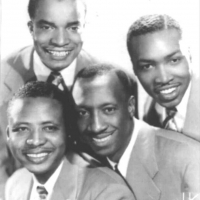
The Four Knights’ Spotify BioBest-known for their smooth pop ballad recordings, the Four Knights were equally at home lending their polished vocal harmonies to gospel songs as well. The group's career spanned almost two decades, from the early '40s through the early '60s, including a substantial amount of recordings, with over 40 commercial singles and three LPs to their credit.
The group formed in 1943 in Charlotte, NC, and consisted of Gene Alford (lead tenor), Oscar Broadway (bass), Clarence Dixon (baritone), and John Wallace (tenor and guitar). This configuration would be retained through most of the group's career. Initially the group formed not as a strictly pop group, but rather as a jubilee quartet performing a mix of gospel and secular material. They were first known as the Southland Jubilee Singers.
They made their professional debut singing for radio station WSOC, a Charlotte NBC subsidiary, in 1944. Before long they had secured a featured spot on rival CBS station WBT's "Carolina Hayride" program. This… feat was a testimony to their prowess as a vocal quartet, as they were carrying the torch previously born by the Southern Sons and the renowned Golden Gate Quartet.
Their first recordings were for the Langworth Record Company, who also took them under their managerial wing. Langworth produced specialty recordings know as transcription discs. These discs were, in fact, mini-albums comprised of 4-6 songs each. They were not sold to the general public, but were marketed to radio stations around the country. This would enable a DJ to program a show around a group, creating the illusion that the group was actually performing live at the station. The first Langworth sessions date from May of 1945. Over 30 traditional gospel tunes were recorded for Langworth as well as some 40-plus secular titles, and indicate the group already had a fairly extensive performance repertoire.
Along with the move to Langworth came the name change to the Four Knights, a more cosmopolitan and less-regionalized name. (Most of the Langworth material appears to be issued by the Four Knights.) The name change may also have reflected their increasing emphasis on a pop- rather than gospel-oriented repertoire. In 1945 the Four Knights also shifted their base of operations to New York City and before long had secured appearances on Arthur Godfrey's radio program.
With increased radio exposure, it wasn't long before a major record label would notice the group. And so in 1946, Decca signed the Four Knights and in April of that year released their first recording, "If You Ever Change Your Mind" backed with "Don't Be Ashamed to Say I Love You." There would be three more Decca releases in 1946-1947, including the group's one major-label gospel release, "Lead Me to the Rock" covered with "He'll Understand and Say Well Done." (Both titles had also been done for Langworth, but appear to have been newly recorded for Decca.) As a side note, the Hayes-Laughton gospel discography attributes one more gospel single to the group, "I Have Heard" backed with "I'm Gonna Walk Right In." This was issued as by the Southland Singers on True Blue in 1948.
In 1948, the group would have no new Decca releases but became regulars on the Red Skelton radio show, initially scoring a six-week spot, followed by a 39-week full-season contract. They stayed busy with their radio work as well as live performances, including a cross-country tour with Bill "Bojangles" Robinson. But 1949 would see two more Four Knights records released, this time on Decca's Coral subsidiary. The most memorable of these sides is "Wrapped Up in a Dream."
In 1950, the Four Knights had a rough year, with no new recordings and a loss of their Red Skelton contract. But 1951 would prove a brighter year for the group, with a change of labels to Capital, where the Four Knights would have their greatest commercial-recording success. During their six-year tenure with Capitol they would issue close to 40 singles, plus three EP and two LP albums. Their first Capitol single, issued in June of 1951, was "I Love the Sunshine of Your Smile" sided with "Sentimental Fool." "Sunshine" reached number 23 on the pop charts and is reported to have later become the Republican Party campaign song. During the early '50s, a new medium called television was starting to become a dominant mass-media vehicle. With their polished style and professional appearance, the Four Knights were well-suited for this new medium. They were able to reconnect with previous radio personality Red Skelton, and appeared on his new TV show, as well as being showcased on The Ed Sullivan Show.
The Four Knights' biggest hit came in 1954 with "I Get So Lonely When I Think About You (Oh Baby Mine)," which made it to the number two spot on the pop charts. Prior to that, they had a few other records climb the charts among a fairly steady stream of early-'50s Capitol issues. While at Capitol they also recorded a number of records backing up Capitol pop superstar Nat King Cole, the two most notable sides being "My Personal Possession" and "That's All There Is to That," both of which charted in the pop and R&B categories. As rock & roll came to prominence in the mid-'50s, the Four Knights' sound basically remained the same. Although booked on some venues as a rock & roll act, they really weren't and probably not too many teenagers were fooled.
Also by the mid-'50s, Gene Alford was suffering increasing health problems from an epileptic condition. Alford's duties in the group were taken over for a time by George Vereen and finally by Clifford Holland, who had formerly sung with the Delta Rhythm Boys. Alford passed away in 1960.
By late 1957, the Four Knights had left Capitol and had returned to Coral. Over the next two years, Coral would release four singles and two LP albums on the group. Of the singles, only one, "Oh Falling Star," met with any commercial success, barely denting the Top 100 pop chart in 1958. The two Coral LPs are of interest and together create some discographical confusion. The self-titled Four Knights LP, issued in 1958, clearly shows the personnel at the time as Holland, Wallace, Dixon, and Broadway, with no mention of Alford. The Million Dollar Baby LP, released in 1960, doesn't delineate all the group members, but contains this puzzling commentary: "The solos alternate between Oscar Broadway and Gene Alford, the top tenor. It is Alford who provides the interesting 'trumpet' effect on "Baby Face," "Rosie Baby," and others." The question is whether Alford had returned to the group for these recordings or the commentator was out of date with his group members. In listening to the tracks, it doesn't sound like Alford. This album is interesting in another aspect -- it's what you would classify as a theme or concept LP, which was somewhat unusual for the time. All the songs on the LP have the word "baby" in them, such as "Baby Face" and "Pretty Baby." One of the tracks is a new version of "Oh Baby (I Get So Lonely)," their earlier Capitol release.
Following their second Coral recording period, the Four Knights had two further and relatively obscure releases. 1962 saw the release of "La La" backed with "Tic Toc" on Triode and "I Need a Woman" covered with "These Things I Hear." By the mid-'60s, the Four Knights brought their two-decade career to an end. Much of their Capitol material can be found on a number of import CDs. The Four Knights rank as one of the top vocal groups of the period, epitomizing polished pop with a dash of R&B. ~ Jim Dunn, Rovi
Viberate is a music analytics platform built for A&Rs, artist managers, labels, booking agents, marketers, and artists.
It helps music professionals track artist growth, analyze audience data, monitor playlist activity, compare artists, follow song performance, and identify opportunities across the music market.
Public artist pages provide a free preview of selected artist data. Paid plans provide access to deeper analytics, historical data, charts, comparisons, playlist tools, exports, alerts, reports, and additional professional features.
Yes. Public Viberate artist pages provide selected artist analytics and music data for free.
Viberate also offers a 7-day free trial of the full platform. A credit card is required to start the trial. The trial includes access to the complete product so users can test deeper artist analytics, historical views, playlist insights, comparisons, charts, exports, alerts, and reporting features before choosing a paid plan.
Viberate provides artist analytics across streaming, playlists, social media, video, radio airplay, songs, and audience markets.
Users can analyze Spotify performance, Spotify and Apple Music playlists, YouTube activity, TikTok and Instagram growth, radio spins, song performance, audience locations, demographics, rankings, and overall artist momentum.
Artist profiles also connect to music charts, similar artists, and comparison tools, helping users benchmark performance and evaluate artists in context.
Viberate updates key artist and track data daily.
For followed artists and tracks, selected data is refreshed multiple times per day. This helps teams monitor playlist changes, streaming movement, audience growth, releases, and campaign performance with more current data.
Update frequency can vary depending on the metric and data source.
Yes. Viberate lets users compare up to five artists side by side across streaming, social media, audience, and engagement metrics.
Users can compare fanbase growth, audience demographics, locations, Spotify performance, social metrics, and other artist data over selected time periods.
Artist comparison can be used for A&R scouting, benchmarking, booking decisions, campaign planning, and evaluating artists with similar audiences or market positions.