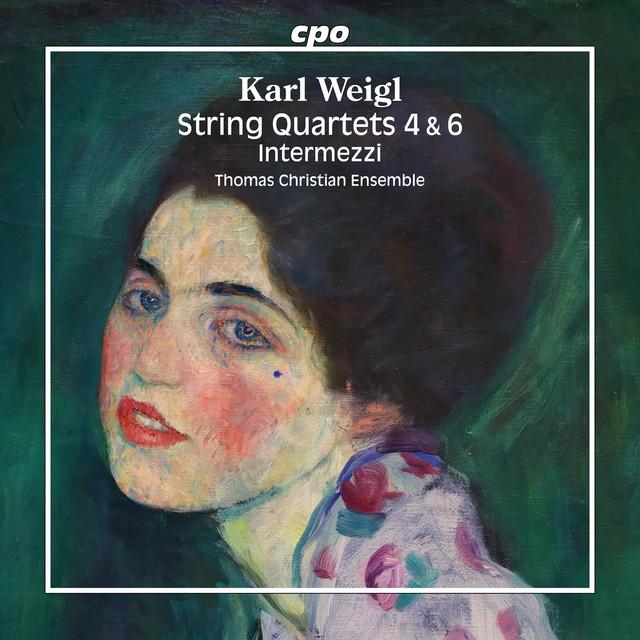
Karl Weigl

Classical
Classical Crossover
 Viberate Rank: 882585
 Viberate Rank: 882585
 Monthly ListenersFollowers
 Subscribers
 Followers
 Followers
 FansTop Spotify Songs
| Track | 7-Day Streams | |
|---|---|---|
1 | 6 |
Top YouTube VideosMonthly ListenersFeatured in PlaylistsAudience| City | Monthly Listeners | |
|---|---|---|
1 |  | 16 |
2 |  | 15 |
3 |  | 12 |
4 |  | 11 |
5 |  | 11 |
See full performance history, audience data, playlist activity, rankings, comparisons, and more in Viberate music analytics. Start with a free trial, then continue with a paid plan.
Karl Weigl’s Spotify BioAdmired in his own time, Karl Ignaz Weigl has received new attention in the 21st century. He was also an influential educator, both in Austria and in the U.S., where he fled after the rise of Nazism in his homeland. Largely forgotten for several decades, Weigl's works found new attention from performers in the 21st century. All six of his symphonies have been recorded, and an album featuring his Symphony No. 3 in B flat major was issued by the Rheinland-Pfalz Staatsphilharmonie in 2025.
Weigl was born in Vienna on February 6, 1881, into a middle-class Jewish family; his father was a banker. He had composition lessons from Alexander Zemlinsky as a teen. Weigl went on to the Vienna Academy (now the Hochschule für Musik und Darstellende Kunst) and the University of Vienna, studying composition with Robert Fuchs at the former and musicology with Guido Adler at the latter; in Adler's classes, Anton Webern was his classmate. Weigl worked for Gustav Mahler as a rehearsal assistant at the… Vienna Court Opera in the first decade of 1900, but as his music grew in popularity, he decided to devote himself to composition. His Symphony No. 1 in E major, Op. 5, was performed in Zurich, Switzerland, in 1910. Weigl served in the Austro-Hungarian army during World War I and, at the war's end, he began teaching at the New Vienna Conservatory. He moved to the University of Vienna in 1929, teaching music theory and harmony. Weigl was an influential teacher whose students included Erich Korngold and Hanns Eisler. In 1932, his opera Die Rattenfänger von Hameln, based on the tale of the Pied Piper of Hamelin, was premiered in Vienna.
Performances of Weigl's music quickly dried up in the 1930s as the Nazis seized power in Germany and then Austria. After the Anschluss connecting the two countries in 1938, Weigl fled via Switzerland, France, and Britain to the U.S., where he taught at the Hartt School of Music in Connecticut, Brooklyn College, the Boston Conservatory (now part of the Berklee College of Music), and the Philadelphia Academy of Music. He composed six symphonies, a variety of other orchestral works, and eight string quartets, and he often appeared as a performer of his own music. Weigl died of bone marrow cancer in New York on August 11, 1949. His music was admired by many in Austria, including Arnold Schoenberg, but was eclipsed as modernist styles came to the fore in the late 20th century. The 21st century has seen Weigl receiving new attention, and by 2025, some 45 of his works had been recorded. A recording of his Symphony No. 3 in B flat major and Symphonisches Vorspiel zu einer Tragödie appeared that year on the Capriccio label, featuring the Staatsphilharmonie Rheinland-Pfalz under conductor Jürgen Bruns. ~ James Manheim, Rovi
Viberate is a music analytics platform built for A&Rs, artist managers, labels, booking agents, marketers, and artists.
It helps music professionals track artist growth, analyze audience data, monitor playlist activity, compare artists, follow song performance, and identify opportunities across the music market.
Public artist pages provide a free preview of selected artist data. Paid plans provide access to deeper analytics, historical data, charts, comparisons, playlist tools, exports, alerts, reports, and additional professional features.
Yes. Public Viberate artist pages provide selected artist analytics and music data for free.
Viberate also offers a 7-day free trial of the full platform. A credit card is required to start the trial. The trial includes access to the complete product so users can test deeper artist analytics, historical views, playlist insights, comparisons, charts, exports, alerts, and reporting features before choosing a paid plan.
Viberate provides artist analytics across streaming, playlists, social media, video, radio airplay, songs, and audience markets.
Users can analyze Spotify performance, Spotify and Apple Music playlists, YouTube activity, TikTok and Instagram growth, radio spins, song performance, audience locations, demographics, rankings, and overall artist momentum.
Artist profiles also connect to music charts, similar artists, and comparison tools, helping users benchmark performance and evaluate artists in context.
Viberate updates key artist and track data daily.
For followed artists and tracks, selected data is refreshed multiple times per day. This helps teams monitor playlist changes, streaming movement, audience growth, releases, and campaign performance with more current data.
Update frequency can vary depending on the metric and data source.
Yes. Viberate lets users compare up to five artists side by side across streaming, social media, audience, and engagement metrics.
Users can compare fanbase growth, audience demographics, locations, Spotify performance, social metrics, and other artist data over selected time periods.
Artist comparison can be used for A&R scouting, benchmarking, booking decisions, campaign planning, and evaluating artists with similar audiences or market positions.