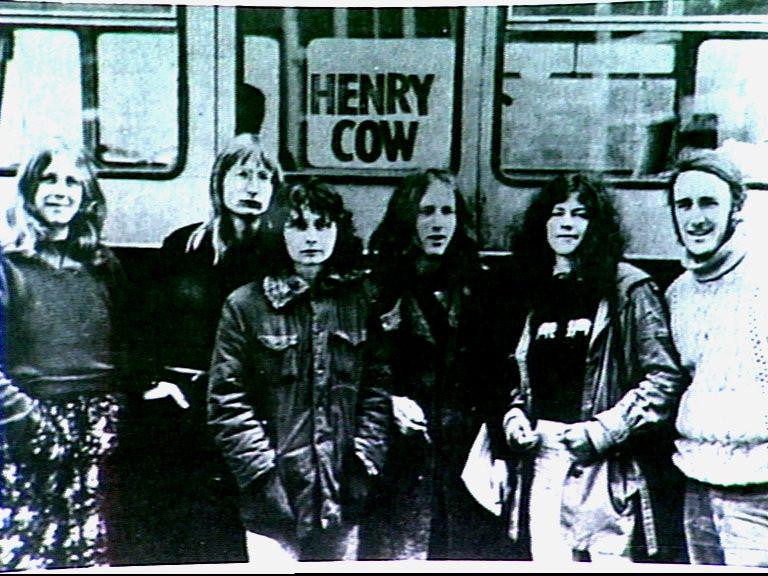
Henry Cow

Rock
Progressive Rock
 Viberate Rank: 220458
 Viberate Rank: 220458
 Monthly ListenersFollowers
 Subscribers
 Followers
 Followers
 FansTop Spotify SongsTop YouTube VideosMonthly ListenersFeatured in Playlists
| Playlist | Followers | |
|---|---|---|
1 |  The Sound of Everything The Sounds of Spotify | 53.81K |
2 |  '60s-'70s occult rock and horror folk 🧿 dialectic ego death 🧿 | 4.33K |
3 |  An Anthology Of Noise And Electronic Music Vols 1-7 mickydazzler | 3.85K |
4 |  selected gems by gyn audinjeee01 | 3.81K |
5 |  The Sound of Canterbury Scene The Sounds of Spotify | 3.46K |
Audience| City | Monthly Listeners | |
|---|---|---|
1 | | 29 |
2 |  | 23 |
3 |  | 16 |
4 |  | 13 |
5 |  | 12 |
See full performance history, audience data, playlist activity, rankings, comparisons, and more in Viberate music analytics. Start with a free trial, then continue with a paid plan.
Henry Cow’s Spotify BioThe progressive rock genre spawned many groups that became top-grossing arena acts -- Pink Floyd and Genesis are two -- as well as many who progressed right into obscurity. Henry Cow were one of the best known and most widely traveled English bands of the progressive era (though only a cult favorite in the U.S. and actually more popular in Continental Europe than in their home country), and their music has aged amazingly well over the ensuing decades due to the group's diverse influences (Oliver Messiaen, Kurt Weill, Frank Zappa, and Soft Machine were a few) and uncompromising creativity. Henry Cow functioned more or less as a collective, with a true group identity that changed from album to album as members came and went. This turnover was one factor in their consistent vitality; another was the dedicated core of the band, a serious, politicized trio whose interest in improvisation served to leaven the complexity they supplied as primary writers.
Tim Hodgkinson played keyboards and… reeds, Chris Cutler played drums, and Fred Frith provided a variety of instruments, most notably guitar. The three appear on all of the Henry Cow albums recorded between 1973 and 1978. Other important members included double reedist Lindsay Cooper, bassist John Greaves, bassist/cellist Georgie Born, and German singer Dagmar Krause. Krause, a member of Slapp Happy (also featuring Anthony Moore and Peter Blegvad), first appeared on record with Henry Cow on 1975's Henry Cow/Slapp Happy collaboration In Praise of Learning -- the third (after 1973's Leg End and 1974's Unrest) of Cow's Virgin Records era "sock cover" albums, and also the band's most overt alignment with the political left -- as well as that year's Desperate Straights, credited in reverse order to Slapp Happy/Henry Cow. Krause also worked with Frith and Cutler in the spinoff Art Bears band and later recorded bilingual renditions of songs by Brecht and Weill. Together, these musicians' sound in the Henry Cow collective was so mercurial and daring that they had few imitators, even though they inspired many on both sides of the Atlantic with a blend of spontaneity, intricate structures, philosophy, and humor that has endured and transcended the "progressive" tag. Henry Cow also played an important role in spearheading an aggregation of likeminded groups (originally including Etron Fou Leloublan from France, Samla Mammas Manna from Sweden, Stormy Six from Italy, and Univers Zero from Belgium -- the latter still going strong as of 2010) under the Rock in Opposition umbrella in 1978; while far from well-known, RIO groups and practitioners of a certain "RIO sound" created sonic ripples that have persisted well into the 21st century avant rock world.
Since the demise of Henry Cow, the group's members have continued in various creative directions, with Cutler joining Pere Ubu in the late '80s, working in Europe with rock-based or improvising ensembles, and also performing solo on his electrified drum set; Hodgkinson joining post-punk outfit the Work, focusing on avant-garde contemporary composition, and improvising on clarinet, tabletop guitar, and electronics in various aggregations including the Konk Pack trio with Thomas Lehn and Roger Turner; and Frith becoming a valued contributor to the New York downtown music scene (including a stint as bassist in John Zorn's Naked City downtown supergroup between 1988 and 1993) before entering the world of academia as a Professor of Composition at Mills College in Oakland, CA, while also composing, recording, and performing in a spectrum ranging from Tzadik label soundtracks to an improvising duo with Zorn to the rockish song-based Cosa Brava quintet, also featuring Zeena Parkins and Carla Kihlstedt. While exploring such diverse musical territories over the years, Cutler, Hodgkinson, and Frith have not reunited as a performing unit, an exception being a December 2006 appearance at the Stone in New York City.
Among other former Cow members, John Greaves has maintained a musical career as solo artist, bandmember, and collaborator in the decades following the band's breakup, performing and recording with Peter Blegvad (including the 1977 cult favorite album Kew. Rhone.) and National Health (1979's Of Queues & Cures and 1982's D.S. al Coda), and releasing a number of song-oriented albums that have seen perhaps their strongest reception in France, where he has lived since the mid-'80s. Lindsay Cooper -- whose bassoon gave the group a singular character when she joined the lineup upon the departure of original reedman Geoff Leigh prior to the recording of Unrest, and who composed the side-two suite "Day by Day" on 1979's Western Culture -- went on to record a number of politically and socially conscious albums (often displaying a strong feminist orientation) including the film scores Rags (1981) and The Gold Diggers (1983), the latter film featuring Julie Christie and noteworthy as the feature-length directorial debut of Sally Potter (Orlando); the live Oh Moscow (1991); and Sahara Dust (1992), a reflection on the 1990-1991 Gulf War in collaboration with Australian singer/writer Robyn Archer. Cooper also performed and/or recorded with diverse ensembles including the Mike Westbrook Orchestra, David Thomas & the Pedestrians, and News from Babel. She was diagnosed with multiple sclerosis and continued performing for years without divulging her condition; by the late '90s, however, Cooper was forced to retire from music and by the close of the 2000s her symptoms had seriously worsened. Sadly, she died from complications of the disease in September 2013.
Many recordings by former Henry Cow members and their RIO ilk have been distributed worldwide through the Recommended Records network spearheaded by Cutler. For Cow enthusiasts, the Holy Grail of archival sets appeared in January 2009 with the release on ReR of The Road, Vols. 1-5 and Vols. 6-10, two box sets commemorating the 40th anniversary of the band's original formation. Consisting in total of nine CDs, a DVD, and two 60-page booklets, The Road features concert recordings and other archival material spanning Henry Cow's career from 1972 to 1978. ~ Myles Boisen & Dave Lynch, Rovi
Viberate is a music analytics platform built for A&Rs, artist managers, labels, booking agents, marketers, and artists.
It helps music professionals track artist growth, analyze audience data, monitor playlist activity, compare artists, follow song performance, and identify opportunities across the music market.
Public artist pages provide a free preview of selected artist data. Paid plans provide access to deeper analytics, historical data, charts, comparisons, playlist tools, exports, alerts, reports, and additional professional features.
Yes. Public Viberate artist pages provide selected artist analytics and music data for free.
Viberate also offers a 7-day free trial of the full platform. A credit card is required to start the trial. The trial includes access to the complete product so users can test deeper artist analytics, historical views, playlist insights, comparisons, charts, exports, alerts, and reporting features before choosing a paid plan.
Viberate provides artist analytics across streaming, playlists, social media, video, radio airplay, songs, and audience markets.
Users can analyze Spotify performance, Spotify and Apple Music playlists, YouTube activity, TikTok and Instagram growth, radio spins, song performance, audience locations, demographics, rankings, and overall artist momentum.
Artist profiles also connect to music charts, similar artists, and comparison tools, helping users benchmark performance and evaluate artists in context.
Viberate updates key artist and track data daily.
For followed artists and tracks, selected data is refreshed multiple times per day. This helps teams monitor playlist changes, streaming movement, audience growth, releases, and campaign performance with more current data.
Update frequency can vary depending on the metric and data source.
Yes. Viberate lets users compare up to five artists side by side across streaming, social media, audience, and engagement metrics.
Users can compare fanbase growth, audience demographics, locations, Spotify performance, social metrics, and other artist data over selected time periods.
Artist comparison can be used for A&R scouting, benchmarking, booking decisions, campaign planning, and evaluating artists with similar audiences or market positions.