Boy Howdy

Country
Contemporary Country
 Viberate Rank: 203278
 Viberate Rank: 203278
 Monthly ListenersFollowers
 Subscribers
 Followers
 Followers
 FansTop Spotify Songs
| Track | 7-Day Streams | |
|---|---|---|
1 | 47.19K | |
2 | 10.74K | |
3 | 2.15K | |
4 | 485 | |
5 | 331 |
Top YouTube VideosMonthly ListenersFeatured in Playlists| Playlist | Followers | |
|---|---|---|
1 |  90s Country Spotify | 2.29M |
2 |  90's Country (Top 100) aly.matthews16 | 193.28K |
3 |  Classic Country (50s, 60s, 70s, 80s, 90s, 00s) Pure Country | 33.71K |
4 | Greatest Love Songs of All Time gregory9102 | 33.63K |
5 |  Best Country Songs Ever Pure Country | 33.62K |
Audience| City | Monthly Listeners | |
|---|---|---|
1 | | 3.17K |
2 | | 2.23K |
3 | | 2.00K |
4 | | 1.81K |
5 | | 1.65K |
See full performance history, audience data, playlist activity, rankings, comparisons, and more in Viberate music analytics. Start with a free trial, then continue with a paid plan.
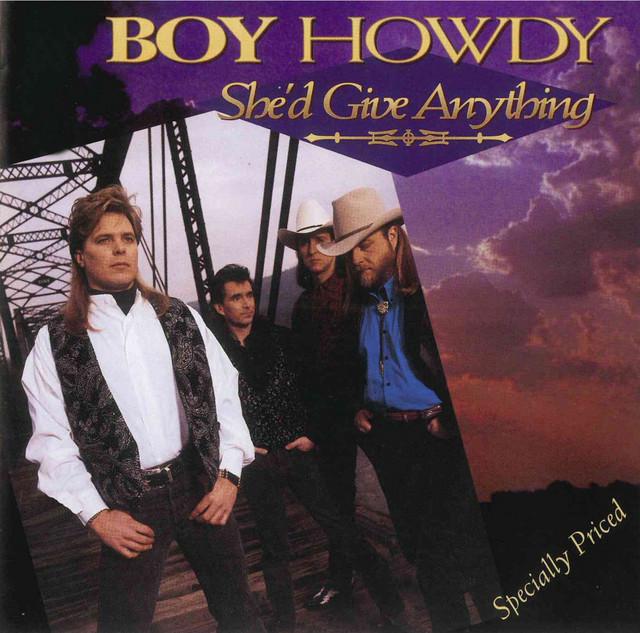
Boy Howdy’s Spotify BioBoy Howdy was a contemporary country-rock band who formed in Los Angeles in 1990. Their primary influence was Little Texas, though one could catch bits of the Eagles and CCR in their sound, and they frequently covered classic rock tunes as well. Vocalist/bassist Jeffrey Steele had previously recorded as a solo artist, and under the guidance of Dwight Yoakam producer Pete Anderson, he contributed the song "Driftin' Man" to the compilation A Town South of Bakersfield, Vol. 2. Brothers Cary (guitar, mandolin) and Larry Parks (guitar, fiddle) were the sons of bluegrass fiddler Ray Parks, and the former had played with Randy Meisner (Eagles) and Rick Roberts (Flying Burrito Brothers) before hooking up with Steele at an L.A. club. Also present at that gig was drummer Hugh Wright, who completed the lineup. Their first single was 1991's independently released "When Johnny Comes Marchin' Home Again," which proved locally popular thanks to the Gulf War, and helped land Boy Howdy a deal with… Curb. Their debut album, Welcome to Howdywood, was released in 1992, and the group went on to appear in George Strait's film Pure Country that year. Tragedy nearly struck when Wright was hit by a car and spent five months in a coma; fortunately, he recovered, and rejoined the band in time for their breakthrough, 1994's She'd Give Anything. Even though it was only a mini-album, it produced two Top Five country singles in the title track and "They Don't Make 'Em Like That Anymore." 1995's full-length, Born That Way, didn't quite duplicate that success, however. ~ Steve Huey, Rovi
Viberate is a music analytics platform built for A&Rs, artist managers, labels, booking agents, marketers, and artists.
It helps music professionals track artist growth, analyze audience data, monitor playlist activity, compare artists, follow song performance, and identify opportunities across the music market.
Public artist pages provide a free preview of selected artist data. Paid plans provide access to deeper analytics, historical data, charts, comparisons, playlist tools, exports, alerts, reports, and additional professional features.
Yes. Public Viberate artist pages provide selected artist analytics and music data for free.
Viberate also offers a 7-day free trial of the full platform. A credit card is required to start the trial. The trial includes access to the complete product so users can test deeper artist analytics, historical views, playlist insights, comparisons, charts, exports, alerts, and reporting features before choosing a paid plan.
Viberate provides artist analytics across streaming, playlists, social media, video, radio airplay, songs, and audience markets.
Users can analyze Spotify performance, Spotify and Apple Music playlists, YouTube activity, TikTok and Instagram growth, radio spins, song performance, audience locations, demographics, rankings, and overall artist momentum.
Artist profiles also connect to music charts, similar artists, and comparison tools, helping users benchmark performance and evaluate artists in context.
Viberate updates key artist and track data daily.
For followed artists and tracks, selected data is refreshed multiple times per day. This helps teams monitor playlist changes, streaming movement, audience growth, releases, and campaign performance with more current data.
Update frequency can vary depending on the metric and data source.
Yes. Viberate lets users compare up to five artists side by side across streaming, social media, audience, and engagement metrics.
Users can compare fanbase growth, audience demographics, locations, Spotify performance, social metrics, and other artist data over selected time periods.
Artist comparison can be used for A&R scouting, benchmarking, booking decisions, campaign planning, and evaluating artists with similar audiences or market positions.