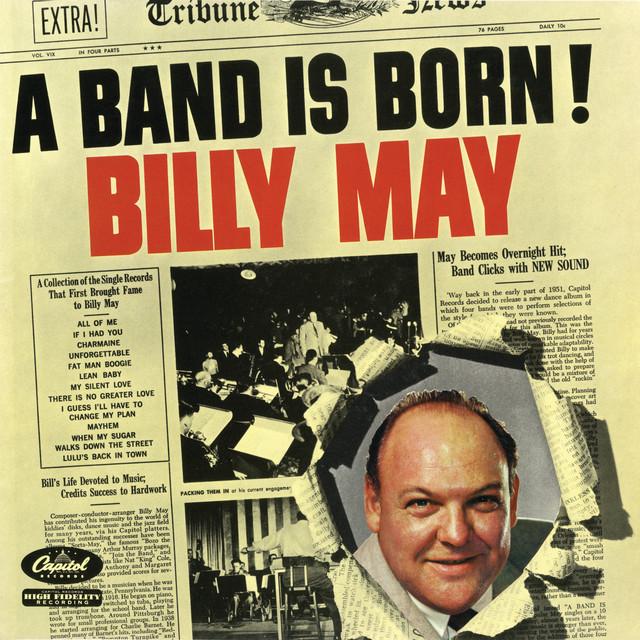
Billy May

Jazz
Big band Jazz
 Viberate Rank: 155995
 Viberate Rank: 155995
 Monthly ListenersFollowers
 Subscribers
 Followers
 Followers
 FansTop Spotify Songs
| Track | 7-Day Streams | |
|---|---|---|
1 | 57.74K | |
2 | 17.31K | |
3 | 12.87K | |
4 | 4.71K | |
5 | 4.71K |
Top YouTube VideosMonthly ListenersFeatured in Playlists| Playlist | Followers | |
|---|---|---|
1 |  Jazz Soundtracks Spotify | 197.28K |
2 |  Classic Easy Listening Spotify | 146.37K |
3 |  Frank Sinatra - I Love You Baby Joshua Chu | 145.39K |
4 |  jazz music to play in the background while cooking Natalie Nguyen | 103.63K |
5 | Wasteland Radio Expanded Neale Christopher Zeringue | 76.98K |
Audience| City | Monthly Listeners | |
|---|---|---|
1 |  | 2.40K |
2 | | 1.86K |
3 | | 1.79K |
4 | | 1.51K |
5 |  | 1.41K |
See full performance history, audience data, playlist activity, rankings, comparisons, and more in Viberate music analytics. Start with a free trial, then continue with a paid plan.
Billy May’s Spotify BioThe last of the great arrangers who wrote regularly for Frank Sinatra, Billy May had several varied careers in and out of jazz. His first notable gig was as an arranger/trumpeter with Charlie Barnet (1938-1940), for whom he wrote the wah-wah-ing hit arrangement of Ray Noble's "Cherokee." Later, he worked in the same capacities for Glenn Miller (1940-1942) and Les Brown (1942) before settling into staff jobs, first at NBC studios, then at Capitol Records, where he led his own studio big band from 1951 to 1954. His arrangements for Sinatra, beginning with Come Fly With Me (1957) and ending with Trilogy (1979), are often in a walloping, brassy, even taunting swing mode, generating some of the singer's most swaggering vocals. May also did extensive scoring for television, film, and commercials. Although May was largely inactive in the '80s and '90s , he unexpectedly surfaced in 1996 with some typically bright big band charts for comic Stan Freberg's The United States of America, Vol. 2… (Rhino), 25 years after his contributions to Vol. 1. The veteran arranger died quietly at home on January 22, 2004 at the age of 87. ~ Richard S. Ginell, Rovi
Viberate is a music analytics platform built for A&Rs, artist managers, labels, booking agents, marketers, and artists.
It helps music professionals track artist growth, analyze audience data, monitor playlist activity, compare artists, follow song performance, and identify opportunities across the music market.
Public artist pages provide a free preview of selected artist data. Paid plans provide access to deeper analytics, historical data, charts, comparisons, playlist tools, exports, alerts, reports, and additional professional features.
Yes. Public Viberate artist pages provide selected artist analytics and music data for free.
Viberate also offers a 7-day free trial of the full platform. A credit card is required to start the trial. The trial includes access to the complete product so users can test deeper artist analytics, historical views, playlist insights, comparisons, charts, exports, alerts, and reporting features before choosing a paid plan.
Viberate provides artist analytics across streaming, playlists, social media, video, radio airplay, songs, and audience markets.
Users can analyze Spotify performance, Spotify and Apple Music playlists, YouTube activity, TikTok and Instagram growth, radio spins, song performance, audience locations, demographics, rankings, and overall artist momentum.
Artist profiles also connect to music charts, similar artists, and comparison tools, helping users benchmark performance and evaluate artists in context.
Viberate updates key artist and track data daily.
For followed artists and tracks, selected data is refreshed multiple times per day. This helps teams monitor playlist changes, streaming movement, audience growth, releases, and campaign performance with more current data.
Update frequency can vary depending on the metric and data source.
Yes. Viberate lets users compare up to five artists side by side across streaming, social media, audience, and engagement metrics.
Users can compare fanbase growth, audience demographics, locations, Spotify performance, social metrics, and other artist data over selected time periods.
Artist comparison can be used for A&R scouting, benchmarking, booking decisions, campaign planning, and evaluating artists with similar audiences or market positions.