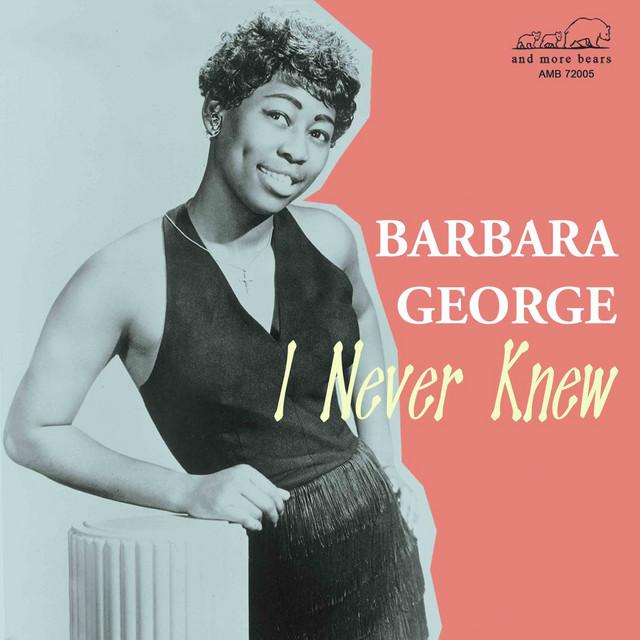
Barbara George

Blues
Classic Blues
Soul
 Viberate Rank: 196982
 Viberate Rank: 196982
 Monthly ListenersFollowers
 Subscribers
 Followers
 Followers
 FansTop Spotify SongsTop YouTube VideosMonthly ListenersFeatured in Playlists
| Playlist | Followers | |
|---|---|---|
1 |  Essential Classics Essential Classics | 31.39K |
2 |  Oldies (Sunday Night Oldies) realchuygomez | 10.61K |
3 |  El Sótano de Radio 3 Groovyfamily | 9.84K |
4 | Top 10,000 Songs of All Time Acclaimed Music | 9.19K |
5 |  New Orleans Funk diego319 | 8.19K |
Audience| City | Monthly Listeners | |
|---|---|---|
1 | | 187 |
2 | | 92 |
3 |  | 90 |
4 |  | 89 |
5 | | 83 |
See full performance history, audience data, playlist activity, rankings, comparisons, and more in Viberate music analytics. Start with a free trial, then continue with a paid plan.
Barbara George’s Spotify BioWith her lone hit "I Know (You Don't Love Me No More)," singer Barbara George recorded one of New Orleans R&B's definitive crossover smashes. Born Barbara Ann Smith in the Crescent City's Ninth Ward on August 16, 1942, she began singing as a teen in her Baptist church choir and writing her own original songs. Already married by age 16, she later befriended local R&B legend Jessie Hill, who wrangled her an audition with saxophonist/arranger Harold Battiste's fledgling AFO (All for One) label. In June 1961 Battiste organized a split recording session for George and fellow AFO artist Prince La La at producer Cosimo Matassa's legendary J&M Studios. Backed by New Orleans studio icons including cornetist Melvin Lastie, guitarist Roy Montrell, and drummer John Boudreaux, an impassioned George cut the self-penned "I Know (You Don't Love Me No More)," a vibrant, up-tempo number inspired by the traditional hymn "Just a Closer Walk with Thee." Issued via AFO's national distribution deal with Jugg…y Murray's Sue Records, "I Know" hit radio and retail in late 1961 and proved an indomitable hit, topping the U.S. R&B charts and crossing over to number three on Billboard's pop countdown.
Once the record broke, Murray began courting George with a Cadillac and new wardrobe (which he surreptitiously funded with her own royalties) and eventually persuaded her to buy out the remainder of her AFO contract. Her second and final AFO single "You Talk About Love" fell several slots shy of the U.S. Top 40 in the spring of 1962, and when Battistedefected to Los Angeles soon after , George's career floundered both professionally and creatively. The charm and verve of her AFO singles is sorely absent from Sue efforts like "If You Think," "Send for Me (If You Need Some Lovin)'," and "Recipe (For Perfect Fools)," and in the wake of 1963's prophetically titled "Something's Definitely Wrong," Murray terminated George's contract. After battling drug and alcohol problems, she resurfaced in 1967 on the New Orleans indie Seven B with the Eddie Bo-produced "Something You Got." When the single failed to return George to chart prominence, she retired from music to focus on raising her three sons, and apart from a pair of late-'70s releases on the local Hep' Me label, "Take Me Somewhere Tonight" and "This Is the Weekend," her recording career was over. A born-again Christian, in later life George primarily restricted her musical pursuits to the church choir, but in 2001 she performed "I Know" at the funeral of longtime friend and fellow New Orleans great Ernie K-Doe. After fighting Hepatitis C for more than a decade, George died in Chauvin, LA, on August 10, 2006, less than a week shy of her 64th birthday. ~ Jason Ankeny, Rovi
Viberate is a music analytics platform built for A&Rs, artist managers, labels, booking agents, marketers, and artists.
It helps music professionals track artist growth, analyze audience data, monitor playlist activity, compare artists, follow song performance, and identify opportunities across the music market.
Public artist pages provide a free preview of selected artist data. Paid plans provide access to deeper analytics, historical data, charts, comparisons, playlist tools, exports, alerts, reports, and additional professional features.
Yes. Public Viberate artist pages provide selected artist analytics and music data for free.
Viberate also offers a 7-day free trial of the full platform. A credit card is required to start the trial. The trial includes access to the complete product so users can test deeper artist analytics, historical views, playlist insights, comparisons, charts, exports, alerts, and reporting features before choosing a paid plan.
Viberate provides artist analytics across streaming, playlists, social media, video, radio airplay, songs, and audience markets.
Users can analyze Spotify performance, Spotify and Apple Music playlists, YouTube activity, TikTok and Instagram growth, radio spins, song performance, audience locations, demographics, rankings, and overall artist momentum.
Artist profiles also connect to music charts, similar artists, and comparison tools, helping users benchmark performance and evaluate artists in context.
Viberate updates key artist and track data daily.
For followed artists and tracks, selected data is refreshed multiple times per day. This helps teams monitor playlist changes, streaming movement, audience growth, releases, and campaign performance with more current data.
Update frequency can vary depending on the metric and data source.
Yes. Viberate lets users compare up to five artists side by side across streaming, social media, audience, and engagement metrics.
Users can compare fanbase growth, audience demographics, locations, Spotify performance, social metrics, and other artist data over selected time periods.
Artist comparison can be used for A&R scouting, benchmarking, booking decisions, campaign planning, and evaluating artists with similar audiences or market positions.