The Weavers

Rock
Folk Rock
Mainstream Pop
Americana/Alt Country
 Viberate Rank: 19525
 Viberate Rank: 19525
 Monthly ListenersFollowers
 Subscribers
 Followers
 Followers
 FansTop Spotify Songs
| Track | 7-Day Streams | |
|---|---|---|
1 | 2.55M | |
2 | 17.27K | |
3 | 8.38K | |
4 | 2.34K | |
5 | 2.34K |
Top YouTube Videos| Video | 7-Day Views | |
|---|---|---|
1 | 92.75K | |
2 | 54.14K | |
3 | 41.57K | |
4 | 32.18K | |
5 | 29.17K |
Monthly ListenersFeatured in Playlists| Playlist | Followers | |
|---|---|---|
1 |  NOW 100 Hits Christmas NOW That’s What I Call Music! | 181.76K |
2 |  Now That's What I Call Christmas (2015) rubypantoja17 | 100.48K |
3 |  Now That's What I Call Christmas 2026 Oliver Hiscox | 49.54K |
4 |  Essential Classics Essential Classics | 31.39K |
5 |  The Best Christmas Album in the World... Ever! Cassii | 27.02K |
Audience| City | Monthly Listeners | |
|---|---|---|
1 |  | 1.41K |
2 | | 634 |
3 | | 633 |
4 | | 609 |
5 |  | 604 |
See full performance history, audience data, playlist activity, rankings, comparisons, and more in Viberate music analytics. Start with a free trial, then continue with a paid plan.
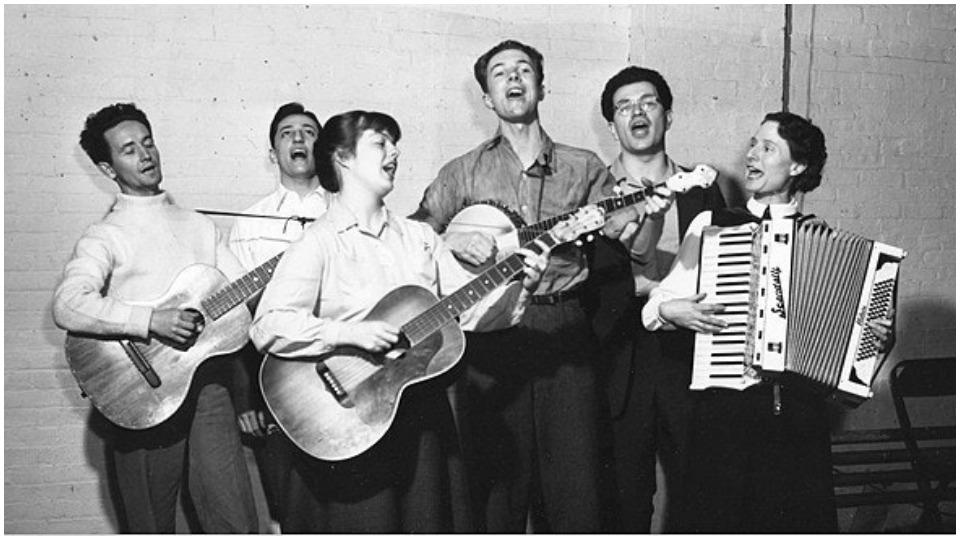
The Weavers’ Spotify BioThe Weavers had the most extraordinary musical pedigree and prehistory of any performing group in the history of folk or popular music. However, their origins, the level of their success, the forces that cut the group's future off in its prime, and the allure that keeps their music selling are all difficult to explain -- as, indeed, none of this was all that easy to explain at the time. How could a song as pleasant and tuneful as "Kisses Sweeter Than Wine" be subversive?
The quartet went from being embraced by the public, and selling four million records, to being reviled and rejected over the political backgrounds of its members, and disbanding after only four years together. Yet, despite the controversy that surrounded them, and the fact that their work was interrupted at its peak, the Weavers managed to alter popular culture in about as profound a manner as any artist this side of Bob Dylan -- indeed, they set the stage for the 1950s folk revival, indirectly fostering the careers of …the Kingston Trio, among others, and bridging the gap between folk and popular music, and folk and the topical song, they helped set the stage for Dylan's eventual emergence. And the songs that they wrote or popularized, including "Kisses Sweeter Than Wine," "Wimoweh," "Goodnight Irene," "Wreck of the John B," "Follow the Drinking Gourd," and "On Top of Old Smoky," continued to get recorded (and occasionally to chart) decades after the group's own time.
The Weavers bear a striking resemblance to an earlier group called the Almanac Singers. Pete Seeger and Lee Hays had worked together for the first time in 1940 as part of the Almanac Singers, who had enjoyed brief but notable success on radio, and as a recording outfit doing topical songs in a folk idiom, until their leftist political views became an issue; the group members had been caught in the uncomfortable position, as dedicated Communists, of having pushed pacifism and American neutrality during 1940 and early 1941, and then reversing themselves after Nazi Germany invaded the Soviet Union. In the intervening years, during and after World War II, Seeger and Hays had both been involved in various causes involving international peace, civil rights, and workers' rights, and late in 1948, Hays had suggested trying to form an ensemble similar to, but better organized than the Almanac Singers. The notion went through some evolution, including the idea -- later abandoned -- of a multiracial sextet, before it settled on Seeger, Hays, Fred Hellerman, and Ronnie Gilbert. The Brooklyn-born Hellerman and New York-born Gilbert had first met Seeger and Hays through People's Songs, a loosely knit assembly of songwriters and musicians formed in the basement of Seeger's house in Greenwich Village in 1946, which was intended to bolster the postwar union and social activism. People's Songs started with a great deal of promise but faltered two and a half years later, along with the left in general, after the election of 1948, in which the leftist presidential ticket of Henry Wallace and Glen Taylor ran last in a four-way race. It was just after the election that Hays had suggested a new singing group, and he, Seeger, Hellerman, and Gilbert, along with a fifth member named Jackie Gibson, who dropped out soon after, had initially performed that Thanksgiving. The surviving group, known informally as "the No-Name Quartet," performed at various venues around New York and once on radio, courtesy of folksinger Oscar Brand, before settling on the name the Weavers, derived from a play of the same title by Gerhart Johann Robert Hauptmann.
The Weavers' first year was spent avoiding starvation. Their intention had been to help support union-sponsored events and other progressive causes, but the members discovered that, in the wake of the collapse of the Wallace campaign, there were hardly any events at which they were welcome, or which could pay them anything. If 1948 had been a disastrous year for the left, 1949 was nothing short of catastrophic, as the forces of reaction, emboldened by Wallace's defeat and with an angry, obstructionist Republican minority in Congress to give them a national platform, went on the attack. In some instances, the attacks were literal -- during the late summer of 1949, rioting broke out at a concert in Peekskill, New York, in which hundreds were injured by members of veterans groups infuriated by the presence of singer and leftist political activist Paul Robeson, who was also the target of an aborted assassination attempt. Challenges became commonplace, to the loyalties of any visible folksingers with a topical edge to their music, or to that of the people who would hire or record them.
Pete Seeger, the most well-known member of the Weavers, was able to eke out fees of as much as $15 at some venues -- there were still schools that would book him to sing for children -- but that was as good as the money got, and it couldn't be increased for the quartet. The Weavers did make a handful of recordings in the late summer and early fall of 1949 for Charter Records, a tiny label run by former People's Songs supporter Mario Casetta, but most of them were never released, and the undercapitalized label closed in 1950.
Fate took a hand when the group, as a last-ditch effort to keep going, auditioned for a spot performing for the Christmas week of 1949 at the Village Vanguard, a New York club owned by Max Gordon, which was most closely associated with jazz. They went over so well that the gig was extended through the winter and then the entire spring, for $250 a week split four ways. Their six months at the Vanguard changed the group's fate. Though the club was virtually empty on the four weeknights, on weekends it filled up, and audiences loved the simple, unaffected enthusiasm that the quartet brought to their music. Folksinging by then had become something of an "art," an elitist, academic activity attuned to scholars, but the Weavers came off completely the opposite of this -- guileless and honest, literally four hay seeds without any experience of playing in clubs. Their presentation and popularity, coupled with the visibility of the Vanguard, soon led to reviews in newspapers and trade journals, and these were almost all positive.
It was from the Village Vanguard shows that the group first hooked up with Harold Leventhal, a young music publishing executive. He loved their work but was also honest enough to admit that, at that point in his career, he didn't know enough about business to represent them adequately, so he recommended someone who did, a manager name Pete Kameron. In the meantime, they'd also attracted the attention of Gordon Jenkins, who was then one of the top arrangers and bandleaders in the music business. Jenkins brought them to Decca Records, where he was under contract, and had the group perform for label chief Dave Kapp -- by the time the audition was over, the entire production staff was listening and singing along, but at first no one knew what to do with four white singers, whose repertory ranged from traditional gospel, work songs and children's songs, so Decca passed. It was only when Mitch Miller at Columbia Records offered the quartet a contract that Jenkins got adamant; he had a contract written and a session booked, and the group was signed to Decca.
The first result of their Decca contract was a collection of Christmas songs issued on a 10" LP, which didn't attract much attention. But their second session yielded a pair of songs, "Tzena Tzena Tzena," which got to number two, and "Goodnight Irene," which hit number one and stayed there for 13 weeks, and ended up selling two million copies as a double-sided hit single. Cut just before the group left the Vanguard in June of 1950, the two songs caught everyone by surprise with their sudden success. Ronnie Gilbert had just gotten married and was planning on an extended honeymoon out west. As the newly married couple drove across the country, however, they were astonished to find "Tzena Tzena Tzena" being played on jukeboxes at the eateries where they stopped, and also turning up on the radio.
Gilbert received a telegram urging her to cut short her honeymoon and return to the group to help fulfill the bookings that were pouring in, and for the next year the world seemed to be at their feet. There were as many bookings as Kameron could accept, all for top dollar, and offers of television appearances as well, and Decca Records was eager to record anything by the group in order to keep the success of the first single going. In later years, purists would criticize Jenkins' use of string arrangements and a big band brass sound to accompany the group on the original recordings of "Goodnight Irene," "Midnight Special," and "Wimoweh," but the public never objected and the members themselves all felt that Jenkins had done his best to keep their sound intact while putting them into the commercial context of the time. Certainly, they had no objection to the idea of selling several million copies of a song like "Goodnight Irene," written and taught to them by their friend Lead Belly, who had struggled for decades for success and recognition and, alas, had died the year before. The label tried their sound in different formats and combinations, even teaming the Weavers with Terry Gilkyson, a beautiful baritone-voiced folksinger, on "On Top of Old Smoky."
It was all too good to last; they knew, and it didn't. Ever since the breakout of the first single as a hit, the members had expected that somewhere down the line their past political affiliations would be thrown back in their faces. Their manager did his best to downplay any political associations by the group -- they were never booked into potentially controversial events, such as union meetings or political rallies, and avoided doing songs that were overly controversial. From the very start, the group's repertory had been put together on the fly; at the Vanguard, when they realized that the handful of songs that they'd prepared weren't enough to cover the lengths of the sets that the audience wanted from them, they would propose and spontaneously do songs right there on-stage, all material that they knew well from their own respective pasts and all of it considered "safe" and appropriate for a club audience, rather than a political meeting -- Hays' background as the son of a Methodist minister gave him a rich trove of religious songs to draw on, and the others, with Seeger as the dominant figure after Hays, chose what they thought were the best and safest songs they knew.
The irony was that their concerts -- usually at clubs, or in hotel venues where big bands were the norm -- were so innocuous politically, that the Weavers were derided by the leftist press, even by their former colleague Irwin Silber in the pages of Sing Out!, a journal then known for its strong editorial positions. They were sneered at as sellouts. And then, in the summer of 1950, just as they were being offered a 15-minute weekly television show of their own, the anti-Communist journal Red Channels denounced the Weavers. The offer of the program disappeared -- though the group did do a series of spots for Snader Television, an early syndicator in the new medium -- and soon bookings began drying up, though not immediately and not completely. The records kept selling, with another two million copies of their music purchased in America in 1951, spearheaded by "Kisses Sweeter Than Wine," their adaptation of an old Irish folk song that they'd learned from Lead Belly. By that time, however, they were under FBI surveillance and the pressure was on -- it's impossible for someone born after the 1950s to appreciate the stigma, coupled with the threat, attached in those days to the very notion of being seen doing business with someone under FBI surveillance, or being called to testify before a Congressional committee; it could end, or at least severely compromise careers, and split up friends and families; in those days, teachers were being fired from their jobs and students were being threatened with expulsion from colleges for refusing to sign loyalty oaths.
For two years, from the middle of 1950, when the first accusations of the group's alleged disloyalty surfaced, until the summer of 1952, Kameron had been able to keep securing the group some work, in smaller, more out of the way venues and from promoters, especially in the northeast, who were willing to risk the protests, hate mail, and threats that inevitably followed the announcement of a Weavers concert. Part of the problem was the group's sheer visibility -- with "Kisses Sweeter Than Wine," as innocuous a song politically as one could imagine, getting a huge amount of airplay, they were a constant source of offense, like a red flag (literally) being waved in the face of rabid anti-Communists. The fact that the Republicans had retaken control of Congress in the 1950 elections, transforming the most rabid anti-Communists from an angry minority into a nasty majority, caused the behavior of their allies around the country to become only more virulent as the military stalemate in the Korean War dragged on through 1951 and 1952. On some subconscious level, it was as though, helpless to defeat the North Koreans (or the Soviets backing them) on the battlefield, the political right transformed any alleged domestic Communists into valid targets, and the Weavers were out there singing, selling lots of records, and making lots of noise. The fact that the group was making money by getting Americans to buy their records, and that a company like Decca Records was earning hundreds of thousands of dollars in profits from their work, only meant that the Weavers were a corrupting force. The very fact that they'd sneaked into their success so suddenly, virtually "under the radar" of the political right, was an offense. And the fact that no member of the group had ever uttered a word in public (or, for all anyone knew, in private) about the Korean War was, curiously, irrelevant amid all of the controversy.
By the end of 1952, the group had called it quits. Decca no longer wanted to record them because it was difficult, if not impossible, to get their records into the stores, and it was no longer possible to get their music played on the radio. The label kept paying them for the duration of their contract until it ended in 1953, and by then each of the members had moved on to other activities. Another key factor, even if the political and business climate had been more favorable, was Pete Seeger, who was never wholly comfortable working in a group context due to the limitations it placed on his repertory, and who liked even less the compromises that the Weavers had made in pursuing their work. The group was seemingly forgotten by the public over the next three years, their music banished from the airwaves and their records withdrawn -- Ronnie Gilbert and her husband moved to California, Fred Hellerman became a music teacher, Seeger performed as a solo act at whatever schools would book him, and Lee Hays wrote radio commercials.
In 1955, however, Harold Leventhal proposed a reunion concert for the four. They tried to book Town Hall in New York but weren't allowed to rent it, so controversial were they still. Instead, in a move that anticipated Brian Epstein's boldness in booking the hall for the Beatles nine years later, Leventhal rented Carnegie Hall -- the irony was that Carnegie Hall's management, involved in the relatively rarefied world of classical music, was totally unaware of any controversy surrounding the Weavers and had no objections. (Similarly, when Brian Epstein called to book the Beatles years later, on the eve of their breakthrough in America, the Carnegie Hall management had no inkling of who they were and assumed that a "quartet" meant four string players and not a rock & roll group, who would not have been allowed to book the hall.) The Weavers reunion event proved to be a sellout and then some, with hundreds turned away; equally important, it was captured on tape, and the tape was then sold to Vanguard Records.
Vanguard at that time was a small but enterprising label specializing in classical music, run by two brothers, Maynard Solomon and Seymour Solomon, a pair of music lovers and scholars. They had no shareholders to answer to and no corporate structure, and even in the world of classical record distribution were fiercely independent. Vanguard released the reunion concert and did very well with it, they followed it up with a second volume, and suddenly Vanguard and the Weavers had a new recording contract. It was through the Vanguard releases, the reunion concerts, and the recordings that followed, that most of the Weavers' baby-boom audience, and virtually any enthusiasts acquired during the folk revival of the late '50s and early '60s, and at any time after, discovered the group and its music.
Their Vanguard recordings were stripped down, very basic productions, just the group members playing with no dubbed-on accompaniment; these recordings are usually regarded more highly than the Decca material which, in any case, wasn't available for many years in any comprehensive form. Seeger left the re-formed group in 1958, preferring to pursue a solo career on his own. By that time, ironically enough, the stage had been set for just such an opportunity by the Weavers themselves. They may not have survived the blacklist intact, but the interest in folk songs that they'd fostered, along with the proof, in the form of millions of copies of "Goodnight Irene" and "Kisses Sweeter Than Wine" that had been sold, wasn't lost on the public or the music business -- by 1956, groups like the Easy Riders (led by Terry Gilkyson and featuring a pair of lesser-known People's Songs alumni, Frank Miller and Richard Dehr), had charted a few huge national hits in a distinctly folk-like idiom with "Marianne"; big record labels were looking at folk music, and smaller ones were recording it, and when the Kingston Trio broke out with the two-million-selling "Tom Dooley" in 1958, the dam burst. Collegiate folk groups were in, and even controversial "old" Pete Seeger was able to get a contract with Columbia Records. By the end of the '50s, the anti-Communists were also in retreat, having been discredited by their woefully flawed national icon, Senator Joseph McCarthy, and his fall from power -- nobody especially wanted to take them on if they could help it, but they weren't winning any new battles or new friends, either. Even the Tokens' 1962 hit single, another version of the Weavers' hit "Wimoweh," entitled "The Lion Sleeps Tonight," only helped sustain the Weavers' reputation.
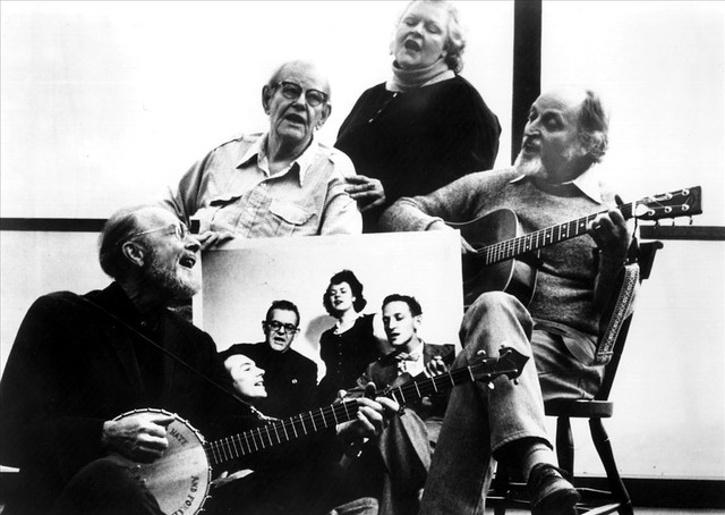
Seeger's first replacement in the Weavers was Erik Darling, a former member of the Tarriers who lasted with the group until 1961 when he left to pursue a solo career and, eventually, to form the Rooftop Singers; he was succeeded by Frank Hamilton, who stayed until 1963 and was succeeded by an acquaintance of Lee Hays', Bernie Krause, who worked with the group during their final year together, including the 1964 Carnegie Hall concert which featured a composite of all the group members working together. The group members went their separate ways, each of them remaining in music to varying degrees, although Ronnie Gilbert also pursued a degree in psychology; Pete Seeger helped introduce Bob Dylan to the established folk audience, and later showed that he had lost none of his flair for controversy, challenging the popular media with new songs such as "Waist Deep in the Big Muddy," dealing with Vietnam; Lee Hays saw a song that he had co-written with Carl Sandburg as "Wreck of the John B," retitled "Sloop John B," turned into a huge rock & roll hit by the Beach Boys, and he later became a mentor to Don McLean (who also performed with Pete Seeger).
In November of 1980, a pair of reunion concerts at Carnegie Hall became the final appearance of the original quartet and the focal point of the film Wasn't That a Time, a documentary that chronicled the Weavers' history. Hays passed away the following summer, on August 26, 1981, at the age of 67, thus ending the active history of the original group, but the other members of the original Weavers remained active into the new millennium. Pete Seeger died in Manhattan on January 27, 2014 at the age of 94; Ronnie Gilbert died in Mill Valley, California on June 6, 2015 at the age of 88; and Fred Hellerman, the last living original group member, died in Weston, Connecticut on September 1, 2016 at the age of 89.
Two box-set collections of the group's work -- Wasn't That a Time on Vanguard, covering their history from 1950 through 1964, and Goodnight Irene: The Weavers 1949-1953 on Bear Family, devoted exclusively to their first four years together -- have appeared in the digital era, along with Kisses Sweeter Than Wine, a double-disc set of previously unreleased live performances from the years 1950-1953 on Omega Records, the successor label to the Solomon brothers' Vanguard Records. Additionally, most of their Vanguard albums have reappeared in digital formats, and a pair of compilations of their Decca work have been issued in England and America.
Listening to their material today, the great irony is the sense of timelessness in the performances. The avoidance of controversy, which made the group such pariahs to their compatriots on the left and utterly infuriating to their opponents on the right, gave the Weavers' music a universality that topical songs of the era would have sorely lacked ten or 20 years later. At the same time, the group's unaffected style, partly a result of their sheer inexperience, gave the recordings an honesty and directness that was lacking in the more scholarly approach to folk music that was more typical of the era. The result is a body of songs several hundred strong that has stood the test of time. ~ Bruce Eder, Rovi
Viberate is a music analytics platform built for A&Rs, artist managers, labels, booking agents, marketers, and artists.
It helps music professionals track artist growth, analyze audience data, monitor playlist activity, compare artists, follow song performance, and identify opportunities across the music market.
Public artist pages provide a free preview of selected artist data. Paid plans provide access to deeper analytics, historical data, charts, comparisons, playlist tools, exports, alerts, reports, and additional professional features.
Yes. Public Viberate artist pages provide selected artist analytics and music data for free.
Viberate also offers a 7-day free trial of the full platform. A credit card is required to start the trial. The trial includes access to the complete product so users can test deeper artist analytics, historical views, playlist insights, comparisons, charts, exports, alerts, and reporting features before choosing a paid plan.
Viberate provides artist analytics across streaming, playlists, social media, video, radio airplay, songs, and audience markets.
Users can analyze Spotify performance, Spotify and Apple Music playlists, YouTube activity, TikTok and Instagram growth, radio spins, song performance, audience locations, demographics, rankings, and overall artist momentum.
Artist profiles also connect to music charts, similar artists, and comparison tools, helping users benchmark performance and evaluate artists in context.
Viberate updates key artist and track data daily.
For followed artists and tracks, selected data is refreshed multiple times per day. This helps teams monitor playlist changes, streaming movement, audience growth, releases, and campaign performance with more current data.
Update frequency can vary depending on the metric and data source.
Yes. Viberate lets users compare up to five artists side by side across streaming, social media, audience, and engagement metrics.
Users can compare fanbase growth, audience demographics, locations, Spotify performance, social metrics, and other artist data over selected time periods.
Artist comparison can be used for A&R scouting, benchmarking, booking decisions, campaign planning, and evaluating artists with similar audiences or market positions.