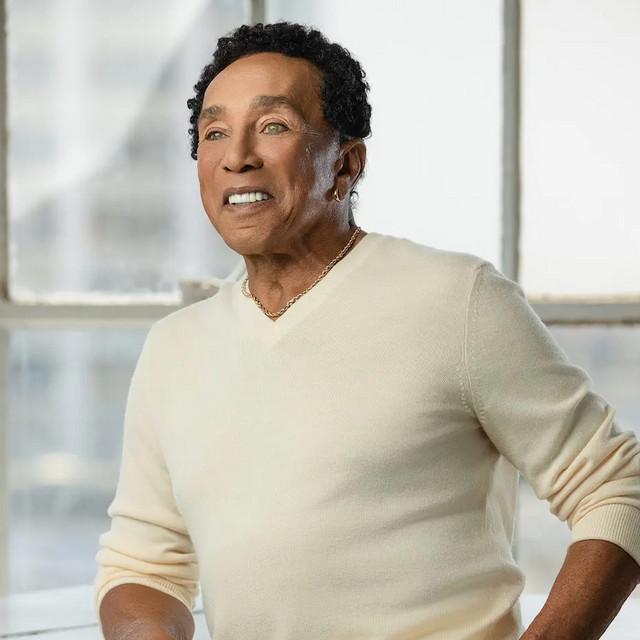
Smokey Robinson

R&B
Contemporary R&B
Soul
 Viberate Rank: 7304
 Viberate Rank: 7304
 Monthly ListenersFollowers
 Subscribers
 Followers
 Followers
 FansTop Spotify Songs
| Track | 7-Day Streams | |
|---|---|---|
1 | 295.09K | |
2 | 136.49K | |
3 | 120.03K | |
4 | 97.87K | |
5 | 90.47K |
Top YouTube Videos| Video | 7-Day Views | |
|---|---|---|
1 | 68.04K | |
2 | 40.99K | |
3 | 27.19K | |
4 | 25.60K | |
5 | 21.36K |
Monthly ListenersFeatured in Playlists| Playlist | Followers | |
|---|---|---|
1 |  Feelin' Good Spotify | 3.58M |
2 |  Soft 70s Spotify | 1.19M |
3 |  Mellow Classics Spotify | 881.33K |
4 |  Feel Good Summer Spotify | 609.21K |
5 |  Motown Spotify | 498.37K |
Audience| City | Monthly Listeners | |
|---|---|---|
1 | | 46.37K |
2 |  | 17.70K |
3 | | 17.62K |
4 | | 17.25K |
5 |  | 15.17K |
See full performance history, audience data, playlist activity, rankings, comparisons, and more in Viberate music analytics. Start with a free trial, then continue with a paid plan.
Smokey Robinson’s Spotify BioSmokey Robinson is one of the most iconic figures in R&B. As the leader of the Miracles, the singer/songwriter and producer played a key role in making Motown the quintessential label of the genre. The first Motown signees, Robinson and his group helped define pop-oriented soul with Top Ten hits such as "Shop Around" (1960), "You've Really Got a Hold on Me" (1962), and the chart-topping "The Tears of a Clown" (1970). At the same time, he became an invaluable behind-the-scenes figure who wrote and produced -- including Mary Wells' "My Guy" and the Temptations' "My Girl," both number one hits -- and scouted and developed talent while serving as vice-president at Motown. Robinson continued to be bankable as a solo artist in the '70s and '80s. His lush, romantic ballads inspired a radio format named after his album A Quiet Storm (1975), before he notched solo Top Ten singles with "Cruisin'" (1979), "Being with You" (1981), and the Grammy-winning "Just to See Her" (1987). Inducted into the… Rock & Roll Hall of Fame in 1987, Robinson entered the Songwriters Hall of Fame three years later, and in 2005 received the Johnny Mercer Award, the highest honor of the latter institution. He continues to perform while occasionally releasing studio projects like Smokey & Friends (2014) and Gasms (2023).
William Robinson, Jr. was born in Detroit, Michigan on February 19, 1940. He grew up in Detroit's Brewster housing project and picked up the nickname "Smokey Joe" from his Uncle Claude, which quickly stuck. Robinson first developed an interest in music by investigating his mother's record collection, which included classic sides by Sarah Vaughan, Billy Eckstine, Muddy Waters, and John Lee Hooker. Robinson's mother died when he was ten, and since his father was frequently on the road making his living as a truck driver, young Smokey was looked after by his older sister Geraldine, and in his early teens he began singing, performing in informal doo wop groups with his friends.
In 1955, Robinson assembled a vocal group called the Five Chimes, which featured his schoolmates Clarence Dawson, James Grice, Pete Moore, and Ronald White. In 1956, the group adopted a new name, the Matadors, after Dawson left and Emerson Rogers took his place, and a year later, Rogers and James Grice left the lineup, and Claudette Rogers and Bobby Rogers (respectively Emerson Rogers' sister and cousin) stepped in. With their new co-ed lineup, the name the Matadors was considered a poor fit, and they began calling themselves the Miracles. A guitarist, Marv Tarplin, joined the act in 1958, and the Miracles began making a name for themselves on Detroit's R&B scene.
In 1958, Robinson met Berry Gordy, a Detroit-based songwriter who had penned several hits for Jackie Wilson and was looking to make a name for himself in the music business. Gordy was impressed with the Miracles and Robinson's talents as a songwriter; he helped the band land a deal with End Records and the Miracles released their first single, "Got a Job" (an answer song to the Silhouettes' hit "Get a Job") later that year. While the single sold well in Detroit, it didn't make much noise nationally, and follow-ups on the End and Chess labels fared no better. Robinson believed he and Gordy could do better themselves, and he urged Gordy to follow through on his idea of forming his own label. The Miracles became the first act signed to Gordy's new record company, Motown, and in 1960, their song "Shop Around," written by Robinson, was the first Motown single to become a nationwide hit.
Throughout the '60s, the Miracles were a frequent presence on the pop and R&B charts, scoring hits with such songs as "Tracks of My Tears," "Mickey's Monkey," "You've Really Got a Hold on Me," "Going to a Go-Go," "Ooo Baby Baby," and many more. As Robinson became recognized as the creative force behind the group, their name was changed to Smokey Robinson & the Miracles in 1966. Robinson also shared his talents with many other Motown acts. He wrote "My Guy" and "The One Who Really Loves You" for Mary Wells, "My Girl," "Get Ready," and "The Way You Do the Things You Do" for the Temptations, "Ain't That Peculiar" and "I'll Be Doggone" for Marvin Gaye, and "The Hunter Gets Captured by the Game" for the Marvelettes, among many others. As a vice-president at Motown, Robinson was also a key part of the label's management and production team, and helped guide the company into being one of the most successful independent American record labels of all time.
Robinson fell in love with Claudette Rogers not long after she joined the Miracles and they were married in 1959. By 1969, Robinson was growing tired of dividing his time between his family, Motown, and the Miracles, and he decided to retire from the group so he could spend more time at home and less time on the road. He postponed his departure when "Tears of a Clown" (recorded in 1966) unexpectedly became a major hit in 1970, but a year later, he launched a "farewell tour" with the Miracles, though the group would continue without him (and Robinson would write one of their latter-day hits, "Floy Joy").
After a two-year layoff, Robinson returned to the recording studio with his first solo album, 1973's Smokey. The LP found Robinson focusing on midtempo romantic numbers as well as more mature and personal themes, which would carry over to his second solo effort, 1974's Pure Smokey. Robinson scored a pair of major R&B hits with 1975's A Quiet Storm, the title tune and "Baby, That's Backatcha," and the former tune would give a name to the sort of polished, romantic R&B that was becoming Robinson's stock in trade. Robinson continued to make his presence known on the charts with the Top Ten hits "Cruisin'" (from 1979's Where There's Smoke) and "Being with You" (from the 1981 album of the same name). The year 1987 was a memorable one for Robinson -- the album One Heartbeat would score a massive hit for him with the song "Just to See Her," which also earned him a Grammy, and he was also inducted into the Rock & Roll Hall of Fame (though the rest of the Miracles were not, much to his consternation). But this came near the end of an important era for Robinson -- in 1988, Motown was sold to MCA, and Robinson stepped down as vice-president. He parted from Motown with Love Smokey, released in 1990, the same year he entered the Songwriters Hall of Fame and was handed a Lifetime Achievement Grammy. He signed with SBK Records for 1992's Double Good Everything.
The end of Motown came during a period for Robinson that was turbulent on personal and professional levels. Following the 1991 release of Double Good Everything, he wouldn't record again until 1999, when he released Intimate for the revived Motown. In 2004, Robinson recorded a contemporary gospel album, Food for the Spirit, and a collection of standards, Timeless Love, followed in 2006. Robinson returned to the smooth soul sounds of his '70s and '80s solo work with 2009's Time Flies When You're Having Fun, released on his own label, Robso Records; several tracks from this album were matched with remakes of Robinson's Motown hits for the collection Now & Then. In 2014, he released a Verve album, Smokey & Friends, for which he remade 11 of his most popular compositions with a roster of duet partners that included Linda Ronstadt, Elton John, and Mary J. Blige. Christmas Everyday, his first holiday album since he left the Miracles, followed a few years later. In 2023, he issued Gasms, his first set of original material in over a decade. ~ Mark Deming, Rovi
Viberate is a music analytics platform built for A&Rs, artist managers, labels, booking agents, marketers, and artists.
It helps music professionals track artist growth, analyze audience data, monitor playlist activity, compare artists, follow song performance, and identify opportunities across the music market.
Public artist pages provide a free preview of selected artist data. Paid plans provide access to deeper analytics, historical data, charts, comparisons, playlist tools, exports, alerts, reports, and additional professional features.
Yes. Public Viberate artist pages provide selected artist analytics and music data for free.
Viberate also offers a 7-day free trial of the full platform. A credit card is required to start the trial. The trial includes access to the complete product so users can test deeper artist analytics, historical views, playlist insights, comparisons, charts, exports, alerts, and reporting features before choosing a paid plan.
Viberate provides artist analytics across streaming, playlists, social media, video, radio airplay, songs, and audience markets.
Users can analyze Spotify performance, Spotify and Apple Music playlists, YouTube activity, TikTok and Instagram growth, radio spins, song performance, audience locations, demographics, rankings, and overall artist momentum.
Artist profiles also connect to music charts, similar artists, and comparison tools, helping users benchmark performance and evaluate artists in context.
Viberate updates key artist and track data daily.
For followed artists and tracks, selected data is refreshed multiple times per day. This helps teams monitor playlist changes, streaming movement, audience growth, releases, and campaign performance with more current data.
Update frequency can vary depending on the metric and data source.
Yes. Viberate lets users compare up to five artists side by side across streaming, social media, audience, and engagement metrics.
Users can compare fanbase growth, audience demographics, locations, Spotify performance, social metrics, and other artist data over selected time periods.
Artist comparison can be used for A&R scouting, benchmarking, booking decisions, campaign planning, and evaluating artists with similar audiences or market positions.