Origin Unknown

Electronic
Drum & Bass
 Viberate Rank: 112735
 Viberate Rank: 112735
 Monthly ListenersFollowers
 Subscribers
 Followers
 Followers
 FansTop Spotify Songs
| Track | 7-Day Streams | |
|---|---|---|
1 | 56.67K | |
2 | 10.54K | |
3 | 6.87K | |
4 | 4.47K | |
5 | 3.16K |
Top YouTube VideosMonthly ListenersFeatured in Playlists| Playlist | Followers | |
|---|---|---|
1 |  90s Rave Classics Tom Bantica | 153.04K |
2 |  Jungle Classics Spotify | 102.40K |
3 |  HOUSE CLASSICS | 80's - 2026 | TOMORROW’S CLASSICS Erwin Oliveira | 99.22K |
4 | 90s JUNGLE CLASSICS Kurt | 92.63K |
5 |  Drum & Bass Classics 90s (1995-2006) - Jungle Classics 90s oppositemarco | 79.15K |
Audience| City | Monthly Listeners | |
|---|---|---|
1 | | 16.40K |
2 | | 4.84K |
3 | | 3.23K |
4 | | 2.35K |
5 |  | 1.98K |
See full performance history, audience data, playlist activity, rankings, comparisons, and more in Viberate music analytics. Start with a free trial, then continue with a paid plan.
Origin Unknown’s Spotify BioEast London jungle imprint Ram Recordings (along with labels such as Droppin' Science, Flex, Infra-Red, and No U-Turn) is closely associated with a new wave of drum'n'bass innovators, twisting darkside and hardstep into future-fueled, increasingly entropic configurations that draw as often from the dry, brittle technologism of techno and electro as from jungle's more uppity roots in hip-hop and ragga. Entirely owned and operated by partners Andy C. and Ant Miles, Ram's back catalog is near-filled with Ant- and Andy-related projects such as Concept 2, Desired State, and perhaps their most well-known and best-respected pseudonym, Origin Unknown. Formed in Essex in 1990, Ram was a product of the area's vibrant pirate radio underground; the label shares roots with hardcore staple Suburban Base (and Sub Base's storefront, Boogie Times), producers Dillinja, Cool Hand Flex, and DJ Hype, and pirate frequencies such as Centreforce and Sunrise. Andy and Ant's working relationship (the pair set… up a studio and began recording together in 1990) grew out of a shared dissatisfaction with more mainstream dance music production and an increasing fascination with exploding breakbeat culture, which by 1992 had grown to critical mass in London's East End.
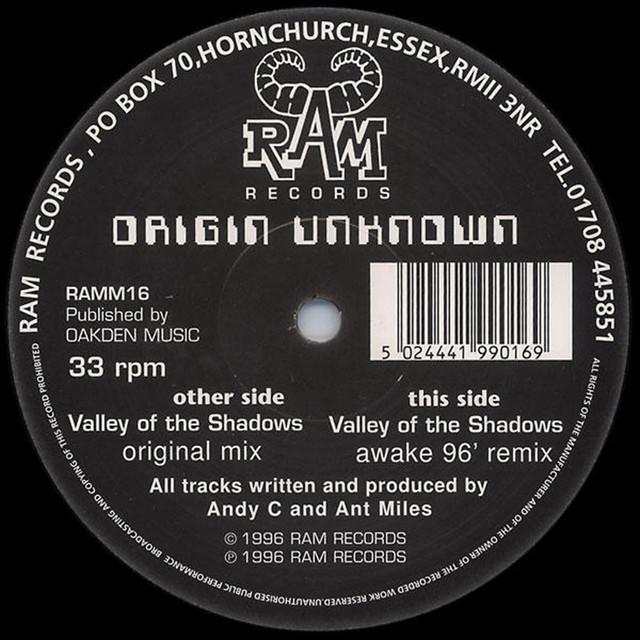
The pair's early releases include remix and engineering work for Suburban Base and an assortment of artists, but Ram was already in the works by the time they were seriously laying down tracks, and by the release of their fourth 12-inch -- "The Touch"/"Valley of the Shadows" -- Ram's trademark of dark, pointed, brazenly technological hardstep was picking up speed in the clubs. That single's B-side, in fact, was one of the earliest blasts from darkside's more bleepy cousin, techstep (popularized by Ed Rush, Trace, Doc Scott, etc.). Rather than following tech's leaders through the murk of fear and isolation, however, Andy and Ant have turned instead to a process of refinishing; an approach similar to techno, with the focus on the details and subtlety and finesse substituted for the brash beats-n-bass attack of techstep's front guard. The breaks still shred through the fabric of their tracks, but rolling beats in the Ram sense never equal soft and sweet, and a nervous, adamant jitter of electronics is usually in tow.
The pair took the formula to new heights in late 1996, coming up with arguably one of the biggest tunes of the year with the Origin Unknown remix of Busta Rhymes' "Whoo-Ha." And while Ram and sister label Liftin' Spirits (home primarily to Miles-related projects) have remained for the most part 12" driven, the pair joined ranks with labels such as Metalheadz, Infra-Red, and Reinforced by releasing The Speed of Sound in early 1997, a full-length collection of new cuts and exclusive mixes from the entire Ram family (which also includes Shimon and Stakka & K-Tee, among others). The following year, Andy C, Miles, and Shimon released three lauded singles (as Ram Trilogy) and followed with the full-length Molten Beats in 1999. In addition to their work together with Ram and Liftin' Spirits, Ant and Andy continue a long reign as in-demand remixers, as well as DJing (Andy) and working on solo material (Miles records as Higher Sense for Moving Shadow). [See Also: Ram Trilogy] ~ Sean Cooper
Viberate is a music analytics platform built for A&Rs, artist managers, labels, booking agents, marketers, and artists.
It helps music professionals track artist growth, analyze audience data, monitor playlist activity, compare artists, follow song performance, and identify opportunities across the music market.
Public artist pages provide a free preview of selected artist data. Paid plans provide access to deeper analytics, historical data, charts, comparisons, playlist tools, exports, alerts, reports, and additional professional features.
Yes. Public Viberate artist pages provide selected artist analytics and music data for free.
Viberate also offers a 7-day free trial of the full platform. A credit card is required to start the trial. The trial includes access to the complete product so users can test deeper artist analytics, historical views, playlist insights, comparisons, charts, exports, alerts, and reporting features before choosing a paid plan.
Viberate provides artist analytics across streaming, playlists, social media, video, radio airplay, songs, and audience markets.
Users can analyze Spotify performance, Spotify and Apple Music playlists, YouTube activity, TikTok and Instagram growth, radio spins, song performance, audience locations, demographics, rankings, and overall artist momentum.
Artist profiles also connect to music charts, similar artists, and comparison tools, helping users benchmark performance and evaluate artists in context.
Viberate updates key artist and track data daily.
For followed artists and tracks, selected data is refreshed multiple times per day. This helps teams monitor playlist changes, streaming movement, audience growth, releases, and campaign performance with more current data.
Update frequency can vary depending on the metric and data source.
Yes. Viberate lets users compare up to five artists side by side across streaming, social media, audience, and engagement metrics.
Users can compare fanbase growth, audience demographics, locations, Spotify performance, social metrics, and other artist data over selected time periods.
Artist comparison can be used for A&R scouting, benchmarking, booking decisions, campaign planning, and evaluating artists with similar audiences or market positions.