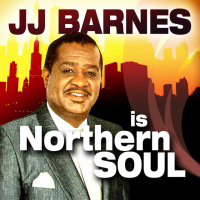
J.J. Barnes

R&B
Contemporary R&B
Soul
 Viberate Rank: 258949
 Viberate Rank: 258949
 Monthly ListenersFollowers
 Subscribers
 Followers
 Followers
 FansTop Spotify Songs
| Track | 7-Day Streams | |
|---|---|---|
1 | 1.05K | |
2 | 949 | |
3 | 949 | |
4 | 416 | |
5 | 374 |
Top YouTube VideosMonthly ListenersFeatured in Playlists| Playlist | Followers | |
|---|---|---|
1 |  Northern Soul - The Best 100 tunes ever! Mike Steed | 49.56K |
2 |  Indications' Inspirations Durand Jones & The Indications | 35.68K |
3 |  Northern Soul ajmcdonald007 | 14.67K |
4 |  Morning Soul. Musical Metaphors | 13.53K |
5 |  The NTS Breakfast Show w/ Flo - NTS NTS ᵇᵒᵗ (killed 2026/03) | 12.70K |
Audience| City | Monthly Listeners | |
|---|---|---|
1 |  | 509 |
2 | | 355 |
3 | | 164 |
4 | | 102 |
5 |  | 88 |
See full performance history, audience data, playlist activity, rankings, comparisons, and more in Viberate music analytics. Start with a free trial, then continue with a paid plan.
J.J. Barnes’ Spotify BioDetroit soul singer J.J. Barnes was active for well over 50 years, recording his earliest singles in 1960 and creating some Northern Soul classics while working adjacent to the peak of the Motown explosion. Barnes' biggest charting hit of his own was 1967's "Baby Please Come Back Home," but he recorded countless others, worked in a group with Edwin Starr, wrote songs for Martha and the Vandellas, recorded new material into the '90s, and was performing on-stage just months before he died at age 79 in 2022.
James Jay Barnes was born November 30, 1943, in Detroit, Michigan. In 1960, when he was 17, Barnes cut his first single, "My Love Came Tumbling Down" b/w "Won't You Let Me Know," for Kable Records, and shortly thereafter released four more singles with Mickay Records. His first, single for the label, 1963's "Just One More Time," became a sought-after Northern soul side. The Scepter label's "These Chains of Love," "Teenage Queen," and "So Far Away" -- all released in 1963 and 1964 --… were good efforts that few heard. He cut one record for Ring Records in 1964, "Poor Unfortunate Me" b/w "She Ain't Ready."
Ric-Tic Records issued Barnes' seventh record and followed it with three more, debuting with "Please Let Me In" in 1965; like many of Barnes' recordings, it had a pronounced, four-on-the-floor beat -- the beat that defined the early Northern soul sound. His Ric-Tic debut sold better than previous singles. "Real Humdinger," its successor, charted at number 20 on the R&B chart and number 60 on the pop chart, but, despite these numbers, wasn't played in some cities. With Edwin Starr (lead) and Steve Mancha, Barnes hit with "I'll Love You Forever" as the Holidays. The record was a complete fluke -- the trio just happened to be around when producer Don Davis got an itch to cut the tune. They never toured as the Holidays -- Davis recruited other singers for that. "Say It" b/w "Deeper in Love" didn't stand a chance because Ed Wingate was in the process of selling Ric Tic/Golden World Records lock, stock, and barrel to Motown.
Barnes wasn't happy being Motown's property, neither was his ex-Ric-Tic buddy Edwin Starr. Motown never released anything by Barnes, the company was more interested in his songwriting abilities and released at least two songs co-written by Barnes: "Show Me the Way" by Martha & the Vandellas (October 1967) and "Don't Make Hurting Me a Habit" by the Marvelettes (December 1968).
Motown released Barnes from his contract and he hooked up with Don Davis again, scoring the first time on Groovesville Records with "Baby Please Come Back Home." Its successor, "Now That I Got You Back" b/w "Forgive Me" (1967), a stomper and a pleader, threw a rod at number 44. The third, "Sweet Sherry," with the Originals harmonizing behind Barnes, didn't sell despite its immense charm. Then came "Easy Living" b/w "I've Lost You," with backing vocals by the Holidays, on the Groove City label, which sank upon release. A stint on Revilot Records resulted in four singles, including "Our Love Is in the Pocket," a popular Northern soul song. Barnes co-wrote his final Revilot single, "So Called Friends" (1969), with George Clinton (Parliament) and two unknown brothers by the last name of Taylor.
Buddah, Volt, Leo, Magic Touch, Perception, and Invasion Records issued Barnes' next five releases, from 1969 to 1973. None hit, but "Snowflakes," the Volt release, was later acclaimed by some Britishers. Perception issued the first J.J. Barnes album, Born Again, in 1973; the Perception sides didn't compare to earlier recordings, nor did what followed.
Old friend Edwin Starr moved to England and became very popular; remembering Barnes, Starr arranged for his old buddy to come over and do a series of shows with him. This proved to be a lucrative move, as Barnes signed a deal with Contempo Records, a U.K. label, in the mid-'70s. Contempo cranked out seven undistinguished singles and an album, Sara Smile, for Barnes. He debuted on Contempo with "To an Early Grave," cut a remake of Hall & Oates' "Sara Smile," and tried to popularize an inner city dance tune, "The Errol Flynn."
He released at least five more records -- including "Think I Got a Good Chance" on Organic, an update of Carl Carlton's "Competition Ain't Nothing" on Inferno in 1984, an attempt to recapture the magic of Frank Wilson's Motown release (which was ignored in the U.S.) "Do I Love You (Deed I Do)" on Inferno in 1985, and two on Motor City. Albums include Rare Stamps on Volt Records, which features cuts by Barnes, Steve Mancha, and Darrell Banks; he also recorded an album on Motor City Records entitled Try It One More Time.
A virtual nobody in the States, Barnes was one of Northern soul's most beloved artists. Soul fans worldwide love him, but at home his sister, Ortheia Barnes, was more known. Ortheia Barnes never had a hit, but once hosted a radio show in Detroit on WCHB every Wednesday called Ortheia's Special Touch; she was fondly remembered by fans who saw her electrifying live performances. Barnes got a tip of the hat from a fellow Detroit artist, Mick Collins of the Dirtbombs, who covered Barnes' song "Chains of Love" on his band's 2001 album Ultraglide in Black. In October 2022, Barnes headlined the Detroit A-Go-Go Festival, a destination event for fans of classic Detroit soul music. Barnes said it would likely be his last public performance, and he was right -- J.J. Barnes died on December 10, 2022 at the age of 79. ~ Andrew Hamilton, Rovi
Viberate is a music analytics platform built for A&Rs, artist managers, labels, booking agents, marketers, and artists.
It helps music professionals track artist growth, analyze audience data, monitor playlist activity, compare artists, follow song performance, and identify opportunities across the music market.
Public artist pages provide a free preview of selected artist data. Paid plans provide access to deeper analytics, historical data, charts, comparisons, playlist tools, exports, alerts, reports, and additional professional features.
Yes. Public Viberate artist pages provide selected artist analytics and music data for free.
Viberate also offers a 7-day free trial of the full platform. A credit card is required to start the trial. The trial includes access to the complete product so users can test deeper artist analytics, historical views, playlist insights, comparisons, charts, exports, alerts, and reporting features before choosing a paid plan.
Viberate provides artist analytics across streaming, playlists, social media, video, radio airplay, songs, and audience markets.
Users can analyze Spotify performance, Spotify and Apple Music playlists, YouTube activity, TikTok and Instagram growth, radio spins, song performance, audience locations, demographics, rankings, and overall artist momentum.
Artist profiles also connect to music charts, similar artists, and comparison tools, helping users benchmark performance and evaluate artists in context.
Viberate updates key artist and track data daily.
For followed artists and tracks, selected data is refreshed multiple times per day. This helps teams monitor playlist changes, streaming movement, audience growth, releases, and campaign performance with more current data.
Update frequency can vary depending on the metric and data source.
Yes. Viberate lets users compare up to five artists side by side across streaming, social media, audience, and engagement metrics.
Users can compare fanbase growth, audience demographics, locations, Spotify performance, social metrics, and other artist data over selected time periods.
Artist comparison can be used for A&R scouting, benchmarking, booking decisions, campaign planning, and evaluating artists with similar audiences or market positions.