Jimmy Reed

Blues
Classic Blues
Contemporary Blues
Smooth Jazz
 Viberate Rank: 57109
 Viberate Rank: 57109
 Monthly ListenersFollowers
 Subscribers
 Followers
 Followers
 FansTop Spotify Songs
| Track | 7-Day Streams | |
|---|---|---|
1 | 36.65K | |
2 | 27.90K | |
3 | 6.02K | |
4 | 4.89K | |
5 | 2.06K |
Top YouTube Videos| Video | 7-Day Views | |
|---|---|---|
1 | 1.44K | |
2 | 364 | |
3 | 268 | |
4 | 174 | |
5 | 172 |
Monthly ListenersFeatured in Playlists| Playlist | Followers | |
|---|---|---|
1 |  Blues Classics Spotify | 2.33M |
2 |  Blues Masters Filtr Legacy Sweden | 226.80K |
3 | TOP 100 Greatest Blues Songs Of All Time: Best Blues Music Kamilgla | 192.49K |
4 |  1000 Recordings to Hear Before You Die (Tom Moon): Album Index Ulysses' Classical | 94.29K |
5 |  Hanni’s Playlist | 63.54K |
Audience| City | Monthly Listeners | |
|---|---|---|
1 |  | 5.80K |
2 |  | 2.15K |
3 |  | 1.99K |
4 |  | 1.76K |
5 | | 1.71K |
See full performance history, audience data, playlist activity, rankings, comparisons, and more in Viberate music analytics. Start with a free trial, then continue with a paid plan.
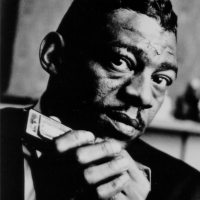
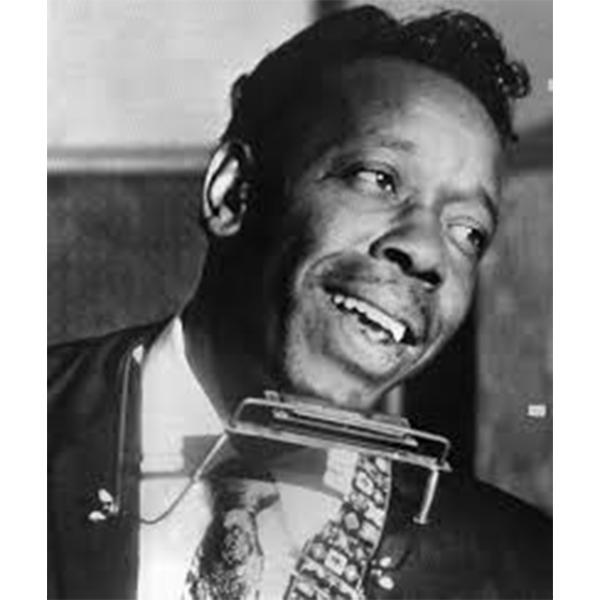
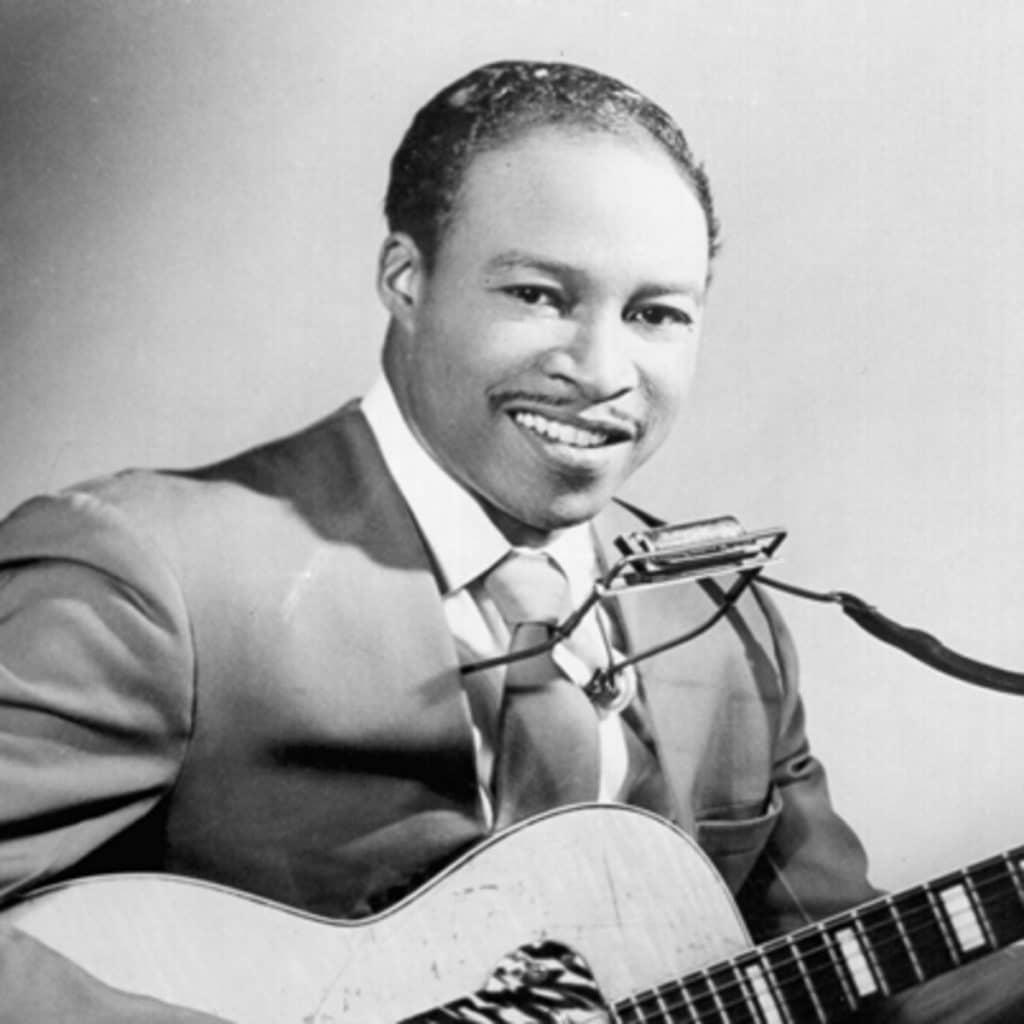
Jimmy Reed’s Spotify BioThere's simply no sound in the blues as easily digestible, accessible, instantly recognizable, and as easy to play and sing as the music of Jimmy Reed. His best-known songs -- "Baby, What You Want Me to Do," "Bright Lights, Big City," "Honest I Do," "You Don't Have to Go," "Going to New York," "Ain't That Lovin' You Baby," and "Big Boss Man" -- have become such an integral part of the standard blues repertoire, it's almost as if they have existed forever. Because his style was simple and easily imitated, his songs were accessible to just about everyone from high-school garage bands having a go at it, to Elvis Presley, Charlie Rich, Lou Rawls, Hank Williams, Jr., and the Rolling Stones, making him, in the long run, perhaps the most influential bluesman of all. His bottom-string boogie rhythm guitar patterns (all furnished by boyhood friend and longtime musical partner Eddie Taylor), simple two-string turnarounds, country-ish harmonica solos (all played in a neck-rack attachment hung… around his neck), and mush-mouthed vocals were probably the first exposure most white folks had to the blues. And his music -- lazy, loping, and insistent, constantly built on the same sturdy frame -- was a formula that proved to be enormously successful and influential, both with middle-aged blacks and young white audiences for a good dozen years. Jimmy Reed records hit the R&B charts with amazing frequency and crossed over onto the pop charts on many occasions, a rare feat for an unreconstructed bluesman. This is all the more amazing simply because Reed's music was nothing special on the surface; he possessed absolutely no technical expertise on either of his chosen instruments and his vocals certainly lacked the fierce declamatory intensity of a Howlin' Wolf or a Muddy Waters. But it was exactly that lack of in-your-face musical confrontation that made Jimmy Reed a welcome addition to everybody's record collection back in the '50s and '60s. And for those aspiring musicians who wanted to give the blues a try, either vocally or instrumentally (no matter what skin color you were born with), perhaps Billy Vera said it best in his liner notes to a Reed greatest-hits anthology: "Yes, anybody with a range of more than six notes could sing Jimmy's tunes and play them the first day Mom and Dad brought home that first guitar from Sears & Roebuck. I guess Jimmy could be termed the '50s punk bluesman."
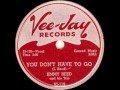
Reed was born on September 6, 1925, on a plantation in or around the small burg of Dunleith, MS. He stayed around the area until he was 15, learning the basic rudiments of harmonica and guitar from his buddy Eddie Taylor, who was then making a name for himself as a semi-pro musician, working country suppers and juke joints. Reed moved up to Chicago in 1943, but was quickly drafted into the Navy where he served for two years. After a quick trip back to Mississippi and marriage to his beloved wife Mary (known to blues fans as "Mama Reed"), he relocated to Gary, Indiana, and found work at an Armour Foods meat packing plant while simultaneously breaking into the burgeoning blues scene around Gary and neighboring Chicago. The early '50s found him working as a sideman with John Brim's Gary Kings (that's Reed blowing harp on Brim's classic "Tough Times" and its instrumental flipside, "Gary Stomp") and playing on the street for tips with Willie Joe Duncan, a shadowy figure who played an amplified, homemade one-string instrument called a Unitar. After failing an audition with Chess Records (his later chart success would be a constant thorn in the side of the firm), Brim's drummer at the time -- improbably enough, future blues guitar legend Albert King -- brought him over to the newly formed Vee-Jay Records, where his first recordings were made. It was during this time that he was reunited and started playing again with Eddie Taylor, a musical partnership that would last off and on until Reed's death. Success was slow in coming, but when his third single, "You Don't Have to Go" backed with "Boogie in the Dark," made the number five slot on Billboard's R&B charts, the hits pretty much kept on coming for the next decade.
But if selling more records than Muddy Waters, Howlin' Wolf, Elmore James, or Little Walter brought the rewards of fame to his doorstep, no one was more ill-equipped to handle them than Jimmy Reed. With signing his name for fans being the total sum of his literacy, combined with a back-breaking road schedule once he became a name attraction and his self-description as a "liquor glutter," Reed started to fall apart like a cheap suit almost immediately. His devious schemes to tend to his alcoholism -- and the just plain aberrant behavior that came as a result of it -- quickly made him the laughingstock of his show-business contemporaries. Those who shared the bill with him in top-of-the-line R&B venues like the Apollo Theater -- where the story of him urinating on a star performer's dress in the wings has been repeated verbatim by more than one old-timer -- still shake their heads and wonder how Reed could actually stand up straight and perform, much less hold the audience in the palm of his hand. Other stories of Reed being "arrested" and thrown into a Chicago drunk tank the night before a recording session also reverberate throughout the blues community to this day. Little wonder then that when he was stricken with epilepsy in 1957, it went undiagnosed for an extended period of time, simply because he had experienced so many attacks of delirium tremens, better known as the "DTs." Eddie Taylor would relate how he sat directly in front of Reed in the studio, instructing him while the tune was being recorded exactly when to start to start singing, when to blow his harp, and when to do the turnarounds on his guitar. Jimmy Reed also appears, by all accounts, to have been unable to remember the lyrics to new songs -- even ones he had composed himself -- and Mama Reed would sit on a piano bench and whisper them into his ear, literally one line at a time. Blues fans who doubt this can clearly hear the proof on several of Jimmy's biggest hits, most notably "Big Boss Man" and "Bright Lights, Big City," where she steps into the fore and starts singing along with him in order to keep him on the beat.
But seemingly none of this mattered. While revisionist blues historians like to make a big deal about either the lack of variety of his work or how later recordings turned him into a mere parody of himself, the public just couldn't get enough of it. Jimmy Reed placed 11 songs on the Billboard Hot 100 pop charts and a total of 14 on the R&B charts, a figure that even a much more sophisticated artist like B.B. King couldn't top. To paraphrase the old saying, nobody liked Jimmy Reed but the people.
Reed's slow descent into the ravages of alcoholism and epilepsy roughly paralleled the decline of Vee-Jay Records, which went out of business at approximately the same time that his final 45 was released, "Don't Think I'm Through." His manager, Al Smith, quickly arranged a contract with the newly formed ABC-Bluesway label and a handful of albums were released into the '70s, all of them lacking the old charm, sounding as if they were cut on a musical assembly line. Jimmy did one last album, a horrible attempt to update his sound with funk beats and wah-wah pedals, before becoming a virtual recluse in his final years. He finally received proper medical attention for his epilepsy and quit drinking, but it was too late and he died trying to make a comeback on the blues festival circuit on August 29, 1976.
All of this is sad beyond belief, simply because there's so much joy in Jimmy Reed's music. And it's that joy that becomes self-evident every time you give one of his classic sides a spin. Although his bare-bones style influenced everyone from British Invasion combos to the entire school of Louisiana swamp blues artists (Slim Harpo and Jimmy Anderson in particular), the simple indisputable fact remains that -- like so many of the other originators in the genre -- there was only one Jimmy Reed. ~ Cub Koda, Rovi
Viberate is a music analytics platform built for A&Rs, artist managers, labels, booking agents, marketers, and artists.
It helps music professionals track artist growth, analyze audience data, monitor playlist activity, compare artists, follow song performance, and identify opportunities across the music market.
Public artist pages provide a free preview of selected artist data. Paid plans provide access to deeper analytics, historical data, charts, comparisons, playlist tools, exports, alerts, reports, and additional professional features.
Yes. Public Viberate artist pages provide selected artist analytics and music data for free.
Viberate also offers a 7-day free trial of the full platform. A credit card is required to start the trial. The trial includes access to the complete product so users can test deeper artist analytics, historical views, playlist insights, comparisons, charts, exports, alerts, and reporting features before choosing a paid plan.
Viberate provides artist analytics across streaming, playlists, social media, video, radio airplay, songs, and audience markets.
Users can analyze Spotify performance, Spotify and Apple Music playlists, YouTube activity, TikTok and Instagram growth, radio spins, song performance, audience locations, demographics, rankings, and overall artist momentum.
Artist profiles also connect to music charts, similar artists, and comparison tools, helping users benchmark performance and evaluate artists in context.
Viberate updates key artist and track data daily.
For followed artists and tracks, selected data is refreshed multiple times per day. This helps teams monitor playlist changes, streaming movement, audience growth, releases, and campaign performance with more current data.
Update frequency can vary depending on the metric and data source.
Yes. Viberate lets users compare up to five artists side by side across streaming, social media, audience, and engagement metrics.
Users can compare fanbase growth, audience demographics, locations, Spotify performance, social metrics, and other artist data over selected time periods.
Artist comparison can be used for A&R scouting, benchmarking, booking decisions, campaign planning, and evaluating artists with similar audiences or market positions.