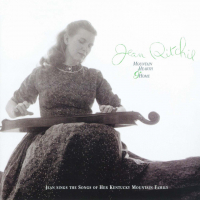
Jean Ritchie

European
Volksmusik/Alpine Folk
Folk
 Viberate Rank: 140281
 Viberate Rank: 140281
 Monthly ListenersFollowers
 Subscribers
 Followers
 Followers
 FansTop Spotify Songs
| Track | 7-Day Streams | |
|---|---|---|
1 | 8.12K | |
2 | 6.11K | |
3 | 5.11K | |
4 | 3.83K | |
5 | 3.11K |
Top YouTube VideosMonthly ListenersFeatured in Playlists| Playlist | Followers | |
|---|---|---|
1 |  Women of Folk Spotify | 336.54K |
2 |  The Sound of Everything The Sounds of Spotify | 53.81K |
3 |  Creepy Old Songs ttk trevor.editss | 37.87K |
4 | Appalachian Folk Music mheld3 | 34.95K |
5 |  Essential Classics Essential Classics | 31.39K |
Audience| City | Monthly Listeners | |
|---|---|---|
1 |  | 894 |
2 | | 834 |
3 | | 741 |
4 | | 678 |
5 | | 666 |
See full performance history, audience data, playlist activity, rankings, comparisons, and more in Viberate music analytics. Start with a free trial, then continue with a paid plan.
Jean Ritchie’s Spotify BioA key figure in the 1950s folk revival, Jean Ritchie was a one-woman treasure trove of near-forgotten American folk songs, most of which she learned as a child growing up in a rural corner of the Appalachian Mountains. Ritchie moved from Kentucky to New York City in the mid-'40s after attending college; there, she became a coffeehouse folksinger at night and a social worker by day. Along with her sporadic but deeply rewarding recording career, Jean Ritchie was best known as a tireless archivist of the Appalachian folk tradition.
Jean Ritchie was born into a large and musical family in Viper, Kentucky in 1922. The Ritchie family was very much a part of the Appalachian folk tradition, and had committed over 300 songs (including hymns, traditional love songs, ballads, children's game songs, etc.) to its collective memory, a tradition that Ritchie drew on (as well as preserved and maintained) during her performing career. She grew up in a home where singing was intertwined with nearly every… task, and the beautiful, ephemeral nature of these mountain songs and fragments was not lost on her. After graduating from high school, Ritchie attended Cumberland Junior College in Williamsburg, Kentucky, moving on to the University of Kentucky, where she graduated in 1946. She accepted a position at the Henry Street Settlement in New York City and soon found her family's songs useful in reaching out to the children in her care. Her singing, although she never had a strong pop sort of voice, was perfect for the old ballads, especially when she accompanied herself on lap dulcimer, and the ancient modal melodies of her family felt fresh and airy in her hands.
Ritchie soon found herself in demand in the New York coffeehouses, and her official career in music began. After hearing some casually recorded songs by Ritchie, Jac Holzman, who was just starting up Elektra Records, signed her to the label, eventually releasing three albums, Jean Ritchie Sings (1952), Songs of Her Kentucky Mountain Family (1957) and A Time for Singing (1962) at the height of the folk revival. Although she never reached the household name status of Peter, Paul & Mary, Joan Baez, Judy Collins or the Kingston Trio, Ritchie maintained her Appalachian authenticity, and her subsequent albums worked to preserve the rich folk tradition of the Southern Appalachians. Among her many releases are two from Smithsonian Folkways, Ballads from Her Appalachian Family Tradition and Child Ballads in America, None But One (which won a Rolling Stone Critics Award in 1977), High Hills and Mountains, Kentucky Christmas, and The Most Dulcimer. Married to the photographer George Pickow, the couple later re-released many of her albums on their own Greenhays Recordings imprint. Hobbled by a 2009 stroke, she returned to Kentucky and died there in 2015. ~ Steve Leggett, Rovi
Viberate is a music analytics platform built for A&Rs, artist managers, labels, booking agents, marketers, and artists.
It helps music professionals track artist growth, analyze audience data, monitor playlist activity, compare artists, follow song performance, and identify opportunities across the music market.
Public artist pages provide a free preview of selected artist data. Paid plans provide access to deeper analytics, historical data, charts, comparisons, playlist tools, exports, alerts, reports, and additional professional features.
Yes. Public Viberate artist pages provide selected artist analytics and music data for free.
Viberate also offers a 7-day free trial of the full platform. A credit card is required to start the trial. The trial includes access to the complete product so users can test deeper artist analytics, historical views, playlist insights, comparisons, charts, exports, alerts, and reporting features before choosing a paid plan.
Viberate provides artist analytics across streaming, playlists, social media, video, radio airplay, songs, and audience markets.
Users can analyze Spotify performance, Spotify and Apple Music playlists, YouTube activity, TikTok and Instagram growth, radio spins, song performance, audience locations, demographics, rankings, and overall artist momentum.
Artist profiles also connect to music charts, similar artists, and comparison tools, helping users benchmark performance and evaluate artists in context.
Viberate updates key artist and track data daily.
For followed artists and tracks, selected data is refreshed multiple times per day. This helps teams monitor playlist changes, streaming movement, audience growth, releases, and campaign performance with more current data.
Update frequency can vary depending on the metric and data source.
Yes. Viberate lets users compare up to five artists side by side across streaming, social media, audience, and engagement metrics.
Users can compare fanbase growth, audience demographics, locations, Spotify performance, social metrics, and other artist data over selected time periods.
Artist comparison can be used for A&R scouting, benchmarking, booking decisions, campaign planning, and evaluating artists with similar audiences or market positions.