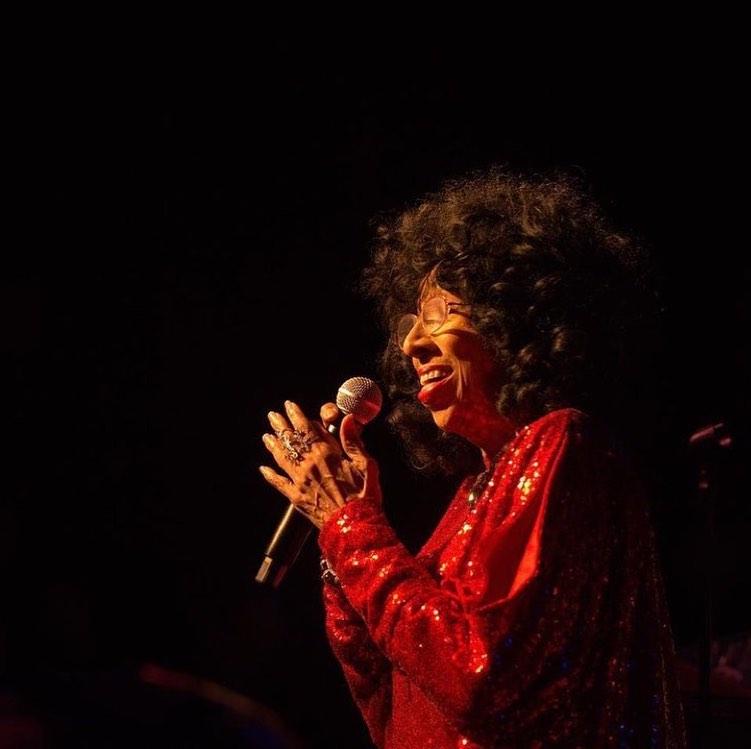
Jean Carn

R&B
Soul
Mainstream Pop
Smooth Jazz
 Viberate Rank: 84380
 Viberate Rank: 84380
 Monthly ListenersFollowers
 Subscribers
 Followers
 Followers
 FansTop Spotify SongsTop YouTube VideosMonthly ListenersFeatured in Playlists
| Playlist | Followers | |
|---|---|---|
1 |  Jazz-Funk Spotify | 425.82K |
2 |  Philly Soul Spotify | 180.58K |
3 |  This Is The Temptations Spotify | 114.23K |
4 |  Disco Decadence Spotify | 75.16K |
5 |  Soul Train 70s Disco and Funk djlarras | 69.74K |
Audience| City | Monthly Listeners | |
|---|---|---|
1 |  | 5.53K |
2 | | 1.70K |
3 | | 1.69K |
4 | | 1.10K |
5 | | 1.07K |
See full performance history, audience data, playlist activity, rankings, comparisons, and more in Viberate music analytics. Start with a free trial, then continue with a paid plan.
Jean Carn’s Spotify BioAn exceptionally graceful jazz and R&B vocalist with a five-octave range, Jean Carn scored her first major hit with "Valentine Love" (1975), a plush duet with Michael Henderson featured on Norman Connors' Saturday Night Special album. This prompted a solo career that began with four charting albums for Philadelphia International, starting with Jean Carn (1976), and an assortment of '70s R&B classics including "Free Love," "Don't Let It Go to Your Head," and "Was That All It Was." After a brief period with Motown, Carn teamed up with Grover Washington, Jr. to top the R&B chart with the ballad "Closer Than Close" (1986). Throughout the following decades, Carn has continued to be a beloved performer, especially in the U.K., and has occasionally recorded new material, such as Jean Carne JID012 (2022), a jazz-rooted collaboration with Adrian Younge and Ali Shaheed Muhammad. Carn's discography as a solo artist tells only one part of her story, though, as she has been active since her teenage… years as a featured vocalist and arranger, with connections to Erroll Garner, former husband Doug Carn, Earth, Wind & Fire, Duke Ellington, and Phyllis Hyman, among other major figures across multiple genres.
Born Sarah Jean Perkins in Columbus, Georgia, Jean Carn (occasionally Jean Carne throughout her career) started performing at the age of four in her church choir. She also began piano lessons around this time. At the age of 13, she appeared on a local television program and performed "Misty," accompanied by Erroll Garner, the standard's composer. After graduating from high school in Atlanta, she attended nearby Morris Brown College on a music scholarship and learned to play several other instruments. She married keyboardist Doug Carn, with whom she moved to Los Angeles and recorded together with Earth, Wind & Fire, appearing on the band's first two albums, Earth, Wind & Fire (1970) and The Need of Love (1971). The year the second album was released, a demo her husband had shopped to disinterested labels, Blue Note and Impulse! included, was released by the independent Black Jazz Records. The singer was featured prominently on that recording, titled Infant Eyes (1971), and her husband's two subsequent leader dates, Spirit of the New Land (1972) and Revelation (1973). Equally powerful showcases on Azar Lawrence's Bridge Into the New Age and Norman Connors' Slewfoot (both 1974) followed shortly thereafter, around the time she was involved with the sessions for Mtume's Rebirth Cycle (recorded in 1974, released three years later). Even more momentous for Carn was performing as a member of the Duke Ellington Orchestra prior to the bandleader's death.
Carn continued to record and perform with Norman Connors and eased the drummer/producer's stylistic transition from jazz to R&B. On Saturday Night Special (1975), she had the spotlight to herself for a couple numbers, and on its "Valentine Love" duetted with bassist and writer Michael Henderson, another musician in the process of branching out. The ballad was released as a single and reached number ten on Billboard's R&B chart. Her commercial prospects evident, Carn signed as a solo artist to Philadelphia International, where she made her debut with a self-titled album (1976) featuring smooth soul and elegant disco produced by label founders Kenny Gamble and Leon Huff, in addition to PIR regulars Dexter Wansel, Gene McFadden, John Whitehead, and Victor Carstarphen. The album hit Billboard's R&B and jazz charts, and made the Billboard 200, supported with the number 23 R&B hit "Free Love" and "Time Waits for No One," the latter of which didn't chart but became a deep disco classic. Between albums, Carn's collaborative activity continued with sessions for LPs by Connors and Wansel, among others. Her follow-up, Happy to Be with You (1978), arrived with the number 54 R&B single "Don't Let It Go to Your Head," a career highlight written and produced by Gamble and Huff. She also looked to the past with a medley of Doug Carn's "Revelation" and Wayne Shorter's "Infant Eyes," revisiting compositions she recorded earlier in the decade with her former husband. Carn additionally became a valued coach during these years, assisting the likes of Henderson, Phyllis Hyman, and Michael Jackson.
The singer continued to stick with rich ballads and sophisticated dancefloor grooves for her releases into the early '80s. When I Find You Love (1979), which fared on the R&B chart roughly the same as the first two albums, was led by the Jerry Butler-produced "Was That All It Was," and contained another stellar deep cut, "My Love Don't Come Easy," co-produced by the O'Jays' Eddie Levert. Issued on PIR subsidiary TSOP, Sweet and Wonderful (1981) yielded a Top 40 R&B hit with "Love Don't Love Nobody," yet another Connors production. "Bet Your Lucky Star," granted by Phyllis St. James, added to Carn's bounty of fine album cuts. Carn then departed PIR for Motown and the Connors-produced Trust Me (1982). That set's charting single was an update of the Gamble and Huff classic "If You Don't Know Me by Now," backed by the Temptations, and it also incorporated a fine cover of Minnie Riperton's "Completeness." It was Carn's fifth straight album to peak in the middle rungs of the R&B chart. During this era, Carn's extracurricular studio time was spent with Al Johnson (a co-lead vocal on the number 26 R&B single "I'm Back for More") and Phyllis Hyman (background vocals and arrangements for Can't We Fall in Love Again), as well as with Connors, Bohannon, George Duke, and Rick James. Later in the '80s, she began to work extensively with Grover Washington, Jr. From a commercial standpoint, this paid off most with "Closer Than Close," a single that topped the R&B chart and sent the like-titled album (released on the Atlantic-distributed Omni in 1986) to number nine on the R&B album chart. Washington also produced one-third of You're a Part of Me (1988), Carn's lone release for Atlantic proper.
Since the tail-end of the '80s, Carn has worked primarily on-stage, performing most often for her devoted following in the U.K. A slew of intermittent independent releases started in the mid-'90s with Love Lessons and Carne Sings McCoy (both 1995), the latter a collection of Van McCoy interpretations. After full-lengths such as Flashback (2013) and Give It Up (2015), both of which featured re-recordings and covers, she teamed with Adrian Younge and Ali Shaheed Muhammad to write and record the 12th volume in the duo's Jazz Is Dead series, Jean Carne JID012 (2022), rooted in her early-'70s work. Also during these years, Carn's '70s and '80s solo discography recirculated in numerous configurations. The Philadelphia International albums have been reissued multiple times in the U.K. One official anthology released in the U.S., Closer Than Close: The Best of Jean Carne (the Right Stuff, 1999), summarized her PIR and Motown output, and was supplemented with the U.K.-issued Collaborations (Expansion, 2002). Don't Let It Go to Your Head: The Anthology (SoulMusic, 2018) has provided the broadest overview yet of her featured and headlining work. ~ Andy Kellman, Rovi
Viberate is a music analytics platform built for A&Rs, artist managers, labels, booking agents, marketers, and artists.
It helps music professionals track artist growth, analyze audience data, monitor playlist activity, compare artists, follow song performance, and identify opportunities across the music market.
Public artist pages provide a free preview of selected artist data. Paid plans provide access to deeper analytics, historical data, charts, comparisons, playlist tools, exports, alerts, reports, and additional professional features.
Yes. Public Viberate artist pages provide selected artist analytics and music data for free.
Viberate also offers a 7-day free trial of the full platform. A credit card is required to start the trial. The trial includes access to the complete product so users can test deeper artist analytics, historical views, playlist insights, comparisons, charts, exports, alerts, and reporting features before choosing a paid plan.
Viberate provides artist analytics across streaming, playlists, social media, video, radio airplay, songs, and audience markets.
Users can analyze Spotify performance, Spotify and Apple Music playlists, YouTube activity, TikTok and Instagram growth, radio spins, song performance, audience locations, demographics, rankings, and overall artist momentum.
Artist profiles also connect to music charts, similar artists, and comparison tools, helping users benchmark performance and evaluate artists in context.
Viberate updates key artist and track data daily.
For followed artists and tracks, selected data is refreshed multiple times per day. This helps teams monitor playlist changes, streaming movement, audience growth, releases, and campaign performance with more current data.
Update frequency can vary depending on the metric and data source.
Yes. Viberate lets users compare up to five artists side by side across streaming, social media, audience, and engagement metrics.
Users can compare fanbase growth, audience demographics, locations, Spotify performance, social metrics, and other artist data over selected time periods.
Artist comparison can be used for A&R scouting, benchmarking, booking decisions, campaign planning, and evaluating artists with similar audiences or market positions.