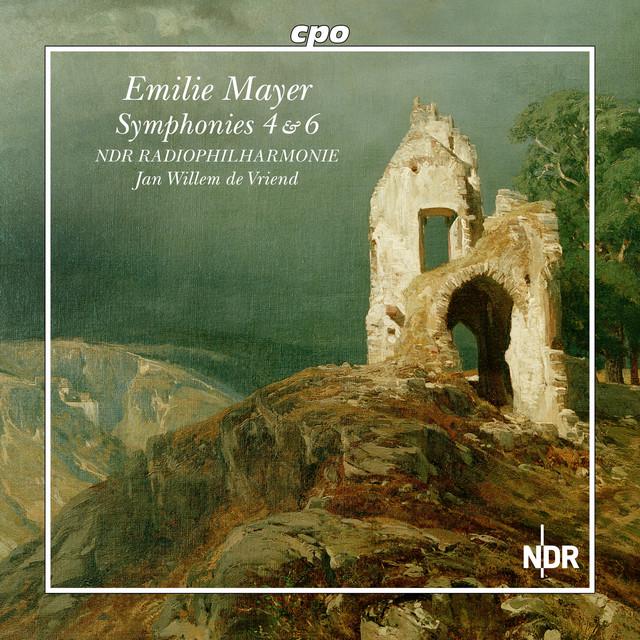
Emilie Mayer

Classical
Orchestral
 Viberate Rank: 359465
 Viberate Rank: 359465
 Monthly ListenersFollowers
 Subscribers
 Followers
 Followers
 FansTop Spotify Songs
| Track | 7-Day Streams | |
|---|---|---|
1 | 466 | |
2 | 369 | |
3 | 326 | |
4 | 279 | |
5 | 251 |
Top YouTube VideosMonthly ListenersFeatured in Playlists| Playlist | Followers | |
|---|---|---|
1 |  Women of Classical Spotify | 102.00K |
2 |  Classical Bangers 2026 Spotify | 47.28K |
3 |  Freemasonry Masonic Music 1149695658 | 5.95K |
4 |  harmonia mundi picks harmonia mundi | 4.66K |
5 |  Chamber Music for Self-Renewal synergy555 | 4.21K |
Audience| City | Monthly Listeners | |
|---|---|---|
1 | | 187 |
2 |  | 117 |
3 |  | 109 |
4 | | 106 |
5 |  | 99 |
See full performance history, audience data, playlist activity, rankings, comparisons, and more in Viberate music analytics. Start with a free trial, then continue with a paid plan.
Emilie Mayer’s Spotify BioUnlike other female composers of the 19th century, Emilie Mayer wrote music in larger forms such as the symphony and opera, as well as songs and chamber works. Although her music was quite widely heard during her lifetime, it was almost forgotten after her death and has only in the 21st century seen some rediscovery.
Mayer was born on May 14, 1812, in Friedland in northeastern Germany, now in the state of Mecklenburg-Vorpommern. Her father was a prosperous pharmacist. Her mother, Henrietta Carolina Mayer, died when Emilie was two. She was trained on both piano and organ as a young woman but showed no particular bent for composition until her father committed suicide in 1840, on the 26th anniversary of her mother's burial. Mayer moved to Stettin (now Szczecin, Poland) in 1841, where she began composition lessons with Carl Loewe. He praised her talent, and she continued to study with him until 1847. During this period, she wrote a Singspiel (an opera with spoken dialogue) and the first… two of her eight symphonies. This was atypical for female composers in the 19th century, who were generally more active in smaller forms such as chamber music and song.
In 1847, Mayer moved to Berlin and continued her studies with Adolph Bernhard Marx and Wilhelm Wieprecht. She began to give private concerts of her work and to publish them, and in 1850, Wieprecht led the Euterpe Orchestra in a concert devoted exclusively to her works. From that point on, Mayer had a good deal of renown. She wrote eight symphonies in all, as well as 15 orchestral overtures. Forty-eight of her works were published, including pieces for piano solo, violin and piano, songs, piano trios, string quartets and quintets, a piano concerto (1850), and a large group for cello and piano. Mayer traveled to major German cities and to France, Belgium, and Austria for performances of her works. Mayer died on April 10, 1883, in Berlin, and her output was largely forgotten for many decades. Renewed attention paid to music by women has resulted in recordings of her work in the early 21st century from chamber groups and by several orchestras, including the Philharmonisches Orchester Bremerhaven and its conductor, Marc Niemann. Many of Mayer's compositions, however, remain unrecorded. ~ James Manheim, Rovi
Viberate is a music analytics platform built for A&Rs, artist managers, labels, booking agents, marketers, and artists.
It helps music professionals track artist growth, analyze audience data, monitor playlist activity, compare artists, follow song performance, and identify opportunities across the music market.
Public artist pages provide a free preview of selected artist data. Paid plans provide access to deeper analytics, historical data, charts, comparisons, playlist tools, exports, alerts, reports, and additional professional features.
Yes. Public Viberate artist pages provide selected artist analytics and music data for free.
Viberate also offers a 7-day free trial of the full platform. A credit card is required to start the trial. The trial includes access to the complete product so users can test deeper artist analytics, historical views, playlist insights, comparisons, charts, exports, alerts, and reporting features before choosing a paid plan.
Viberate provides artist analytics across streaming, playlists, social media, video, radio airplay, songs, and audience markets.
Users can analyze Spotify performance, Spotify and Apple Music playlists, YouTube activity, TikTok and Instagram growth, radio spins, song performance, audience locations, demographics, rankings, and overall artist momentum.
Artist profiles also connect to music charts, similar artists, and comparison tools, helping users benchmark performance and evaluate artists in context.
Viberate updates key artist and track data daily.
For followed artists and tracks, selected data is refreshed multiple times per day. This helps teams monitor playlist changes, streaming movement, audience growth, releases, and campaign performance with more current data.
Update frequency can vary depending on the metric and data source.
Yes. Viberate lets users compare up to five artists side by side across streaming, social media, audience, and engagement metrics.
Users can compare fanbase growth, audience demographics, locations, Spotify performance, social metrics, and other artist data over selected time periods.
Artist comparison can be used for A&R scouting, benchmarking, booking decisions, campaign planning, and evaluating artists with similar audiences or market positions.