Devo

Rock
Pop Rock
Other Electronic Music
 Viberate Rank: 11960
 Viberate Rank: 11960
 Monthly ListenersFollowers
 Subscribers
 Followers
 Followers
 FansTop Spotify Songs
| Track | 7-Day Streams | |
|---|---|---|
1 | 338.37K | |
2 | 59.47K | |
3 | 54.63K | |
4 | 46.88K | |
5 | 27.38K |
Top YouTube VideosMonthly ListenersFeatured in Playlists| Playlist | Followers | |
|---|---|---|
1 |  Stranger Things Official Playlist Spotify | 3.19M |
2 |  Alternative 80s Spotify | 2.11M |
3 |  Classic Punk Spotify | 1.60M |
4 |  Early Alternative Spotify | 1.28M |
5 |  Essential New Wave Spotify | 1.01M |
Audience| City | Monthly Listeners | |
|---|---|---|
1 |  | 31.91K |
2 |  | 29.93K |
3 | | 28.73K |
4 | | 24.28K |
5 | | 23.51K |
See full performance history, audience data, playlist activity, rankings, comparisons, and more in Viberate music analytics. Start with a free trial, then continue with a paid plan.
Devo’s Spotify BioOne of new wave's most innovative bands, Devo bubbled up from the Midwestern underground of the 1970s with an intelligently obtuse, self-designed vision that they successfully conveyed to a large audience. Taking their name from their philosophy of "de-evolution," the Akron, Ohio-based group merged dark social satire and offbeat humor with highly stylized visuals, briefly breaking through to the mainstream with 1980's Freedom of Choice and its smash single "Whip It," whose accompanying video became a staple on the fledgling MTV network. Their jerky, robotic rhythms, unique uniforms, and focus on "little minds through big technology" were like nothing else on the pop landscape, though their campier elements led some critics to unfairly dismiss them as a novelty group. Although their success ebbed in the late '80s, Devo's legacy grew over the decades into that of a highly influential cult band with legions of followers. Through various reunions and re-formations, they continued to… develop creatively into the 21st century, composing music for soundtracks and commercials, publishing a video game, and even collaborating with Disney to create a tween-led version of the band called DEV2.0. 2010's Something for Everybody marked their return to new music, and they celebrated their golden anniversary with 2023's career-inclusive anthology 50 Years of De-Evolution 1973-2023.
Musicians Gerald Casale and Mark Mothersbaugh were both art school students at Kent State University at the outset of the 1970s. With their friend Bob Lewis, who joined an early version of Devo and later became their manager, they developed their own philosophy of "de-evolution" -- the idea that instead of evolving, humankind has actually regressed, as evidenced by the dysfunction and herd mentality of American society. Their de-evolution theory was deepened with the aid of a book entitled The Beginning Was the End: Knowledge Can Be Eaten, which held that humankind had evolved from mutant, brain-eating apes. The trio adapted the theory to fit their view of American society as a rigid, dichotomized instrument of repression ensuring that its members behaved like clones, marching through life with mechanical, assembly-line precision and no tolerance for ambiguity. The whole concept was treated as an elaborate joke until the bandmembers witnessed the infamous National Guard killings of student protesters at the university; suddenly there seemed to be a legitimate point to be made.
The first incarnation of Devo was formed in earnest in 1973, with Casale (bass), Mark Mothersbaugh (vocals), and Mark's brothers Bob (lead guitar) and Jim, who played homemade electronic drums. Jerry's brother Bob Casale joined as an additional guitarist, and Jim left the band, to be replaced by Alan Myers. The group honed their sound and approach for several years (a period later chronicled on Rykodisc's Hardcore compilations of home recordings), releasing a few singles on their own Booji Boy label and inventing more bizarre concepts: Mothersbaugh dressed in a baby-faced mask as Booji Boy (pronounced "boogie boy"), a symbol of infantile regression; there were recurring images of the potato as a lowly vegetable without individuality; the band's costumes presented them as identical clones with processed hair; and all sorts of sonic experiments were performed on records, using real and homemade synthesizers as well as toys, space heaters, toasters, and other objects. Devo's first big break came with their score for the short film The Truth About De-Evolution, won a prize at the 1976 Ann Arbor Film Festival; David Bowie and Iggy Pop saw the film and were impressed enough to help the group secure a contract with Warner Bros.
Recorded under the auspices of pioneering producer Brian Eno, Q: Are We Not Men? A: We Are Devo! was seen as a call to arms by some and became an underground hit. Others found Devo's sound, imagery, and material threatening; Rolling Stone, for example, called the group fascists. But such criticism missed the point: Devo dramatized conformity, emotional repression, and dehumanization in order to attack them, not to pay tribute to them.
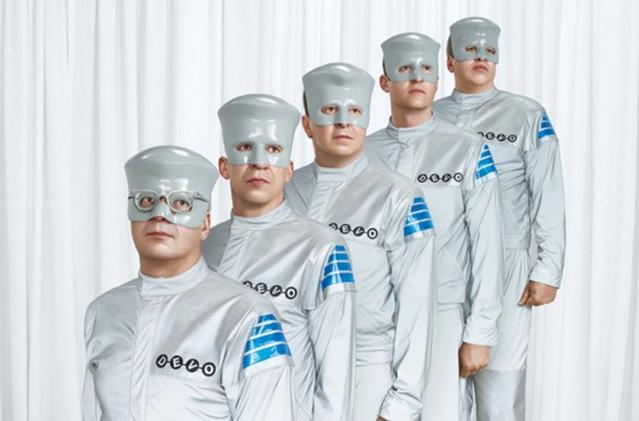
While 1979's Duty Now for the Future was another strong effort, the band broke through to the mainstream with 1980's Freedom of Choice, which yielded the gold-selling single "Whip It" and represented a peak in their sometimes-erratic songwriting. The video for "Whip It" became an MTV smash, juxtaposing the band's low-budget futuristic look against a down-home farm setting and hints of S&M. With this album, Devo introduced one of their most iconic visual elements in the "energy dome," a red plastic terraced hat worn by the bandmembers that over the years became synonymous with their brand.
Already chafing from their newly acquired global success, Devo quickly changed tack with 1981's New Traditionalists, an overall darker and more serious album whose lead single, "Through Being Cool," was a direct response to their popularity. That same year, they contributed a typically mechanical cover of the old Lee Dorsey hit "Working in the Coal Mine" to the film Heavy Metal and backed up singer Toni Basil on her debut album, Word of Mouth. They were also plagued by several controversies: Bob Lewis successfully sued for theft of intellectual property after a tape of Mothersbaugh was found acknowledging Lewis' role in creating de-evolution philosophy, and the sessions for 1982's Oh, No! It's Devo were marred by an ill-considered attempt to use poetry written by would-be Ronald Reagan assassin John Hinckley, Jr. as lyrical material.
As the '80s wore on, Devo found themselves increasingly relegated to cult status and critical indifference. 1984's Shout failed to make much of an impact and Warner Bros. subsequently dropped them from their roster. With the band's shift toward electronic drums, Alan Myers departed in 1986, to be replaced by ex-Sparks and Gleaming Spires drummer David Kendrick. Following Rykodisc's 1987 reissue of E-Z Listening Disc, a collection of "Muzak"-style versions previously available to their fan club, Devo released their seventh album, 1988's Total Devo, with the Enigma label.
Two years later, Smooth Noodle Maps bookended Devo's initial run as a group. Between the album's poor sales and the bankruptcy of their label Enigma, the band didn't even make it through their entire tour before splitting up. By the early '90s, most of Devo's members had begun to concentrate on their own projects, with Mark Mothersbaugh composing for commercials and soundtracks, writing theme music for MTV's Liquid Television, Nickelodeon's Rugrats, Pee-Wee's Playhouse, and the Jonathan Winters sitcom Davis Rules. He also played keyboards with the Rolling Stones, programmed synthesizers for Sheena Easton, sang backup with Debbie Harry, and beginning with 1996's Bottle Rocket, forged a successful bond composing soundtracks for director Wes Anderson. Buoyed by this success, Mothersbaugh opened a profitable production company called Mutato Muzika, which employed his fellow Devo bandmates. Jerry Casale, meanwhile, who directed most of the band's videos, directed video clips for popular acts like Rush, Foo Fighters, and Soundgarden.
No reunions were expected, but as Devo's legend grew and other bands acknowledged their influence (Nirvana covered "Turnaround," while "Girl U Want" has been recorded by Soundgarden, Superchunk, and even Robert Palmer), their minimalistic electro-pop was finally given new exposure on six dates of the 1996 Lollapalooza tour, to enthusiastic fan response.
The following year, Devo released a CD-ROM game (The Adventures of the Smart Patrol) and accompanying music soundtrack, in addition to playing more selected dates on the Lollapalooza tour. A pair of double-disc Devo anthologies were released in 2000: the first was the half-hits/half-rarities Pioneers Who Got Scalped: The Anthology for Rhino, while the second was the limited-edition mail-order release Recombo DNA for Rhino's Handmade label, the latter of which consisted solely of previously unreleased demos. In 2001, the Mothersbaugh and Casale brothers reunited under the name the Wipeouters for a one-off surf release, P'Twaaang!!! Casale would introduce his Jihad Jerry & the Evildoers solo project with the 2006 album Mine Is Not a Holy War. That same year, the band teamed with Disney for DEV2.0, a band/project/album that involved a set of preteens re-recording classic Devo tracks, although some lyrics were adjusted to be more "family friendly."
Devo got back to releasing their own material in 2007 with the single "Watch Us Work It," but a promised new album failed to materialize. In 2008 they returned to Akron for a rare show in support of Barack Obama's presidential campaign, with all proceeds going toward the Summit County Democratic Party. After deluxe 2009 reissues of Q: Are We Not Men? A: We Are Devo! and Freedom of Choice sent the band back on the road to play said albums live in their entirety, work resumed on a new record. An Internet campaign where fans got to choose the full-length's 12 tracks inspired 2010's Something for Everybody, Devo's first new album in 20 years. Just prior to the 2013 release of the 2000s-era rarities compilation Something Else for Everybody, the band's original drummer Alan Myers died of stomach cancer. Less than a year later, founding member Bob Casale died of heart failure. Devo completed their Hardcore Devo tour of 2014 with new member Josh Hager assuming Casale's duties. A live album and DVD from this tour called Hardcore Devo Live! was released in 2015. At the start of the next decade, Devo remained in legacy mode, starring in the 2021 television documentary Devolution: A Devo Theory, playing occasional gigs, and relaunching the annual Cleveland-based fan convention Devotion.
In 2023, as Devo were in the midst of a string of dates they suggested might be their last, the group celebrated a half-century of creative non-conformity with 50 Years of De-Evolution 1973-2023, a career-spanning anthology that offered a sampling of their most popular and important work alongside unreleased demos, rare single sides, and remixes. The album appeared in several editions, including a two-CD set and a deluxe four-LP vinyl edition that included deluxe packaging, an air freshener emblazoned with the cover image from Oh No! It's Devo, and a cardboard replica of their trademark Energy Dome headgear. 2024 saw two more historical box sets from Devo's archives. Art Devo, issued in September 2024, was drawn from rare and unreleased material from the group's early years, featuring demos, basement recordings, and live tapes from the years 1973 through 1977. In December 2024, Futurismo Records delivered a deluxe expanded edition of Recombo DNA, Rhino Handmade's 2000 anthology of unreleased studio demos and live recordings. ~ Steve Huey & Timothy Monger, Rovi
Viberate is a music analytics platform built for A&Rs, artist managers, labels, booking agents, marketers, and artists.
It helps music professionals track artist growth, analyze audience data, monitor playlist activity, compare artists, follow song performance, and identify opportunities across the music market.
Public artist pages provide a free preview of selected artist data. Paid plans provide access to deeper analytics, historical data, charts, comparisons, playlist tools, exports, alerts, reports, and additional professional features.
Yes. Public Viberate artist pages provide selected artist analytics and music data for free.
Viberate also offers a 7-day free trial of the full platform. A credit card is required to start the trial. The trial includes access to the complete product so users can test deeper artist analytics, historical views, playlist insights, comparisons, charts, exports, alerts, and reporting features before choosing a paid plan.
Viberate provides artist analytics across streaming, playlists, social media, video, radio airplay, songs, and audience markets.
Users can analyze Spotify performance, Spotify and Apple Music playlists, YouTube activity, TikTok and Instagram growth, radio spins, song performance, audience locations, demographics, rankings, and overall artist momentum.
Artist profiles also connect to music charts, similar artists, and comparison tools, helping users benchmark performance and evaluate artists in context.
Viberate updates key artist and track data daily.
For followed artists and tracks, selected data is refreshed multiple times per day. This helps teams monitor playlist changes, streaming movement, audience growth, releases, and campaign performance with more current data.
Update frequency can vary depending on the metric and data source.
Yes. Viberate lets users compare up to five artists side by side across streaming, social media, audience, and engagement metrics.
Users can compare fanbase growth, audience demographics, locations, Spotify performance, social metrics, and other artist data over selected time periods.
Artist comparison can be used for A&R scouting, benchmarking, booking decisions, campaign planning, and evaluating artists with similar audiences or market positions.